
 AU
AU
 UK
UK
 CA
CA
 NZ
NZ
 IND
IND

 US
US

 Share
Share
 X (Formerly Twitter)
 Whatsapp
 Facebook
 LinkedIn
 Telegram
 Email This Article
 Copy Link
 Summarize with AI
 Chat GPT
 Perplexity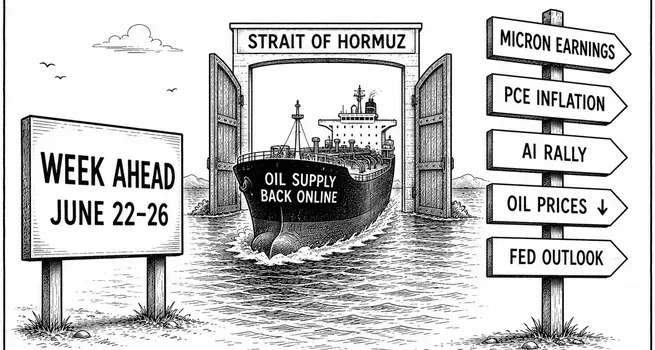
U.S. markets face a pivotal week as Micron Technology earnings on Wednesday test AI chip demand momentum, May PCE inflation on Thursday provides the Fed's preferred price read, and the Strait of Hormuz reopening reshapes the energy and inflation outlook heading into the second half of 2026.
The US-Iran deal to lift the blockade on the Strait of Hormuz has reshaped the macro backdrop entering this week, with oil prices falling and the most immediate upward pressure on energy-driven inflation beginning to ease. Major U.S. stock indexes are hovering near all-time highs, supported by robust corporate earnings driven by the AI investment boom, with the S&P 500 up approximately 8% for the year and the Philadelphia SE Semiconductor Index hitting a record high, up 7% for the week ending June 19.
Micron Technology's quarterly results on Wednesday will check the pulse of chip demand and determine whether the surge in data centre spending and semiconductor profits can continue to surprise to the upside at a time when valuations are elevated and investors are questioning whether the rally is overextended. Running alongside the AI test is the week's most consequential macro release: May PCE inflation on Thursday, the Federal Reserve's preferred price gauge, arriving in the immediate aftermath of Warsh's first meeting and the Fed's upwardly revised inflation forecasts for 2026.
Monday, June 22
Market
No economic data or Fed speakers are scheduled. Markets open with relief from the US-Iran deal driving oil prices lower and the Strait of Hormuz returning to operation, removing the primary upward pressure on energy-driven inflation that has defined the macro backdrop since February. The focus turns immediately to Tuesday's flash PMI readings and Wednesday's Micron results.
Tuesday, June 23
Earnings
FedEx (NYSE:FDX) reports in the afternoon as the week's first major earnings event and a reliable proxy for global trade volumes and logistics demand. Its results will be read for any evidence that the Strait of Hormuz reopening is beginning to translate into improved shipping economics and supply chain normalisation. Carnival (NYSE:CCL) also reports in the morning, offering a read on discretionary consumer spending in travel and leisure under the backdrop of easing energy costs.
Economic Data
S&P Global flash PMI surveys for June open Tuesday's data calendar. The US Flash Manufacturing PMI, prior at 55.3, and US Flash Services PMI, prior at 60.9, together provide the first real-time read on whether private sector activity is accelerating or moderating as the Iran conflict de-escalates and energy costs begin to ease. Services at 60.9 in the prior print signals strong expansion, and any significant deterioration would raise questions about the durability of the consumer spending recovery heading into Thursday's PCE release.
Wednesday, June 24
Earnings
Micron Technology (NASDAQ:MU) reports in the afternoon in the week's most consequential earnings event. Shares are up 298% year-to-date, and the memory chipmaker's results will help investors gauge whether the surge in data centre spending is still accelerating or beginning to plateau at elevated levels. Semiconductor book-to-bill ratios and backlog data have signalled demand well in excess of current chip capacity, and Micron's forward guidance will be the primary test of whether that imbalance is structural or cyclical. Any indication of continued AI-related spending strength would reinforce the positive feedback loop that has driven the Philadelphia SE Semiconductor Index to a record high. Big Tech has signalled that AI capital expenditure is set to rise past $700 billion in 2026 from $400 billion in 2025, and Micron's results will either validate or complicate that trajectory.
Paychex (NASDAQ:PAYX) also reports before the open, providing a read on small and medium-sized business payroll health and human capital management software demand, two indicators sensitive to both labour market conditions and the post-Fed-decision confidence environment.
Economic Data
New home sales for May, prior at 622,000, land at 10:00 am ET, adding a demand-side housing read ahead of Thursday's broader income and spending data. The Federal Reserve releases its 2026 annual bank stress test results at 4:00 pm ET, assessing how major U.S. banks would perform under a hypothetical severe economic downturn. The results carry implications for bank capital return programmes, dividend capacity, and the broader financial system's resilience at a moment when the rate hike scenario remains live.
Thursday, June 25
Earnings
Darden Restaurants (NYSE:DRI) reports before the open, offering the week's primary restaurant and casual dining read. Its same-restaurant sales and traffic commentary will be watched for evidence of whether easing energy costs and gasoline prices are beginning to translate into increased household discretionary spending, or whether the cumulative inflation shock of the past several months has left a more durable mark on consumer behaviour.
Economic Data
Thursday is the week's defining data day. May PCE inflation lands at 8:30 am ET alongside personal income and personal spending. Core PCE is projected to climb 0.3% month-on-month, accelerating from 0.2% in April, with the year-on-year core reading at 3.3%. Headline PCE is forecast at 0.4% MoM and 3.8% YoY. Personal spending is expected to increase 0.6%, up from 0.5% in April, while personal income is forecast to rise 0.4% after being unchanged the prior month. The PCE release arrives in the immediate aftermath of the Fed's upwardly revised 2026 inflation forecasts and will be parsed for whether the Strait of Hormuz reopening has yet had any visible disinflationary effect on the May data, or whether the energy price shock is still fully embedded in the pipeline.
The third estimate of Q1 GDP, prior at 1.6%, also releases Thursday. A further downward revision would introduce a stagflationary undercurrent into a session already dominated by the inflation read. Durable goods orders for May, prior at 7.9%, are expected to fall sharply by 4.7%, reflecting the unwind of the prior month's surge. Weekly jobless claims for the week ending June 20, prior at 226,000, provide the labour market read. The Kansas City Fed Manufacturing Survey for June, prior at 9, closes the day.
Friday, June 26
Economic Data
The final University of Michigan Consumer Sentiment reading for June, prior at 44.9, closes the week. Sentiment has been tracking near record lows for several months, and any recovery here would be the first tangible evidence that the US-Iran deal and falling oil prices are beginning to restore household confidence. Advance economic indicators, wholesale inventories, prior at 0.6%, and retail inventories, prior at 0.7%, round out the week's data calendar.
Geopolitical Backdrop
The US-Iran agreement to lift the blockade on the Strait of Hormuz marks the most significant market-moving development since the conflict began in February. Oil prices have fallen on the news and the immediate energy price shock that drove CPI to a three-year high in May is beginning to dissipate. However, the return of tankers crossing the Strait remains the primary variable to monitor this week, as full normalisation of oil supply routes will take months to achieve and the inflationary consequences of the past four months are still embedded in the PCE data arriving Thursday.
Uncertainties persist. The deal addresses the Strait's reopening but defers the question of Iran's nuclear programme to a later stage, meaning the geopolitical risk premium in energy markets has eased but not been fully extinguished. Apple's agreement to partner with Intel to design and manufacture chips in the U.S. adds a separate positive signal for domestic technology infrastructure investment, potentially accelerating Intel's turnaround and broadening the AI supply chain beyond Nvidia. SpaceX, now publicly traded, has reinforced AI infrastructure momentum, while Nasdaq's inclusion of AI and chip infrastructure names including Astera Labs and CoreWeave will force index funds to increase their exposure, adding a structural bid to the sector heading into the second half.
The Week in Context
Two readings will define the week's narrative before Friday's close. Micron's results on Wednesday will either confirm that the AI semiconductor cycle has enough remaining momentum to justify elevated valuations across the sector, or introduce the first signs of demand normalisation that would prompt a reassessment of the 298% year-to-date gain.
Thursday's PCE print will determine whether the Strait of Hormuz reopening has arrived in time to prevent another round of inflationary data from complicating Warsh's next move, or whether the pipeline pressure from four months of elevated energy costs is still working its way through the consumer price complex. Second-quarter S&P 500 earnings growth is estimated at 22.9%, down from 29.3% in the first quarter — a deceleration that makes Micron's guidance and the PCE trajectory more consequential than the headline numbers alone would suggest.

 Jun 20, 2026




 Please wait processing your request...