
 AU
AU
 UK
UK
 CA
CA
 NZ
NZ
 IND
IND

 US
US

 Share
Share
 X (Formerly Twitter)
 Whatsapp
 Facebook
 LinkedIn
 Telegram
 Email This Article
 Copy Link
 Summarize with AI
 Chat GPT
 Perplexity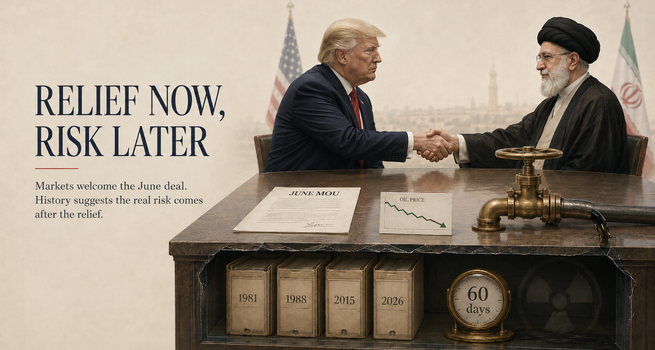
When Trump said Iran never loses a negotiation, he was describing a four-decade pattern. The June MOU follows that pattern point by point. Oil is down, the Fed has options again, and the tail risk is hiding in the history.
Key Highlights
- Every major US-Iran settlement since 1981 has followed the same sequencing: economic access granted upfront, nuclear concessions deferred.
- The June 19 MOU grants Iran immediate oil export sanctions relief before any verifiable nuclear commitment is made.
- Brent crude fell roughly 12% on the deal announcement; Treasury yields dropped as markets priced out war-era inflation risk.
- The Federal Reserve removed all 2026 rate-cut guidance at its June 17 meeting; a September pivot depends entirely on CPI data through August.
- The historical base rate of US-Iran agreements surviving their nuclear follow-on phase is zero.
Donald Trump coined the phrase in January 2020, two days after ordering the strike that killed Qasem Soleimani. Iran never won a war, but never lost a negotiation. He intended it as a taunt. At the G7 in France this week, Fox News correspondent Peter Doocy read those exact words back to him and asked how the current deal with Tehran was a win. Trump's answer: this time is different because Iran lost militarily.
He may be right about the war. He is almost certainly wrong to think it changes the negotiation.
The Strait of Hormuz formally reopened on June 19 as the memorandum of understanding signed at Versailles on June 17 took legal effect. Markets responded predictably: oil down, equities up, Treasury yields lower. But embedded in that reaction is a question that has repeated itself across four decades of US-Iran diplomacy. Once the leverage is gone, what exactly did you buy?
The Historical Playbook
The pattern is not subtle. It has produced the same outcome in every significant US-Iran settlement since the Islamic Republic was founded.
In January 1981, the Algiers Accords ended the 444-day hostage crisis. Iran secured the unfreezing of approximately $8 billion in assets held in third-country banks, termination of all US legal claims against Iran, and a formal American pledge of non-interference in Iranian internal affairs. The United States recovered its 52 diplomats. No military operation had worked. Operation Eagle Claw crashed in the Iranian desert in April 1980, killing eight US servicemen. The deal came not through force but through Iran waiting out one president and signaling readiness to the next. The hostages were freed minutes after Reagan was sworn in. Iran entered the negotiation from a position of diplomatic isolation and left with a legal framework that constrained American options for years.
In 1988, eight years of devastating war with Iraq ended when Ayatollah Khomeini accepted UN Security Council Resolution 598. In his letter announcing the decision, Khomeini described it as "more deadly than drinking from a poisoned chalice." Iran ended the war without territorial gains, with a shattered economy, and with an entire generation of casualties. It also ended the war with its revolutionary government intact, its ideological framework undisturbed, and enough residual capacity to begin rebuilding regional influence almost immediately. Within a few years, Hezbollah operations in Lebanon were receiving expanded Iranian funding. The military loss produced no strategic concession of lasting consequence.
In 2015, the JCPOA asked Iran to cap its enrichment capacity, dilute its uranium stockpiles, and accept international inspections. Iran received the lifting of international sanctions and access to roughly $100 billion in previously frozen assets. When the United States withdrew from the agreement in 2018, Iran did not collapse. It waited, rebuilt its enrichment program to levels substantially above pre-2015 baselines, and entered the current conflict with a more advanced nuclear posture than it had agreed to constrain under the deal.
The structure across all three episodes is identical. Iran enters from acknowledged military or strategic weakness. It secures economic relief early. It defers the concessions that matter most, specifically on nuclear capability and regional proxies, to later stages when US leverage has already been partially surrendered. It survives to negotiate again.
How True Is It Today
Trump's claim that this deal is different because Iran lost militarily requires testing against that record. The military facts are not in dispute. US-Israeli strikes from February 2026 degraded Iranian air defenses, missile capacity, and several key IRGC command structures. The Hormuz blockade that Iran imposed drove Brent above $115 a barrel and created genuine economic stress inside the country. The regime did not fall, but it was measurably weakened.
What the June 14 MOU reveals is that the sequencing of the current settlement mirrors the historical template almost precisely. Iran receives an immediate Treasury waiver allowing it to resume crude oil exports free of sanctions, with petrochemical trade and associated banking and insurance services reintegrating into global markets simultaneously. The nuclear concessions are deferred. The MOU does not prohibit uranium enrichment. It preserves the status quo of Iran's nuclear program and opens a 60-day window for follow-on nuclear talks, a window that begins after the economic lifeline has already been extended.
This is not a coincidence of drafting. It is the outcome Iran has consistently negotiated toward. Economic access now. Nuclear ambiguity maintained. Diplomatic survival secured. The poisoned chalice, as Khomeini framed it in 1988, is not the deal itself. It is what Iran accepts on the surface while preserving what it cannot afford to concede beneath it.
Trump is correct that Iran lost this round militarily. What the historical record demonstrates is that Iran has never needed to win militarily. It has needed only to survive militarily long enough for the negotiating table to open. At that point, the record speaks for itself.
What the Markets Are Pricing
The immediate asset price response since June 14 reflects rational near-term logic. Brent crude fell from approximately $87 to $76 a barrel as roughly 20% of global seaborne oil supply reintegrated through the reopened Strait. The S&P 500 (NYSE:SPX) gained 1.9% and the Dow Jones Industrial Average (NYSE:DJIA) crossed 52,000 for the first time. The 10-year US Treasury yield fell more than 2 basis points to 4.459%, while the 2-year yield dropped more than 3 basis points to 4.054%.
The bond market was pricing one specific outcome: if energy inflation reverses, the Federal Reserve regains optionality it lost during the war. The Fed held rates at 3.5% to 3.75% at its June 17 meeting under Chair Kevin Warsh and stripped all 2026 rate-cut guidance from its dot plot. Before the June 14 announcement, futures markets had priced a 99% probability of a hold and were beginning to assign non-trivial probability to a year-end hike. Gasoline prices below $3.50 a gallon and headline CPI declining toward 2.5% through July and August would give Warsh sufficient cover to restore a projected cut to the September dot plot. That is the bullish macro trade embedded in current positioning.
What the Markets Are Missing
The historical base rate of US-Iran agreements surviving their nuclear follow-on phase is zero.
The 2015 JCPOA collapsed within three years of a new administration. The Algiers Accords produced a claims tribunal that took decades to resolve and left bilateral relations structurally frozen. None of the prior settlements produced a durable and verifiable reduction in Iranian nuclear or proxy capability. In each case, Iran used the economic relief secured in the initial phase to rebuild the strategic capacity it had nominally constrained.
The current deal's 60-day nuclear window begins after the economic lifeline is already flowing. Iranian crude is back on global markets. Sanctions waivers are in place. The $300 billion Gulf-funded reconstruction pathway, which Vance confirmed this week, is being discussed as a deliverable in the final agreement. If the nuclear talks fail at the end of the 60-day window, the question is whether the United States reimpose the naval blockade and sanctions, or accepts a partial outcome and moves on. Every prior precedent points toward the latter.
That tail risk is not exotic or low probability. It is the modal outcome of this specific diplomatic pattern across four decades. Markets are currently treating the bullish scenario as the base case and treating the historical record as the tail. The options market is pricing the tail more honestly than the spot market is.
The Structural Lesson
Trump's phrase is accurate as institutional observation. Iran has not won wars. It has also not, across 45 years and four major settlements, produced an agreement that resulted in verifiable and durable reduction of its strategic capabilities.
The current deal, signed the day the Strait reopens, is structurally identical to its predecessors. Iran receives economic access now. Verification comes later. The leverage that made the deal possible, the naval blockade, the sanctions architecture, the military pressure, was traded for a 60-day window whose historical analogues are not encouraging.
For investors, the near-term trade is clear: energy disinflation, Treasury duration, and downstream energy consumers that lagged the initial equity rally are the natural beneficiaries if the deal holds through August. For macro analysts, the more useful frame requires a longer lens.
Iran never lost a negotiation not because its diplomats are uniquely skilled. It is because every administration that has sat across the table eventually concluded that the economic cost of sustained pressure exceeded the strategic cost of a partial deal. Trump reached that conclusion in June 2026. His predecessors reached it in 1981, 1988, and 2015.
The markets are right to price disinflation in the near term. They would be wise to remember what happened to the last three deals that looked exactly like this one.
This article is intended for informational purposes only and does not constitute financial or investment advice.

 Jun 20, 2026


 Please wait processing your request...