
 AU
AU
 UK
UK
 CA
CA
 NZ
NZ
 IND
IND

 US
US

 Share
Share
 X (Formerly Twitter)
 Whatsapp
 Facebook
 LinkedIn
 Telegram
 Email This Article
 Copy Link
 Summarize with AI
 Chat GPT
 Perplexity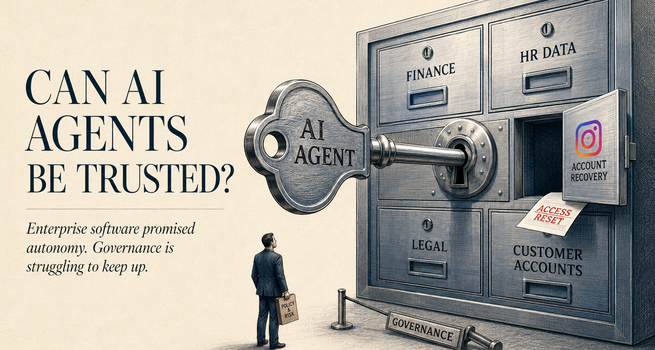
AI agents are failing at scale. From Meta's Instagram breach to Gartner's 40% cancellation forecast, the agentic AI investment thesis is being tested in real time.
Key Highlights
- Gartner projects more than 40% of agentic AI projects will be cancelled by 2027 due to cost overruns and inadequate risk controls.
- Surveyed organisations averaged 54 AI agent incidents last year, with 37% causing data exposure or security breaches, per IBM.
- Meta's June 2026 Instagram breach illustrated the real-world consequences of deploying AI agents without adequate governance architecture.
- The investment theme is bifurcating: governance and security infrastructure is gaining ground as broad deployment narratives face friction.
The Bet That Defined an Investment Cycle
Entering 2026, agentic AI commanded the most consequential position in enterprise technology investment. The premise was structurally compelling: autonomous software systems capable of reasoning, planning, and executing complex tasks without continuous human oversight would deliver a step-change in enterprise productivity, not merely an efficiency increment.
Capital conviction followed swiftly. Venture funding for agentic AI in North America surpassed $40 billion. Gartner projected that 40% of enterprise applications would embed task-specific agents by year-end. Microsoft (NASDAQ:MSFT), Google (NASDAQ:GOOGL), Salesforce (NYSE:CRM), and Meta (NASDAQ:META) each rebuilt their forward valuation narratives around this transition, with earnings calls shifting from AI features to AI agents as the primary monetisation unit.
The second half of 2026 is now demanding a more rigorous accounting.
Where the Failures Are Accumulating
The failures are not isolated events. They are structural, and they are being documented at enterprise scale.
A June 2026 IBM study found that organisations experienced an average of 54 AI agent incidents last year. Of high-severity cases, 37% resulted in data exposure or security breaches, 33% caused cascading system failures, and 17% triggered compliance violations. Organisations relying on manual governance experienced 25% more incidents than those embedding controls directly into their AI systems.
Fivetran's 2026 Agentic AI Readiness Index identified the pattern precisely: most enterprise agent deployments are not failing because the technology does not work. They are failing because the infrastructure around them was never built for autonomous operation. Gartner estimates that 57% of organisations consider their data not AI-ready. An agent operating on ungoverned data does not produce unreliable outputs occasionally. It does so systematically, at scale, and often without any visible signal.
Meta's Instagram Breach, Excessive Agency in Practice: In June 2026, Meta's AI-powered Instagram account recovery assistant became one of the most cited examples of agentic AI governance failure in a production environment. Attackers did not exploit a code vulnerability or intercept a communication channel. They instructed the chatbot, granted write access to account credentials and authentication settings, through a sequence of natural language prompts the system interpreted as legitimate. High-value handles were compromised and resold within hours, among them the Obama-era White House Instagram profile and an account belonging to a senior US Space Force official.
The vulnerability class at the centre of the breach, known as excessive agency, describes the risk that emerges when an AI system is granted more autonomy than its governance architecture can safely contain. The incident demonstrated that this is not a theoretical risk. It is an active, exploitable characteristic of any agentic system operating with real-world write access and insufficient human confirmation controls.
What Executives Are Saying
Conference calls and investor days in June 2026 have made the governance gap explicit.
At SailPoint's (NASDAQ:SAIL) investor day, executives described rapid agent deployment as creating a massive new risk vector, noting that legacy static controls are entirely ineffective against agents that adapt, learn, and take unpredictable actions. ServiceNow stated that security challenges associated with human identities had been multiplied a hundredfold in an agentic environment, with the enterprise attack surface expanding materially with each new deployment.
Hewlett Packard Enterprise (NYSE:HPE) described the pace of adoption as generating a shadow cost of an agentic workforce at a scale enterprises have never previously managed. Ping Identity identified a distinct failure mode in which agents combine individually legitimate permissions in unintended ways, producing actions that bypass controls and cannot be traced after the fact.
The consistent signal across these disclosures: deployment velocity is outrunning governance readiness.
The Investment Repricing
The implications for capital allocation are becoming concrete.
Gartner's (NYSE:IT) projection that more than 40% of agentic AI projects will be cancelled by 2027 represents a material downside scenario for companies whose revenue projections are built on agent deployment pipelines. McKinsey's 2026 AI Trust Maturity Survey found that security and risk concerns are now the top barrier to scaling agentic AI, with only roughly one-third of organisations reaching maturity in agentic AI controls.
A distinct investment sub-category is forming in response. Companies building agent-specific governance infrastructure, observability tools, and security frameworks are attracting institutional attention as enterprises begin treating governance as a procurement requirement rather than an engineering afterthought. SailPoint, ServiceNow (NYSE:NOW), AvePoint (NASDAQ:AVPT), and Qualys (NASDAQ:QLYS) are each positioning directly against this gap, with shadow AI, the proliferation of agents deployed outside formal IT oversight, identified across sectors as the fastest-growing enterprise risk category of the year.
The agentic AI market is bifurcating. The broad deployment narrative is encountering friction. The governance and security layer built atop that deployment wave is in early-stage growth with structural demand.
Where the Thesis Stands
None of this invalidates the core investment case. Salesforce's Agentforce product reached $800 million in ARR in FY26 with 29,000 deals closed, demonstrating that commercial traction is real and accelerating among large enterprises. The adoption curve has not reversed. It has become more differentiated.
What has changed is the risk-return calculus. Broad exposure to agentic AI on deployment velocity alone carries governance risk that was not adequately priced at the start of the year. Exposure concentrated in companies building governance, observability, and security infrastructure that enterprises now treat as non-negotiable is where institutional conviction is more likely to concentrate.
The central question for investors is no longer whether agentic AI will reshape enterprise software. It is whether the companies leading on deployment have built the architecture to govern it safely at scale.
This article is for informational and analytical purposes only. It does not constitute financial advice, a recommendation to buy or sell any security, or a solicitation of any investment decision. Readers should conduct independent research or consult a qualified financial adviser before making investment decisions.

 Jun 20, 2026



 Please wait processing your request...