
 AU
AU
 UK
UK
 CA
CA
 NZ
NZ
 IND
IND

 US
US

 Share
Share
 X (Formerly Twitter)
 Whatsapp
 Facebook
 LinkedIn
 Telegram
 Email This Article
 Copy Link
 Summarize with AI
 Chat GPT
 Perplexity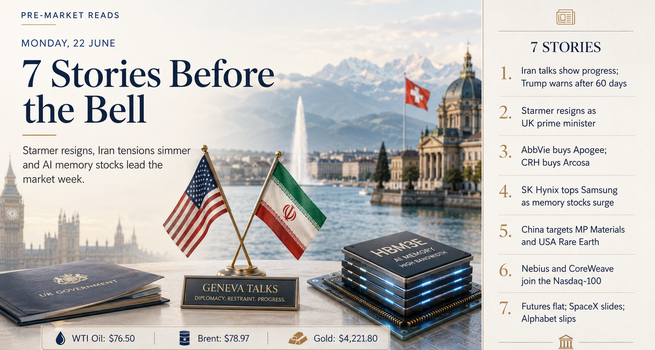
Markets return from Juneteenth to a heavy geopolitical slate: Keir Starmer has resigned as Britain's prime minister, U.S.-Iran Switzerland talks closed with progress claimed and threats issued in the same breath, and SK Hynix has overtaken Samsung as South Korea's most valuable listed company.
Thursday's session closed at S&P 500 +1.08% (7,500.58) and Nasdaq +1.91%, but futures are little changed Monday morning as investors weigh Iran deal durability.
1. IRAN/DIPLOMACY: Switzerland Talks Conclude With "Encouraging Progress"; Trump Warns He Can "Take Over the Rest" After 60 Days; Iran Pushes Back
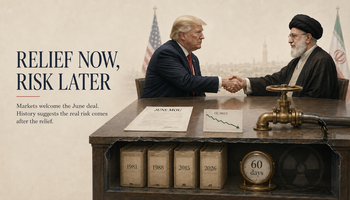
American and Iranian officials concluded a round of talks in Switzerland over the next stage of the Versailles peace deal, with Qatari and Pakistani mediators describing "encouraging progress" toward a lasting agreement. The 60-day negotiating window opened when Trump signed the memorandum of understanding at Versailles on June 18. WTI sits at $76.50 (-0.13%) and Brent at $78.97 (-1.99%). Gold at $4,221.80 is recovering modestly after a three-session loss. Trump separately warned that after the 60-day pause he can "do whatever I want," including "take over the rest of the country." Iran's lead negotiator Mohammad Bagher Ghalibaf warned America against issuing threats, introducing the first significant public friction since the MOU was signed.
- Qatar and Pakistan's mediator role carries genuine economic weight; both nations have direct exposure to Hormuz normalisation, giving them incentive to hold the framework together through the window regardless of bilateral rhetoric.
- Risk note: if Ghalibaf's pushback hardens into a formal Iranian position before the next negotiating session, oil markets reprice the Hormuz reopening timeline and the sub-$77 WTI floor breaks.
2. UK POLITICS: Starmer Resigns as Prime Minister and Labour Leader; Burnham Expected to Succeed; Nominations Open July 9
Keir Starmer resigned as Britain's prime minister and Labour leader after nearly two years in office, saying he had "heard the answer" of his party on whether he should lead it into the next election. Leadership nominations open July 9. Andy Burnham, the former mayor of Greater Manchester who returned to parliament via a by-election last week, is widely expected to replace him. The FTSE 100 is trading higher and gilt yields are falling, with markets reading Starmer's departure as a catalyst for political reset rather than instability. Burnham's centrist positioning makes him the market-legible option, but a contested race introduces weeks of domestic policy uncertainty.
- The FTSE 100's international revenue composition means sterling weakness is the more direct transmission channel for UK political risk than index-level selling.
- Risk note: if the Labour leadership race becomes contested and extends beyond July 9, UK political risk premium persists in sterling through the autumn, compounding gilt sensitivity to global rate expectations.
3. M&A: AbbVie Acquires Apogee Therapeutics for $10.9B at 49% Premium; CRH Buys Arcosa for $8.5B All-Cash
AbbVie confirmed it will acquire Apogee Therapeutics (NASDAQ: APGE) for $10.9 billion at $135.11 per share in cash, a 49% premium to Thursday's close, to accelerate its respiratory pipeline. Apogee surged 50% pre-market; AbbVie gained about 1%. CRH separately announced it is acquiring Arcosa (NYSE: ACA) for $8.5 billion all-cash at $150 per share, a 10% premium, citing Arcosa's construction products business as complementary to its existing portfolio. Arcosa rose more than 7% pre-market. Both deals signal that strategic buyers remain acquisition-ready despite the elevated rate environment.
- AbbVie's 49% premium reflects the scarcity value of late-stage respiratory pipeline assets as GLP-1 competitive dynamics reshape large-cap pharma prioritisation.
- Risk note: any antitrust scrutiny of CRH's expanding U.S. construction materials footprint could extend the Arcosa timeline and introduce deal spread risk.
4. SEMICONDUCTORS: SK Hynix Overtakes Samsung as Korea's Most Valued at $1.35T; Micron +4.5% on Dual Target Hikes; Memory Leads Pre-Market
SK Hynix became South Korea's most valuable listed company on Monday, surpassing Samsung Electronics with a market capitalisation of $1.35 trillion after shares rose 5.6%, driven by surging demand for high-bandwidth memory chips required for AI infrastructure. SK Hynix shares have risen 340% in 2026. South Korea's government separately pledged to invest $530 billion in the country's chip industry over the next two decades. In U.S. pre-market trading, Micron Technology (NASDAQ: MU) rose 4.5% after Bernstein raised its price target to $1,300 and Needham raised its target to $1,550. Memory peers Seagate Technology (NASDAQ: STX), Western Digital (NASDAQ: WDC), and Sandisk were the best S&P 500 performers pre-market.
- SK Hynix overtaking Samsung is not a marginal event; Samsung has been South Korea's most valuable company for decades, and the inversion reflects how completely the AI memory cycle has reshuffled the global semiconductor pecking order.
- Risk note: high-bandwidth memory demand is concentrated in a small number of AI accelerator customers; if Nvidia's capex cycle moderates in H2 2026, SK Hynix's premium over Samsung compresses rapidly
5. CHINA/RARE EARTHS: Beijing Targets MP Materials and USA Rare Earth With Export Controls; Non-Chinese Firms Also Barred From Selling China-Origin Equipment
China imposed export controls on MP Materials (NYSE: MP) and USA Rare Earth, barring Chinese companies from supplying them with dual-use equipment. Critically, even non-Chinese firms are barred from selling them equipment that originated in China, extending the controls into a global supply chain prohibition. China dominates the mining and processing of rare-earth minerals used in everything from missiles to wind turbines. The action represents a targeted escalation in the critical materials competition, arriving in the same week South Korea pledges $530 billion in chip investment, a direct link between resource control and AI-era industrial strategy.
- MP Materials operates the Mountain Pass mine in California, the primary U.S. domestic rare-earth facility; the controls attempt to strand its processing capability by cutting off Chinese-origin equipment with no immediate Western substitute at scale.
- Risk note: if the U.S. responds with retaliatory technology export controls, the rare-earth action escalates into a broader critical materials decoupling affecting semiconductor, defence, and clean energy supply chains simultaneously.
6. INDEX/AI: Nebius and CoreWeave Join Nasdaq-100 Today; Mandatory Index Buying Begins; Getty Images +150% on OpenAI Content Deal
AI infrastructure firms Nebius Group (NASDAQ: NBIS) and CoreWeave (NASDAQ: CRWV) officially join the Nasdaq-100 at Monday's open following Nasdaq's June 11 announcement, which had already triggered a 34% surge in NBIS and a 24% jump in CRWV. Mandatory buying from index-tracking funds adds structural upward pressure to both names today.
Separately, Getty Images surged 150% pre-market after announcing a content licensing agreement with OpenAI; Getty's images will appear on OpenAI search and ChatGPT. Getty's market capitalisation remains below $1 billion even after the move, illustrating how deeply the market had discounted its content library before the deal.
- Today's index-fund buying in NBIS and CRWV is non-discretionary rebalancing, which tends to sustain intraday price support regardless of broader market direction.
- Risk note: CoreWeave's Nasdaq-100 inclusion increases its correlation to broad tech drawdowns in a way its pre-inclusion price history does not reflect.
7. PRE-MARKET SETUP: Futures Little Changed After Juneteenth; SpaceX -5% in Sixth Straight Session; Alphabet -2% on DeepMind Talent Exits
U.S. equity futures are little changed Monday morning. SpaceX (NASDAQ: SPCX) fell more than 5% pre-market in its sixth consecutive down session; shares are approximately 13% below their Tuesday closing high but remain 30% above the IPO price of $135.
Alphabet (NASDAQ: GOOGL) fell nearly 2% after senior research scientist John Jumper left Google DeepMind for Anthropic on Friday, days after VP of Engineering Noam Shazeer announced he was joining OpenAI. Two senior AI research departures from the same organisation in one week is a signal the market is pricing as a talent concentration risk.
Credo Technology (NASDAQ: CRDO) rose more than 3% after Evercore ISI initiated coverage with an outperform rating, describing it as a copper AI connectivity play transitioning toward optical.
- Alphabet's simultaneous talent losses to both Anthropic and OpenAI suggest a competitive compensation and research autonomy dynamic that a single retention package cannot resolve.
- Risk note: with Starmer's resignation, Iran friction, and the Nasdaq-100 reshuffle all competing for market attention at Monday's open, the absence of a dominant macro anchor amplifies intraday volatility in individual movers.

 Jun 20, 2026

 Please wait processing your request...