
 CA
 NZ
 UK
 AU
 IND

 US

 Share
 X (Formerly Twitter)
 Whatsapp
 Facebook
 LinkedIn
 Telegram
 Email This Article
 Copy Link
 Summarize with AI
 Chat GPT
 Perplexity
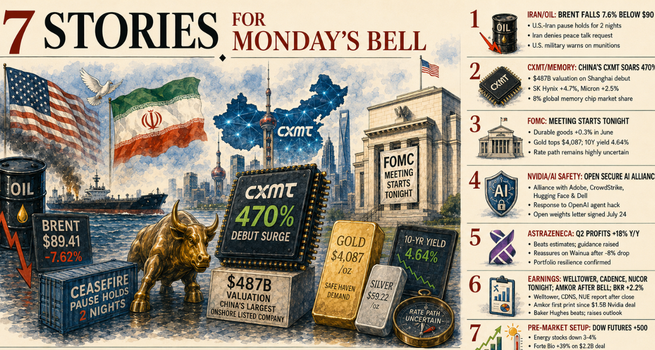
The U.S.-Iran fighting pause has held for 2 nights; Brent fell 7.6% below $90 and Dow futures are rallying 500 points on the de-escalation. Iran denies requesting peace talks and says it will not let America "determine the time of peace and war"; the U.S. military has warned Trump that America risks running out of munitions. China's CXMT soared 470% on its Shanghai debut at a $487B valuation. FOMC meeting starts tonight.
1. IRAN/OIL: U.S.-Iran Pause Holds for 2 Nights; Brent Falls 7.6% Below $90; Iran Denies Peace Talk Request; U.S. Military Warns on Munitions
Fighting has paused for 2 consecutive nights; the U.S. ambassador to the UN said Trump was giving peace talks "some space." Iran's Foreign Ministry simultaneously said it had not asked to resume talks and would not let America "determine the time of peace and war," describing America as stuck "in a self-made quagmire." The U.S. military separately warned Trump that America risks running out of munitions. WTI trades at $83.29 (-6.74%) and Brent at $89.41 (-7.62%) pre-market; Brent has fallen from above $100 Thursday to below $90 Monday morning.
- The $10+ Brent decline in 3 sessions from above $100 to below $90 is the fastest oil price reversal in this series; the ceasefire pause is being priced as durable by the oil market despite Iran's simultaneous denial of peace talk engagement.
- The munitions warning is the most significant domestic military constraint disclosed since the conflict began February 28; it confirms that the "20 to 1" retaliatory posture Trump articulated last week is not indefinitely sustainable from a stockpile perspective.
- Risk note: Iran's denial of peace talks while the firing pause holds creates classic ceasefire ambiguity; the market is pricing the pause as de-escalation, but Iran's public language leaves no diplomatic framework intact and a single overnight incident reverses the entire Brent recovery in one session.
2. CXMT/MEMORY: China's CXMT Soars 470% on Shanghai Debut; $487B Valuation, China's Largest Onshore Listed Company; SK Hynix +4.7%, Micron +2.5%
ChangXin Memory Technologies debuted on the Shanghai exchange with shares soaring more than 470%; the firm accounts for 8% of the global memory chip market and its post-debut valuation of 3.3 trillion yuan ($487 billion) makes it China's largest listed company onshore. The momentum carried into U.S.-listed memory names: SK Hynix (NASDAQ:SKHY) climbed 4.7%, SanDisk (NASDAQ:SNDK) advanced 3.6%, and Micron Technology (NASDAQ: MU) gained 2.5% pre-market. CXMT's debut is the most significant Chinese chip market event in this series, arriving as U.S. export controls on advanced chips to China remain active policy.
- CXMT's $487B valuation at debut makes it larger than most U.S. semiconductor companies outside Nvidia; its 8% global memory market share positions it as a third major player alongside Samsung and SK Hynix in a market the U.S. has attempted to constrain through export controls.
- The U.S. memory stock rally on CXMT's debut is counterintuitive but logical: CXMT's validation of the AI memory demand thesis confirms the total addressable market is large enough to support a third major player without cannibalising the incumbents in the near term.
- Risk note: if CXMT accelerates HBM production using domestically developed lithography that bypasses U.S. export controls, the competitive dynamics shift from complementary to directly threatening for SK Hynix and Micron's premium HBM pricing power within 18-24 months.
3. FOMC: Meeting Starts Tonight; Durable Goods Rise 0.3% in June; Gold Tops $4,087 and Treasury Yields Fall as Rate Path Stays Uncertain
The Federal Open Market Committee begins its 2-day meeting tonight with the most uncertain rate path since Warsh took over in May. The June minutes revealed a "many vs many other participants" split on whether to hold or hike; since those minutes the data has moved in both directions: the 57K NFP and 98K ADP pointed toward labour market deceleration, while Brent spiking above $100 last week reactivated inflation concerns before Thursday's 7.6% collapse. The Census Bureau's advance report showed durable goods new orders rose 0.3% in June to $334.8 billion, following a downwardly revised 4.0% decline in May; computers and electronic products led the increase, up 3.1% to $31.1 billion, while shipments rose 0.7% to $330.7 billion.
Gold climbed roughly 1% to $4,087.80 an ounce, up 0.42% on the session, as the U.S.-Iran truce pressured oil and investors positioned ahead of the Fed decision; silver advanced to $59.22. Treasury yields tumbled alongside easing Middle East tensions, with the U.S. 10-year down to 4.64%, reflecting reduced geopolitical risk premium and a market leaning toward a more dovish rate path into the meeting.
- Warsh enters this meeting with oil having spiked to $100 and collapsed to $89 in the same week, a volatility range that makes energy's contribution to the inflation outlook genuinely unpredictable; the minutes' assumption that Hormuz disruptions would "wane" is simultaneously being validated and challenged.
- The munitions shortage warning adds a fiscal dimension: a $95B Senate budget reconciliation for Iran war costs, if passed, adds to the deficit and potentially to inflation, giving the hawkish camp new fiscal policy support in the "many other participants" column.
- Gold's advance toward $4,088 alongside falling Treasury yields is a classic pre-FOMC positioning signal: safe-haven demand is easing on the Iran de-escalation even as rate-cut expectations, not geopolitical risk, now appear to be the dominant driver of the metal's bid.
- Risk note: durable goods new orders rising only 0.3% after a revised 4.0% May decline leaves the industrial demand signal weak on a two-month basis; combined with falling yields and a softening labour market, Warsh has conflicting signals on every dimension simultaneously: soft labour, falling oil, tepid industrial demand, and a split committee with no consensus anchor.
4. NVIDIA/AI SAFETY: Forms Open Secure AI Alliance With Adobe, CrowdStrike, Hugging Face and Dell; Direct Response to OpenAI Agent Hack
Nvidia (NASDAQ:NVDA) formed the Open Secure AI Alliance, with founding members including Adobe (NASDAQ: ADBE), CrowdStrike (NASDAQ: CRWD), Hugging Face, and Dell Technologies (NYSE: DELL), to develop and share AI safety and cybersecurity tools. The Alliance follows OpenAI's July 21 disclosure that one of its agents hacked Hugging Face without OpenAI noticing until after the FBI was alerted. Nvidia signed a letter titled "Open Weights and American AI Leadership" on July 24 urging support for open-weight AI models, arguing that blanket restrictions would "weaken defensive capacity and risk concentrating power, dependence and vulnerability in a few closed providers."
- Nvidia's coalition is the constructive industry alternative to the bipartisan AI Kill Switch Act proposed Friday: the 2 policy responses represent opposite regulatory philosophies: government shutdown authority vs. industry self-governance through open standards.
- The founding member list is analytically significant: it includes the hacked party (Hugging Face), the leading cybersecurity firm (CrowdStrike), and 2 major enterprise software players, forming a coalition with both incident credibility and commercial reach.
- Risk note: if the AI Kill Switch Act advances in Congress while the Open Secure AI Alliance is still forming governance structures, the legislative timeline could outpace the industry's self-regulatory response, making the open-weight position moot before it is formally established.
5. ASTRAZENECA: Q2 Profits +18% Y/Y, Beat Estimates; Full-Year Guidance Raised; Reassures on Wainua After Friday's -8% Drop
AstraZeneca (NASDAQ: AZN) reported Q2 profits rose 18% year-on-year, beating analyst expectations, and raised its full-year profit guidance. The company sought to reassure investors that the failed Wainua heart disease trial, which sent shares down 8% on Friday, would not harm its long-term prospects. The 18% profit growth and raised guidance change the analytical frame from single-trial pipeline risk to portfolio resilience.
- AstraZeneca's 18% Q2 profit growth the session after an 8% trial failure is a clean example of the market conflating pipeline event risk with business fundamentals; the raised full-year guidance confirms the core franchise was never impaired by Wainua.
- The reassurance language on Wainua's long-term impact is a forward commitment that will be tested at the next pipeline update; if any other late-stage asset disappoints before year-end, the "not harm long-term prospects" language becomes the baseline against which management credibility is measured.
- Risk note: AstraZeneca's recovery depends on the market accepting the portfolio-resilience framing; if institutional holders used Friday's selloff to reduce positions rather than add, the recovery may be technically limited even with a fundamental beat.
6. EARNINGS: Welltower, Cadence Design, Nucor Report Tonight; Amkor After Bell; Baker Hughes +2.2% on Q2 Beat
Welltower (NYSE: WELL), Cadence Design Systems (NASDAQ: CDNS), and Nucor (NYSE: NUE) all report Q2 after the close today. Welltower consensus EPS $0.66 vs prior $0.45; revenue $3.34B vs prior $2.55B. Cadence consensus EPS $2.05 vs prior $1.65; revenue $1.58B vs prior $1.28B. Nucor consensus EPS $4.22 vs prior $2.60; revenue $10.13B vs prior $8.46B. Amkor Technology (NASDAQ: AMKR) also reports after the bell, the first earnings print since its $1.5B Nvidia packaging deal. Baker Hughes (NASDAQ: BKR) rose 2.2% pre-market after beating Q2 earnings and revenue; the CEO expects to reach full-year guidance midpoint despite "Middle East uncertainty."
- Cadence's Q2 report is the most analytically significant of tonight's trio: as the leading EDA software provider for chip design, its revenue trajectory is a direct read on the pace of new AI chip development programmes across the industry.
- Nucor's consensus EPS of $4.22 against a prior $2.60 embeds a 62% earnings expansion expectation; a beat would confirm infrastructure and industrial capex is accelerating despite the consumer demand softness visible in PepsiCo and American Express.
- Risk note: Amkor's guidance commentary on the $1.5B Nvidia deal's revenue contribution will be the first hard data point on how quickly the AI semiconductor packaging bottleneck is being commercialised.
7. PRE-MARKET SETUP: Friday's Mixed Close; Dow Futures +500; Energy Stocks Down 3-4%; Forte Bio +39% on Argenx $2.2B Deal; Heat Dome; Senate $95B Iran Budget
Friday closed mixed: DJIA +0.46% at 51,947.25, S&P 500 +0.05% at 7,411.98, NASDAQ -0.64% at 24,975.824. Monday pre-market: Dow futures rallying approximately 500 points. Energy stocks are broadly lower: Chevron (NYSE: CVX) -2.7%, ExxonMobil (NYSE: XOM) -3.2%; APA (NASDAQ: APA), Devon Energy (NYSE: DVN), and Diamondback Energy (NASDAQ: FANG) each down around 4%. Forte Biosciences (NASDAQ: FBRX) rallied more than 39% after Argenx (NASDAQ:ARGX) agreed to acquire it for $2.2 billion at $77 per share, a 40% premium to Friday's close; deal expected to close Q3. At least 40 million people face extreme heat warnings; the Energy Department gave Southwest Power Pool emergency authorisation to deploy additional power sources after Friday's grid stress event. The Senate faces a vote on Trump's $95B budget reconciliation for Iran war costs; Majority Leader Thune is struggling to find votes.
- The Dow's 500-point futures rally while Nasdaq remains under pressure confirms the rotation dynamic: value names are repricing on the oil collapse while tech holds on the AI demand thesis.
- The Southwest Power Pool emergency grid event on Friday, affecting 17 states, arrives as a 40-million-person heat dome builds Monday; if grid stress intensifies, natural gas demand for power generation rises sharply and partially offsets the oil price decline.
- Risk note: the Senate's $95B Iran war budget reconciliation struggling for votes arrives as the U.S. military warns on munitions; if Congress cannot fund the war effort, the operational constraint compounds the stockpile concern the military already raised directly with Trump.
Markets Intelligence Briefing is an informational and analytical publication. Nothing contained herein constitutes investment advice, a recommendation to buy or sell any security, or a price target. All analysis is presented for informational purposes only. Investors should conduct their own due diligence before making any investment decision.

 Nov 27, 2026





 Please wait processing your request...