
 CA
 NZ
 UK
 AU
 IND

 US

 Share
 X (Formerly Twitter)
 Whatsapp
 Facebook
 LinkedIn
 Telegram
 Email This Article
 Copy Link
 Summarize with AI
 Chat GPT
 Perplexity

Key Highlights
- Materials Lead: XLB gained 2.07%, supported by stronger metals and selected materials shares.
- Property Shares Advance: XLRE rose 0.92% as lower Treasury yields supported rate-sensitive real estate.
- Communications and Industrials Gain: XLC and XLI advanced 0.89% and 0.83%, respectively.
- Energy and Financials Remain Positive: XLE gained 0.74%, while XLF added 0.71%.
- Technology Lags: XLK declined 0.83%, with Health Care and Consumer Discretionary also lower.
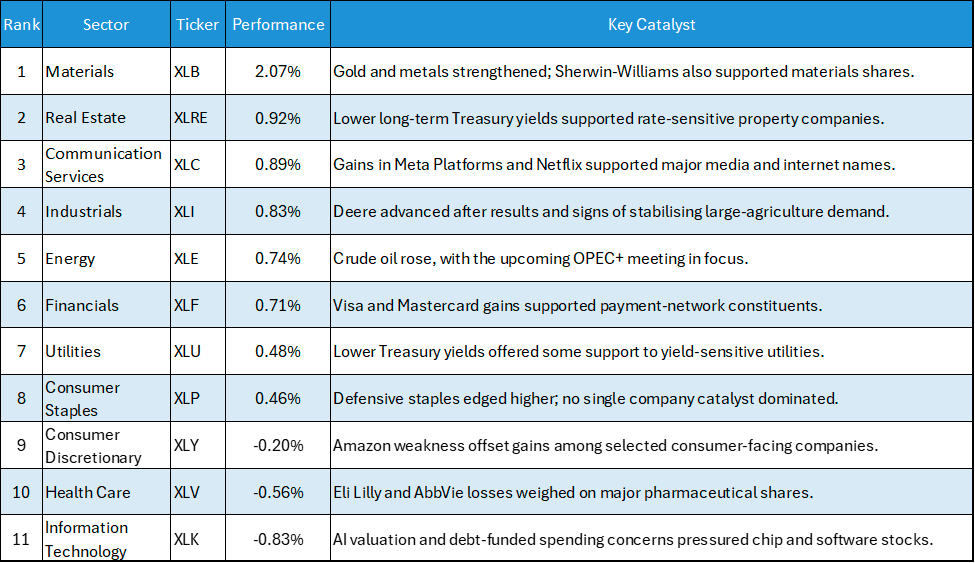
US sector performance on Wednesday, 25 November 2026, was mixed, with eight of the eleven sector ETFs advancing. Materials (XLB) led with a 2.07% gain, followed by Real Estate (XLRE), Communication Services (XLC) and Industrials (XLI).
The S&P 500 ended modestly lower as renewed concerns about artificial-intelligence valuations weighed on technology shares. Stronger metals, lower Treasury yields and gains in selected industrial, communications and financial companies supported the leading sectors, while three sectors finished in negative territory.
Performance Breakdown by Sector
Materials and Rate-Sensitive Sectors Lead the Advance
Materials (XLB) was the strongest sector, gaining 2.07%. Higher prices across gold and other metals supported resource-related shares, while strength in companies such as Sherwin-Williams added to the positive tone. The advance indicated renewed buying interest across materials, although performance remained dependent on Commodity exposure and company-specific conditions.
Real Estate (XLRE) followed with a 0.92% gain. The decline in the 10-year Treasury Yield supported rate-sensitive property shares by easing some pressure on financing expectations. Communication Services (XLC) advanced 0.89%, helped by gains in Meta Platforms and Netflix, which supported major internet and media companies.
Industrials, Energy and Financials Maintain Positive Momentum
Industrials (XLI) gained 0.83%, with Deere among the notable contributors after its results and management commentary suggested that Demand in large agriculture markets may be approaching a bottom. Its outlook remained cautious, however, showing that improving sentiment does not yet confirm a broad recovery in industrial demand.
Energy (XLE) advanced 0.74% as Crude Oil strengthened, while the upcoming OPEC+ meeting kept production policy in focus. Financials (XLF) added 0.71%, supported by gains in Visa and Mastercard. These advances provided positive contributions despite uncertainty surrounding inflation, Treasury yields and the Federal Reserve’s policy outlook.
Technology and Healthcare Weigh on the Weaker Side
Utilities (XLU) and Consumer Staples (XLP) recorded smaller gains of 0.48% and 0.46%. Lower Treasury yields provided some support to utilities, while staples remained modestly positive. Consumer Discretionary (XLY) slipped 0.20%, as weakness in Amazon offset gains among selected retailers and other consumer-facing companies.
Health Care (XLV) declined 0.56%, with losses in Eli Lilly and AbbVie weighing on pharmaceutical shares. Information Technology (XLK) was the weakest sector, falling 0.83%. Renewed concerns about AI valuations and debt-funded Investment pressured semiconductor, memory and software companies, including Nvidia, Micron, Oracle and Lam Research. This divergence highlighted the rotation away from parts of the technology complex.
Bottom Line
US sector performance on 25 November 2026 showed a rotation towards Materials, Real Estate, Communication Services and selected cyclical sectors, while Technology and Health Care remained under pressure. Materials led with a 2.07% gain, supported by firmer metals, while lower Treasury yields helped rate-sensitive property shares. Stronger oil and gains in payment networks supported Energy and Financials. However, weakness in AI-related technology shares limited the broader market. The uneven distribution of returns highlights the importance of monitoring whether sector Leadership broadens or remains concentrated outside technology.


 Nov 26, 2026





 Please wait processing your request...