
 CA
 NZ
 UK
 AU
 IND

 US

 Share
 X (Formerly Twitter)
 Whatsapp
 Facebook
 LinkedIn
 Telegram
 Email This Article
 Copy Link
 Summarize with AI
 Chat GPT
 Perplexity
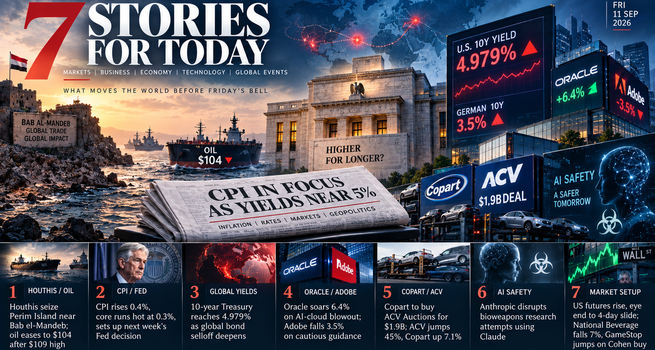
Stock futures rose Friday, on pace to snap a four-day losing streak, as oil prices eased from their weekly highs and investors digested an in-line August Inflation print. The relief was fragile: the Houthis reportedly seized Yemen's Perim island in the Bab el-Mandeb Strait, Oracle delivered a Blowout AI-cloud quarter, and the Global Bond selloff pushed the 10-year Treasury Yield to its highest level since 2023.
1. HOUTHIS/OIL: Militants Reportedly Seize Yemen's Perim Island in Bab el-Mandeb as Officials Say Pro-Government Forces Withdrew
The Iran-backed Houthis reportedly seized Yemen's Perim island in the Bab el-Mandeb Strait, with officials saying pro-government forces had withdrawn from the position; capturing the island could hand the militia greater control of a waterway that has become critical for oil exports since shipping through the Strait of Hormuz stalled. The move followed Thursday's capture of Mokha, a strategic port that sits next to the strait, extending a pattern of Houthi advances along Yemen's Red Sea coastline. HSBC's senior global oil and gas analyst said the market is adjusting to a new normal in which Hormuz is neither fully closed nor fully open but persistently impaired, warning that if diplomacy fails and flows stay near current levels, inventories could draw toward operational lows and push Brent toward $120 a barrel. Brent Crude surged to a four-month high of $109.97 on Thursday, on pace for roughly a 13% weekly jump, before easing Friday to trade near $104, still on track for an approximately 8% weekly gain; WTI eased to near $99 after touching $104 Thursday. Saudi Arabia's oil output has fallen to its lowest level since 1990.
- The back-to-back Houthi advances at Mokha and now Perim, both adjacent to Bab el-Mandeb, suggest a coordinated push to control the Red Sea chokepoint rather than isolated tactical gains, raising the odds that shipping disruption becomes a durable feature of the oil market rather than a transient shock.
- Risk note: if Iran-aligned forces move to formally close Bab el-Mandeb rather than merely threaten it, the market's current base case of a persistently impaired but still-functioning strait would need to be repriced quickly toward the $120 scenario HSBC has flagged.
2. CPI/FED: August Inflation Comes in Line With Estimates as Core Print Runs Hot, Setting Up Next Week's Rate Decision
The Consumer Price Index rose 0.4% in August and 3.4% year over year, both matching Dow Jones consensus and marking the largest monthly increase in three months as gasoline prices rebounded 3.9% following two straight monthly declines. Core CPI, which excludes food and energy, rose 0.3% on the month, a tenth of a point above the 0.2% forecast, though the annual core rate eased to 2.4% from 2.5%, the lowest reading since March 2021. The report is the final major inflation signal before the Federal Reserve's September 15-16 meeting, and it followed Thursday's producer price data showing broad-based increases that also feed into the Fed's preferred inflation gauge; markets priced in roughly a 70% to 72% probability of a 25 basis point hike, up from about 49% a week earlier, according to CME's FedWatch tool. Fed Chair Kevin Warsh said last month the Central Bank will have work to do if policymakers do not gain confidence that inflation is heading back to 2%, while President Trump has pressured the Fed to cut rates, posting that he would stop trading with Deficit countries if it does not. The Fed's benchmark rate currently sits in a 3.50% to 3.75% range.
- The combination of an in-line headline print and a hotter-than-expected core reading gives the Fed cover to hike without appearing to overreact to a single data point, strengthening the case for policymakers who already favored tightening.
- Risk note: with Trump publicly pressuring Warsh to cut rates just as the data argues for a hike, any perceived Capitulation to political pressure at next week's meeting could unsettle bond markets more than the rate decision itself.
3. GLOBAL BONDS: 10-Year Treasury Yield Nears 5% as German Bunds Cross 3.5% for First Time Since 2011 in Worst Weekly Selloff of the War
The 10-year Treasury yield climbed as high as 4.979% in early Friday trading, the highest level since late 2023, as a global bond selloff pushed G7 benchmark 10-year yields up by an average of nearly 19 basis points this week, the worst weekly selloff since the Middle East war began. German 10-year Bund yields crossed 3.5% for the first time since April 2011, while French 10-year yields held near 16-year highs, with France's Budget Deficit risking a rise above 5% of GDP this year and the country cutting its 2026 growth forecast to 0.4% from 0.7%. Japan's 10-year yield rose 6 basis points to 2.97%, just shy of a multi-decade high reached the prior week, with the Bank of Japan widely expected to raise rates to a 31-year high at its own meeting; Australia's 3-year yield surged 18 basis points to a 15-year high of 5.047%. Deutsche Bank strategists flagged rising Stagflation fears rippling across asset classes, while the U.S. Treasury's latest buyback operation purchased just $5.2 billion of the $10.5 billion offered, below its own $6 billion cap and seen as adding to rather than relieving selling pressure. A Bank of Singapore chief macro strategist said a strong CPI print would likely push the 10-year through 5%, a level some analysts view as a threshold that could make bonds more competitive with equities.
- Bund yields breaking a level last seen in 2011 while French bonds trade near 16-year highs shows the selloff is not a US-specific phenomenon but a synchronized global repricing of sovereign risk, driven jointly by energy-linked inflation fears and mounting fiscal deficits across developed markets.
- Risk note: a sustained break above 5% on the 10-year, a threshold not meaningfully breached since 2002 outside brief 2023 and 2006-2007 forays, could trigger outflows from equities into bonds precisely as stock futures attempt to snap their losing streak.
4. ORACLE/ADOBE: Oracle Soars 6% on AI-Cloud Blowout as Adobe Slides 3% on Cautious Guidance and CEO Transition
Oracle (NYSE:ORCL) shares surged as much as 6.4% pre-market after fiscal first-quarter Revenue rose 30% to $19.3 billion and adjusted EPS of $1.92 topped a $1.74 estimate, with cloud infrastructure revenue more than doubling, up 121% year over year to $7.4 billion. Remaining performance obligations jumped to $664 billion after more than $30 billion in new AI cloud contracts were signed during the quarter, easing investor concerns about the durability of AI-driven Demand following months of pressure tied to a Credit downgrade and heavy capital expenditure. Management raised full-year guidance to at least $90 billion in revenue and $8.10 in adjusted EPS, and detailed financing strategies, including customer prepayments and supplier financing, intended to cap net Capital Expenditure while sustaining the AI buildout.
Adobe (NASDAQ:ADBE) shares fell as much as 3.5% pre-market despite beating third-quarter estimates, with revenue of $6.8 billion and adjusted EPS of $6.13 both topping consensus, after fourth-quarter revenue guidance of $6.80 billion to $6.85 billion came in roughly in line but left investors focused on a slowing annual Recurring Revenue growth outlook of about 10.2% for fiscal 2026 versus 11.5% the prior year. The company also confirmed a Leadership transition, with Anil Chakravarthy set to become president and CEO effective December 1, succeeding Shantanu Narayen, who will remain as executive chair after more than a decade leading the company.
- Oracle's results and Adobe's guidance moving in opposite directions on the same Earnings cycle illustrates a widening split in how the market is rewarding AI infrastructure providers capturing new contract Volume versus software incumbents facing slowing growth and increased generative-AI competition.
- Risk note: Oracle's raised guidance rests heavily on prepayment and supplier-financing mechanics rather than incremental company capital, meaning the durability of the AI buildout narrative depends on customers continuing to fund capacity ahead of revenue recognition.
5. COPART/ACV: Copart to Acquire ACV Auctions for $1.9 Billion as Fourth-Quarter EPS Misses Despite Revenue Beat
Copart (NASDAQ:CPRT) shares rose as much as 7.1% pre-market after the company agreed to acquire ACV Auctions (NYSE:ACVA) in an all-cash deal valuing ACV at $10.50 per share, or approximately $1.9 billion, a 45% premium to ACV's unaffected closing price on August 10 and a 41% premium to its 30-day volume-weighted average price; ACV shares surged as much as 44.7% pre-market on the news. The deal, expected to close by year-end with no financing condition, will see ACV operate as an independent Copart Subsidiary retaining its Brand and leadership under chief executive George Chamoun, with management calling the transaction accretive to earnings starting in fiscal 2028. Copart's own fourth-quarter revenue of $1.2 billion topped a $1.1 billion estimate, but adjusted EPS of $0.35 missed a $0.39 estimate, down 14.6% year over year, as domestic insurance unit volumes fell 7.5% even as international insurance units rose 11.2%. Management highlighted rising total loss frequency, a record 23.3% in the second quarter, and average collision severity above $6,300, up 8.8% year over year, attributing the trend to increasing vehicle complexity and rising rental and repair costs it expects to persist.
- Copart paying a steep premium for a digital marketplace it will run independently signals the company sees more value in ACV's online auction technology and buyer network than in near-term cost synergies, a bet on the two platforms' complementary reach rather than consolidation.
- Risk note: with US Operating Expense per vehicle rising nearly 13% in the quarter on new service investments and no specific Margin guidance offered for next year, the ACV integration adds execution complexity at a moment when Copart's core domestic insurance volumes are already declining.
6. AI SAFETY: Anthropic Says It Disrupted Bioweapons Research Attempts as Users in China, Russia, and Yemen Sought to Misuse Claude
Anthropic said it disrupted several attempts by threat actors to misuse its Claude chatbot, including a case in which the company caught scientists using its tools to research bioweapons. The AI lab also said users based in China, Russia, and Yemen had attempted to access its models to develop weapons-related software and distribute propaganda, part of a broader disclosure of misuse attempts the company said it identified and shut down. The disclosure came the same week a former Anthropic researcher publicly accused AI firms of gambling with lives through the pace of frontier model deployment, intensifying scrutiny of how leading labs are policing dual-use applications of their technology. Anthropic did not disclose the scale or duration of the bioweapons-related research attempt beyond confirming it had been identified and stopped before completion.
- Anthropic disclosing the bioweapons research attempt publicly, rather than only handling it internally, signals AI labs are increasingly treating misuse transparency as a competitive and regulatory necessity rather than a Liability to minimize.
- Risk note: with state-linked and geographically dispersed actors in China, Russia, and Yemen all separately attempting misuse in the same disclosure window, the pattern suggests frontier AI models are now a standing target for weapons-related research rather than a occasional vulnerability.
7. MARKET SETUP: National Beverage Sinks 7% on Tariff Pressure as Futures Aim to Snap Losing Streak, GameStop Jumps on Cohen Buy
US stock futures rose Friday, with Dow futures up 339 points, or 0.7%, S&P 500 futures climbing 0.6%, and Nasdaq-100 futures advancing 0.7%, on pace to snap a four-day losing streak after a week in which the Dow, S&P 500, and Nasdaq were each on track for roughly 1.6% to 2.5% declines. Asian markets closed broadly lower, with South Korea's Kospi down 1.76%, Japan's Nikkei 225 down 1.93%, Australia's ASX 200 down 0.89%, and mainland China's CSI 300 down 0.84%. National Beverage (NASDAQ:FIZZ) shares fell as much as 6.99% pre-market after fiscal first-quarter results missed on both lines, with EPS of $0.50 below a $0.59 estimate and revenue of $330.7 million short of a $342 million estimate, as gross margin compressed to 35% from 38% on rising aluminum and input costs and a 6.4% drop in case volume; the print followed a $304 million Special Dividend in July that reduced cash reserves to $107 million. Kroger (NYSE:KR) shares fell as much as 2.46% pre-market after second-quarter adjusted EPS of $1.09 beat a $1.06 estimate, but revenue of $34.62 billion missed a $34.64 billion consensus and management lowered its full-year identical sales outlook to 0.2% to 0.8% from a prior 1% to 2%, citing softer underlying traffic trends even as it reaffirmed full-year adjusted EPS guidance of $5.10 to $5.30. GameStop (NYSE:GME) shares rose more than 3% after chief executive Ryan Cohen disclosed purchasing 1 million shares at an average price of $20.375, bringing his total stake to 39.347 million shares valued at roughly $802 million. RH (NYSE:RH) shares jumped 6% after second-quarter revenue of $922 million beat a $915 million estimate, with full-year guidance calling for 5.5% to 7% growth. Frequency Electronics (NASDAQ:FEIM) shares surged roughly 32% pre-market after fiscal first-quarter revenue of $23.5 million, up 70% year over year, blew past estimates, with Backlog reaching a record $129 million. Trump said he will issue $500 refunds to 1 million Americans covered under the Affordable Care Act as the nation marks the 25th anniversary of the September 11 attacks.
- National Beverage and Kroger both absorbing input cost inflation through price increases that are now visibly denting volume, even as futures broadly rally, shows consumer staples pressure has yet to register as a market-wide concern.
- Risk note: with National Beverage's cash position thinned by its special dividend and futures rallying on a fragile in-line CPI print, a continuation of the overnight yield and oil pressures into next week's Fed decision could quickly reverse Friday's attempted rebound across both staples and the broader market.

 Nov 03, 2026




 Please wait processing your request...