
 CA
 NZ
 UK
 AU
 IND

 US

 Share
 X (Formerly Twitter)
 Whatsapp
 Facebook
 LinkedIn
 Telegram
 Email This Article
 Copy Link
 Summarize with AI
 Chat GPT
 Perplexity

Key Highlights
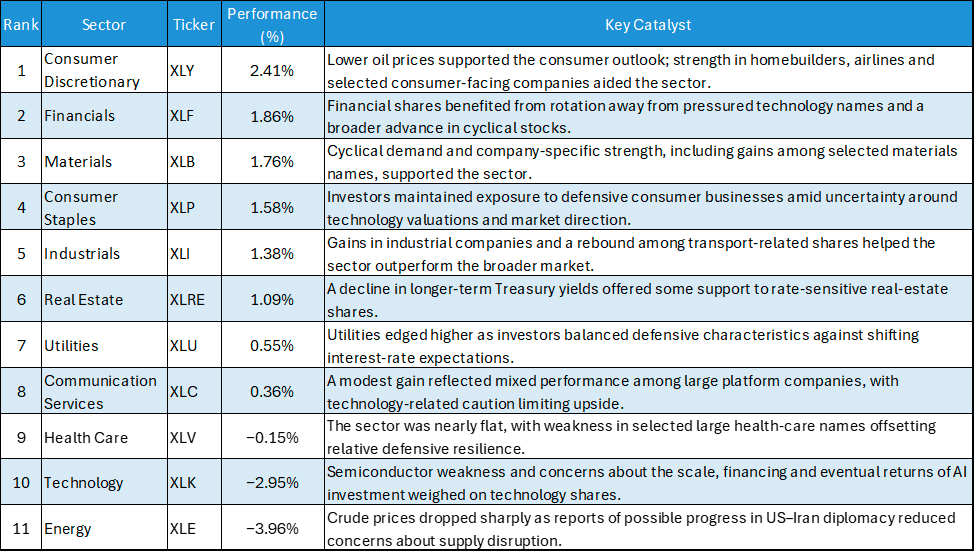
- Consumer Discretionary Leads: XLY rose 2.41%, the strongest performance among the 11 sectors, as cyclical shares benefited from a sharp retreat in oil prices and gains across consumer-facing businesses.
- Financials and Materials Advance: XLF gained 1.86% and XLB added 1.76%, reflecting strength beyond technology and a rotation toward selected cyclical sectors.
- Consumer Staples and Industrials Gain: XLP climbed 1.58%, while XLI advanced 1.38%, with defensive Demand and broad participation supporting the session’s leading groups.
- Energy Records the Largest Decline: XLE fell 3.96% as crude prices dropped sharply amid hopes for progress in US–Iran diplomacy.
- Technology Remains Under Pressure: XLK lost 2.95%, as semiconductor weakness and concerns about the financing and returns of heavy AI Investment continued to weigh on technology shares.
- Mixed Market Breadth: Eight sectors advanced and three declined in the supplied data, although weakness in Technology and Energy remained a significant drag on the broader market.
US sector performance on 2 November 2026 showed a clear split between cyclical leaders and areas exposed to commodity-price and technology-specific pressure. Consumer Discretionary (XLY) gained 2.41%, followed by Financials (XLF) at 1.86% and Materials (XLB) at 1.76%. By contrast, Energy (XLE) fell 3.96% and Technology (XLK) declined 2.95%. The retreat in oil prices, alongside continued caution toward AI-related investment, helped reshape sector leadership. Despite strength across most sectors, weakness in technology shares contributed to a mixed session for major US benchmarks.
Performance Breakdown by Sector
Consumer Discretionary and Cyclical Shares Lead
Consumer Discretionary (XLY) topped the sector rankings with a 2.41% advance. The sharp decline in oil prices improved the near-term backdrop for fuel-sensitive businesses and helped support sentiment toward consumer spending. Homebuilders, airlines and other consumer-facing shares also recorded gains, suggesting that buying extended beyond a single industry. Financials (XLF) rose 1.86%, while Materials (XLB) added 1.76%, reinforcing the impression of a rotation toward selected cyclical areas. However, one session of outperformance does not establish a lasting improvement in consumer demand or corporate Earnings expectations.
Defensive Sectors Also Post Gains
Consumer Staples (XLP) climbed 1.58%, while Industrials (XLI) gained 1.38%. Real Estate (XLRE) advanced 1.09%, and Utilities (XLU) rose 0.55%. The gains across staples and utilities indicate that investors continued to value defensive exposure even as cyclical groups led the rankings. Real Estate may also have received support from a decline in longer-term Treasury yields, which can ease financing pressure and improve the relative appeal of income-oriented assets. Communication Services (XLC) added 0.36%, while Health Care (XLV) slipped just 0.15%. Their limited moves point to a more mixed picture among traditionally defensive or platform-heavy sectors.
Energy and Technology Weigh on Performance
Energy (XLE) was the weakest sector, falling 3.96%. Crude prices dropped sharply after reports of possible progress in US–Iran diplomacy reduced some of the geopolitical risk premium embedded in oil. A sustained decline in crude can pressure producers’ Revenue expectations and quickly reverse energy-sector leadership. Technology (XLK) fell 2.95%, extending pressure on semiconductor and other AI-related shares. Investor concerns about the scale of AI infrastructure spending, financing requirements and the time needed to generate adequate returns remained important themes. The technology decline also showed that gains across other sectors were not enough to remove uncertainty surrounding high-profile growth stocks.
Market Outlook and Risks
The next direction for sector Leadership will depend on developments in oil markets, Treasury yields, company earnings guidance and sentiment toward AI investment. Further easing in crude prices could continue to support transport and consumer-sensitive shares, but it would remain a headwind for energy producers. A stabilisation in semiconductor and large-cap technology stocks would help determine whether the recent weakness represents a short-term repricing or a more persistent shift in investor expectations. Financials, Materials and Industrials may benefit if cyclical participation broadens, while defensive sectors could retain appeal if Volatility remains elevated. These moves are not guaranteed to persist, and daily ETF performance alone cannot establish the durability of a sector rotation.
Bottom Line
The 2 November session featured leadership from Consumer Discretionary (XLY), up 2.41%, followed by Financials (XLF) at 1.86% and Materials (XLB) at 1.76%. Energy (XLE) fell 3.96% as oil prices retreated, while Technology (XLK) declined 2.95% amid ongoing concerns about AI-related spending and returns. Eight sectors advanced in the supplied data, but the divergence between cyclical winners and the weakest commodity- and technology-sensitive groups highlights a market still adjusting to changing macroeconomic and investment expectations. Investors will likely monitor crude prices, Treasury yields and technology-sector stability to assess whether the rotation continues.

 Nov 03, 2026



 Please wait processing your request...