
 CA
 NZ
 UK
 AU
 IND

 US

 Share
 X (Formerly Twitter)
 Whatsapp
 Facebook
 LinkedIn
 Telegram
 Email This Article
 Copy Link
 Summarize with AI
 Chat GPT
 Perplexity
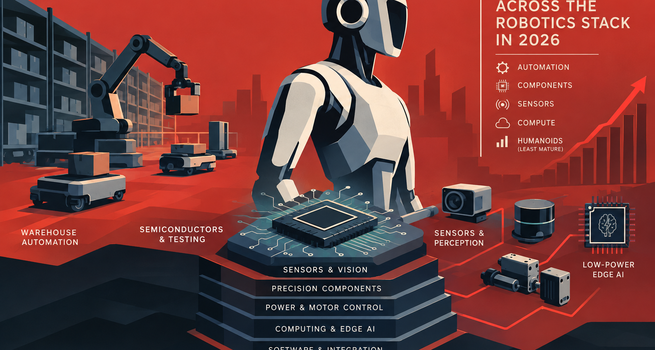
Robotics is developing across semiconductor testing, precision components, sensing, computing and Warehouse automation, with humanoids representing its least mature commercial layer. Examining ten listed companies reveals substantial differences in Revenue visibility, deployment Economics and ownership exposure. Established automation businesses coexist with emerging products and pending transactions, making financial disclosure and commercial evidence more useful than a shared robotics label.
Key Highlights
- Teradyne (NASDAQ: TER) reported $100 million of robotics revenue in Q2 2026, compared with $1.122 billion from semiconductor testing, demonstrating the difference between direct robotics sales and broader chip demand.
- Symbotic (NASDAQ: SYM) generated $721 million of quarterly revenue, while its $22.5 billion of remaining performance obligations represented work extending across future reporting periods.
- onsemi (NASDAQ: ON) agreed to acquire Synaptics Incorporated (NASDAQ: SYNA), but the announced transaction remained pending, with completion expected in mid-2027.
- Churchill Capital Corp XI (NASDAQ: CCXI) remained a SPAC awaiting its proposed Agility Robotics combination; the operating company was not yet a completed public-market holding.
- Goldman Sachs (NYSE: GS) publicly projected a $38 billion humanoid market by 2035, revising an earlier $6 billion forecast rather than establishing growth of more than 2,000%.
Commercial Automation Provides the Financial Starting Point
The clearest evidence of robotics commercialisation is already appearing in warehouse automation accounts. Symbotic (NASDAQ: SYM) reported $721 million of revenue for its fiscal third quarter ended June 27, 2026, up 22% year over year, alongside $55 million of consolidated GAAP net income. Management reported 77 systems in deployment. These are measurable operating results, although deployment does not mean every system is fully operational.
That distinction frames the broader robotics market. Machines require reliable chips, precision movement, environmental perception, power conversion and software coordination before they can perform useful work. Humanoid manufacturers combine these capabilities into human-shaped platforms, but many suppliers already serve established industrial and medical applications.
Consequently, these ten stocks do not represent equivalent exposures. Some sell complete automation systems; others Supply components used across numerous industries. One represents a pending Acquisition vehicle. Their economic connection is a technology stack, while their financial Maturity varies considerably.
Semiconductor Testing and Direct Robotics Are Different Businesses
Teradyne (NASDAQ: TER) illustrates that separation. Its Q2 2026 revenue totalled $1.329 billion, including $1.122 billion from Semiconductor Test and $100 million from Robotics. Robotics therefore represented approximately 7.5% of consolidated sales. Advanced-chip testing demand, including AI-related demand, must not be relabelled as robot revenue.
Universal Robots and Mobile Industrial Robots are unlisted businesses within its robotics operations. The former supplies collaborative robotic arms; the latter supplies autonomous mobile robots for material movement. These provide direct commercial automation exposure, distinct from equipment that tests semiconductors ultimately sold into many different applications.
The resulting investment-market sensitivity is mixed. Semiconductor equipment orders respond to chipmakers’ capacity and technology spending, whereas factory robots depend on manufacturers’ willingness to redesign production workflows. Strength in one Business cannot establish equivalent Demand in the other.
Precision Motion and Force Sensing Connect Software to Work
Novanta (NASDAQ: NOVT) participates through precision photonics, motion control and robotic accessories. Its unlisted ATI Industrial Automation business supplies tool changers and force/torque sensors, while Celera Motion contributes motion technologies. These components support industrial automation and medical robotics without requiring the supplier to manufacture a complete robot.
Q2 2026 revenue increased 10.3% to $265.8 million, with GAAP Net Income of $12.5 million. Those are consolidated figures, not disclosed robotics revenue. The completed Riverpoint Medical acquisition further expands medical exposure, reinforcing why the company should be understood as a diversified precision-technology supplier.
Its commercial advantage rests partly on integration into demanding equipment designs. However, qualification requirements also lengthen sales cycles. Customers can defer capital equipment purchases, and technical importance does not automatically establish pricing power.
Vishay Precision Group (NYSE: VPG) addresses another physical requirement: measuring force accurately. Its strain gauges, load cells and force transducers serve weighing, industrial measurement and documented robotic actuator-feedback applications. Much of the portfolio remains associated with other markets.
Fiscal Q2 2026 revenue rose 11.7% to $83.9 million, but the company recorded a $1.7 million net loss attributable to shareholders. Management reported a vendor nomination from its initial humanoid customer supporting an anticipated production ramp. That is evidence of supplier selection, not proof that projected volumes have shipped. Currency movements, shipment delays and product mix also affected profitability.
Together, these suppliers show why better robotic capability and stronger near-term Earnings need not arrive simultaneously.
Lidar and Machine Vision Have Different Revenue Foundations
Ouster (NASDAQ: OUST), now listed on Nasdaq rather than the NYSE, supplies digital lidar and a broader sensing-and-perception platform. Lidar measures distance using light, helping autonomous machines interpret their surroundings.
Q2 2026 revenue reached $55 million, up 56%, including $53 million of product revenue. The company attributed growth principally to industrial and smart-infrastructure applications, including warehouse automation and yard logistics. It shipped more than 17,000 lidar and camera sensors; that combined figure must not be described as lidar shipments alone. GAAP gross Margin was 49%, but the company still reported an $18 million net loss.
Product sales provide stronger commercial evidence than demonstrations, although aggregate revenue is not a robotics-only measure. Customer reorders, pricing and production deployments matter more than shipment counts without context. Competing lidar architectures and alternative camera-based systems create pressure on cost and performance. The financial challenge is converting adoption into durable cash generation.
Himax Technologies (NASDAQ: HIMX) offers a different machine-vision route. Its June 2026 HE-series indirect time-of-flight depth decoders process information used for three-dimensional sensing. The announcement documented adoption by industry partners for machine vision, including a module supporting robotic picking, obstacle avoidance, mapping and navigation. This establishes a specific robotics application beyond a generic AI narrative.
Its WiseEye technology also addresses low-power, always-on sensing, but such capabilities serve broader device markets. Q2 2026 revenue was $227.4 million, with display-driver categories accounting for most sales. Robotics revenue was not separately identified.
The analytical distinction is between a verified component application and financial materiality. Design adoption can precede meaningful revenue by several product cycles, while competing vision architectures can limit eventual volumes.
Low-Power Computing Offers Potential Without Disclosed Robot Sales
Ambiq Micro, Inc. (NYSE: AMBQ) is the verified legal name behind the low-power computing business. Its Apollo processors use the proprietary SPOT platform to reduce energy consumption, with established applications including wearables, fitness devices and wireless sensors. Edge AI means processing information locally rather than sending every task to a remote server.
For robots, lower-power local processing could support distributed sensing and functions that remain active continuously. That is a plausible architectural application, not evidence that the company already supplies a financially significant humanoid market.
Q2 2026 net sales increased 89.7% to $33.9 million, while GAAP gross margin reached 45%. The GAAP net loss was $7.1 million. Management also identified semiconductor supply constraints. These figures demonstrate growing demand for its broader computing platform, not separately quantified robotics growth.
Competition involves both energy efficiency and software support. A processor must fit developers’ tools, performance requirements and production schedules. An attractive power specification alone does not guarantee adoption.
Power Management Is Commercial; the Proposed Combination Remains Pending
onsemi (NASDAQ: ON) supplies verified building blocks for smart and mobile robots, including image sensors, power conversion, battery protection and motor-drive circuitry. These functions translate electronic commands into controlled movement while managing heat, voltage and current. Its robotics application materials demonstrate portfolio relevance, but do not establish a separately reported robotics business.
Q2 2026 consolidated revenue was $1.6035 billion, compared with $1.4687 billion a year earlier. That total spans wider semiconductor markets and cannot serve as a proxy for robot-related sales.
The claim that it had already acquired Synaptics Incorporated (NASDAQ: SYNA) requires correction. A definitive all-stock agreement was announced on June 25, 2026, representing approximately $7 billion of enterprise value. Completion was expected in mid-2027, subject to Shareholder approval, regulatory clearances and other conditions.
The proposed rationale combines power and sensing with the target’s connected-computing and interface capabilities. Until closing, those remain separate businesses. Any integrated platform benefits are prospective and carry integration, retention and execution risks. Industrial semiconductor demand also remains exposed to inventory adjustments and customers’ capital-spending cycles.
Warehouse Automation Converts Engineering Into Contract Economics
Symbotic (NASDAQ: SYM) integrates robots, storage structures and software into warehouse systems. This makes deployment execution central to its economics: equipment must operate reliably within a customer’s existing logistics network.
At June 27, 2026, remaining performance obligations were $22.5 billion, with approximately 15% expected to become revenue over the following 12 months. That is contracted future work, not cash already collected or sales already realised. One customer represented 90.5% of quarterly revenue, demonstrating substantial concentration.
Accounting also matters. Where acceptance can be reasonably assured at contract inception, systems revenue is recognised over time using costs incurred relative to estimated total costs. Otherwise, recognition can wait until final customer acceptance. Changes in project estimates therefore affect the relationship between engineering progress and reported performance.
Fiscal Q3 adjusted EBITDA was $95 million, compared with $55 million of consolidated GAAP net income; the measures are not interchangeable. Cash and equivalents were approximately $1.7 billion.
The competitive test is sustained throughput, dependable service and economical installation. Delays or cost overruns can weaken returns even when the long-term order pipeline remains substantial.
Humanoid Platforms Require Separate Commercial Tests
Tesla (NASDAQ: TSLA) offers exposure to Optimus through an established operating company, but the humanoid programme remains at a different stage from its automotive and energy businesses.
Its Q2 2026 update described installing first-generation Optimus Manufacturing lines at Fremont and designated initial builds for internal training-data collection and functionality development. The manufacturing table classified Optimus facilities as under construction. Production expectations therefore remained management targets, rather than evidence of completed external deliveries.
Demonstrations establish that a machine can perform selected tasks under particular conditions. Internal trials test development progress. Commercial validation requires paying customers, dependable utilisation and evidence that operating costs justify deployment. The reviewed disclosures did not establish externally verified commercial Optimus deployments or separately reported robot revenue.
For scale, Tesla (NASDAQ: TSLA) reported more than 480,000 vehicle deliveries and 13.5 GWh of energy-storage deployments in Q2 2026. These established operations remain the measurable commercial foundation against which humanoid spending must be assessed.
Churchill Capital Corp XI (NASDAQ: CCXI) presents a different ownership structure. Its proposed combination with private Agility Robotics remained pending as of September 24. A September 17 announcement anticipated fourth-quarter completion and subsequent Nasdaq trading under the proposed ticker AGLT. That symbol was prospective, not the SPAC’s current ticker.
Agility nevertheless has customer-confirmed commercial activity. GXO Logistics (NYSE: GXO) announced a multi-year robots-as-a-service agreement in June 2024, following a pilot, for Digit robots moving totes in a warehouse. This supports a specific commercial application, rather than proof of general-purpose humanoid capability at scale.
The Merger announcement contemplated more than $620 million of gross proceeds, including approximately $200 million of private financing and $420 million of trust cash assuming no redemptions. Shareholder and other approvals remained conditions. Redemptions could reduce available cash, while transaction-related share issuance changes ownership percentages. Production expansion and continuing development create further financing demands. Holding the SPAC before closing is therefore conditional transaction exposure, not completed ownership of Agility.
What the Public Humanoid Market Forecast Actually Says
Goldman Sachs (NYSE: GS), in a public article dated February 27, 2024, projected a $38 billion humanoid robotics market by 2035. It described this as an increase from its previous $6 billion forecast for the future opportunity.
Goldman Sachs (NYSE: GS) projected in February 2024 that the global humanoid robotics market could reach USD 38 billion by 2035, supported by advances in artificial intelligence, declining component costs and potential demand for industrial automation. These developments could expand opportunities across sensing, precision components, computing and robot manufacturing. However, commercial adoption depends on reliability, safety and cost-effectiveness. The estimate raised an earlier USD 6 billion forecast; it does not substantiate the claim of market growth exceeding 2,000%.
The Robotics Stack Has Several Economic Timelines
The evidence supports a layered market rather than a single robotics cycle. Precision components and semiconductor platforms already generate commercial revenue, but robotics often remains unquantified within diversified accounts. Warehouse systems provide clearer automation exposure, accompanied by concentration and execution risks. Humanoids introduce greater uncertainty over reliability, safety and production economics.
Across these layers, technical progress must eventually improve customer economics. Installation, maintenance, supervision, downtime and financing belong in the calculation alongside hardware prices. A robot that completes a demonstration still has to justify its place in a working operation.
For financial analysis, the essential distinctions are between products and prototypes, orders and realised revenue, and announced transactions and completed ownership. Those distinctions explain more about the robotics stack in 2026 than the humanoid label alone.


 Nov 08, 2026





 Please wait processing your request...