
 AU
AU
 UK
UK
 CA
CA
 NZ
NZ
 IND
IND

 US
US

 Share
Share
 X (Formerly Twitter)
 Whatsapp
 Facebook
 LinkedIn
 Telegram
 Email This Article
 Copy Link
 Summarize with AI
 Chat GPT
 Perplexity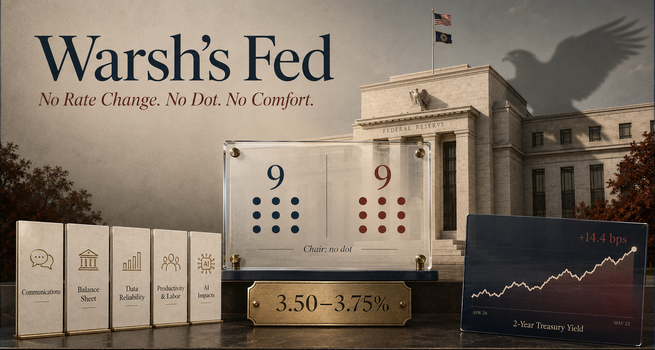
Key Highlights
- Federal Reserve holds the benchmark federal funds rate at 3.5%–3.75% with no reported dissents.
- The dot plot splits evenly 9-9, with the median projection pointing toward a quarter-point rate hike later in 2026.
- Warsh formally abstains from submitting a rate projection, reinforcing his long-held opposition to forward guidance.
- The 2-year Treasury yield surges 14.4 basis points as markets reprice for a higher-for-longer rate environment.
- Five task forces announced to reform Fed communications, balance sheet policy, inflation framework, and AI impact assessment.
A Rate Hold With a Hawkish Edge
The Federal Reserve's June 2026 meeting delivered no change in interest rates but generated substantial market turbulence nonetheless. The Federal Open Market Committee voted to maintain the benchmark federal funds rate at 3.5%–3.75%, a decision that carried little surprise.
What caught markets off guard was the tone, the structure of the dot plot, and the institutional reforms Chairman Kevin Warsh chose to announce alongside it. Equities sold off sharply in the hours following the decision, and bond markets moved with unusual urgency for a meeting at which nothing formally changed.
The Dot Plot Divide
The so-called dot plot, which aggregates the rate projections of individual FOMC participants, revealed a committee in genuine disagreement. The 18 participants split directly down the middle: nine projected steady rates or one cut through the remainder of 2026, while nine anticipated at least one hike. The median dot, as a result, pointed modestly toward a quarter-point increase before the year's end.
This is not a committee drifting toward ease. It is one that has, under Warsh's early stewardship, tilted its center of gravity back toward restraint. For fixed income markets accustomed to pricing in cuts over the medium term, the June dot plot effectively reset the risk calculus.
Warsh's Deliberate Abstention
Warsh confirmed what markets had anticipated: he did not submit a rate projection. His reasoning is consistent with views he has held for years. Participating in the Summary of Economic Projections, he explained, would constrain future policy discretion in ways that he considers counterproductive.
This is more than personal preference. By withholding a dot, Warsh signals that under his leadership, the Fed will not anchor its credibility to published forecasts. That is a structural shift. The SEP has, for more than a decade, functioned as an unofficial commitment device. Warsh's abstention serves notice that this convention is under review.
Five Task Forces and a Structural Reset
Beyond the rate decision itself, Warsh used the June meeting to announce the formation of five internal task forces. Their briefs span communications reform, balance sheet strategy, the reliability of the Fed's data inputs, the intersection of productivity and labor market dynamics, and the macroeconomic implications of artificial intelligence and other transformative technologies.
The final task force will reconsider the Fed's inflation framework. That last mandate carries the highest long-term significance. A fundamental recalibration of how the central bank defines, measures, and targets price stability would have consequences for every asset class, from equities to real estate to credit.
Price Stability as a Policy Signal
Throughout his post-meeting press conference, Warsh returned repeatedly to the phrase "price stability." By most counts, he used the term approximately twelve times. For a chairman who, before his appointment, was associated with a market-sensitive approach to monetary conditions, the emphasis was striking.
His framing was unambiguous: the committee's commitment to restoring and sustaining price stability is, in his words, unanimous. Markets reacted accordingly. The policy-sensitive 2-year Treasury yield rose 14.4 basis points on the day, a move that in the context of a no-change meeting represents a meaningful repricing of rate expectations.
Brevity as Institutional Signal
The post-meeting statement itself was reduced to 130 words, less than half the length of statements issued under prior leadership, which routinely exceeded 300 words. The trimming was deliberate. Warsh has long argued that the Fed's communications have become so elaborate and conditional that they obscure rather than clarify the committee's intentions.
A shorter statement carries interpretive risk of its own. With less language to parse, markets are left with greater reliance on the chair's press conference and on the data itself. That shift in the locus of guidance is itself a form of communication: the Fed under Warsh intends to be read through actions, not through elaborate forward-looking prose.
Markets Price In Higher for Longer
The post-meeting selloff in equities reflected a straightforward reassessment. A 9-9 dot split with a median pointing toward a hike, a chairman who will not commit to any rate path in advance, and five task forces signaling institutional reconfiguration collectively present a picture of a central bank that is tightening its grip rather than preparing to loosen it.
Whether that reassessment proves durable will depend on the incoming inflation and labor market data. Should price pressures remain elevated through the summer, the hawks within the committee will gain political weight. If disinflation resumes, the balance may shift. For now, the market consensus is adjusting to a Fed that has, under Warsh, shed its dovish pretensions and restored the primacy of price stability as its guiding mandate.

 Jun 18, 2026



 Please wait processing your request...