
 CA
 NZ
 UK
 AU
 IND

 US

 Share
 X (Formerly Twitter)
 Whatsapp
 Facebook
 LinkedIn
 Telegram
 Email This Article
 Copy Link
 Summarize with AI
 Chat GPT
 Perplexity
Key Highlights
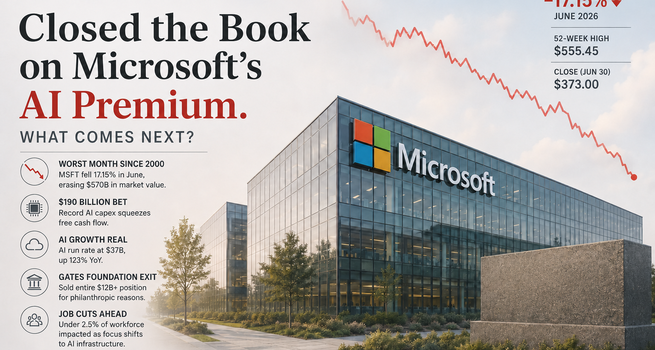
• Microsoft (NASDAQ: MSFT) fell 17.15% in June 2026, its worst monthly performance since December 2000, with shares settling near $373.
• The decline is driven primarily by investor concern over $190 billion in planned capital expenditure for 2026, squeezing near-term free cash flow.
• Microsoft's AI segment has reached a $37 billion annualised run rate, up 123% year over year, yet the market is repricing the cost of sustaining that growth.
• The Gates Foundation Trust completed a full exit from MSFT across two tranches, selling roughly $8.8 billion in Q3 2025 and $3.2 billion in Q1 2026, for philanthropic portfolio reasons unrelated to the company's fundamentals.
• Microsoft is reported to be preparing a fresh round of involuntary job cuts affecting under 2.5% of its global workforce, across sales, consulting, and Xbox, as the company continues to redirect payroll savings toward AI infrastructure spending.
A Repricing, Not a Collapse
June 2026 will be recorded as one of the more instructive months in Microsoft's public market history, and not because the business deteriorated. It is instructive because the market finally forced a reckoning with what AI leadership actually costs. The stock fell 17.15% over the month, its worst performance since December 2000, erasing more than $570 billion in market value and pulling shares from a 52-week high of $555.45 to a closing level near $373. For a company that spent three years as the defining emblem of the artificial intelligence investment thesis, the reversal has been striking. Trading volume for the month reached 1.07 billion shares, the highest since the Covid-driven sell-off of March 2020, pointing to institutional-scale repositioning rather than retail panic.
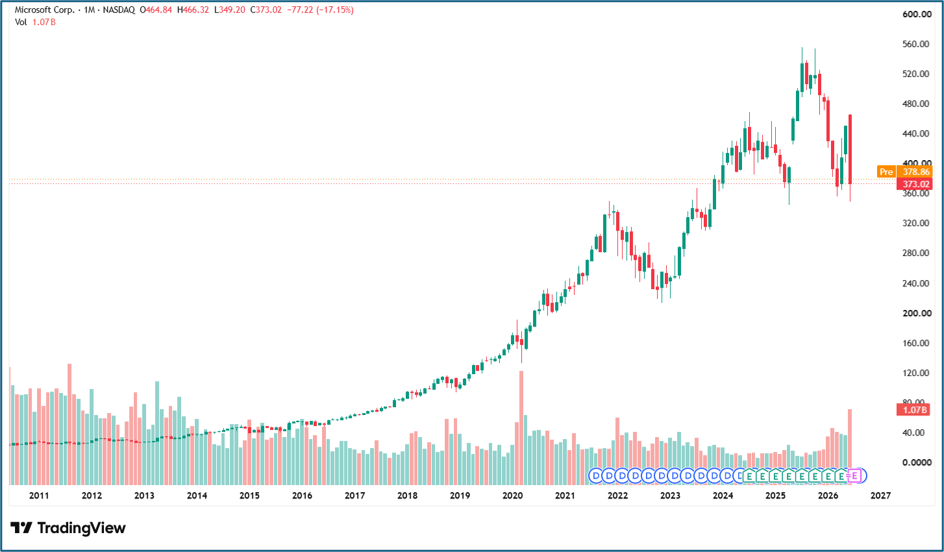
What makes the decline analytically significant is the disconnect between the operating results and the stock's behaviour. Microsoft's most recent quarter showed revenue growth of 18% to $82.9 billion, earnings per share expansion of 21%, and Azure cloud growth of 40% in constant currency, the fifth consecutive quarter of acceleration. By conventional measures, this is a business performing well. What has changed is not the trajectory of the business but the capital intensity required to sustain it, and the market's reassessment of how that intensity flows through free cash flow and forward returns.
The stock's move from a price-to-earnings multiple closer to 35 times at its 52-week high to approximately 23 times at June's close is not a collapse. It is a compression, and the distinction matters for how investors should frame what comes next.
The Capex Overhang: What $190 Billion Actually Means
Microsoft's management has guided for approximately $190 billion in capital expenditure in calendar year 2026, a 61% increase from the prior year and roughly $35 billion above analyst consensus heading into the Q3 earnings call. Chief Financial Officer Amy Hood attributed approximately $25 billion of that increase to higher component prices, primarily memory and chips, rather than additional capacity, which makes the number harder to defend as pure demand-driven investment.
The mechanics of the problem are straightforward. In Q3 FY2026, quarterly capital expenditure hit $30.88 billion, up 84% year over year. Free cash flow fell to $15.8 billion from $20.3 billion in the year-ago period, even as net income rose to $31.8 billion. The gap between accounting profit and actual cash generation is precisely what equity markets are wrestling with, particularly investors who price long-duration technology assets on the basis of distributable cash rather than reported earnings.
The concern is not that Microsoft is spending on AI without reason. The company's commercial remaining performance obligations reached $627 billion in Q3, up 99% year over year. Azure capacity constraints have been a genuine revenue ceiling throughout the year, and management has guided for acceleration in the second half of calendar 2026 as new data centre capacity comes online. The investment is not speculative. The question is one of pacing: how long before $190 billion in annual infrastructure spend translates into margin expansion rather than compression, and what is the appropriate multiple to pay while investors wait?
The Gates Foundation Exit: Context Matters
Two institutional transactions have attracted significant attention and require careful separation from the stock's operational story.
The Bill and Melinda Gates Foundation Trust sold approximately 17 million Microsoft shares in Q3 2025 for roughly $8.8 billion in proceeds, cutting its position by 65%. In Q1 2026, the Trust offloaded its remaining 7.7 million shares for approximately $3.2 billion, completing a full exit from a position it had held since the foundation's founding.
The narrative that this exit signals insider scepticism about Microsoft does not hold up to scrutiny. Gates announced in May 2025 that the Foundation will wind down operations by 2045, distributing the entirety of its endowment, approximately $200 billion, toward global health and education. A foundation with a defined spend-down horizon and a fiduciary obligation to deploy capital toward its charitable mission cannot justify maintaining more than a quarter of its portfolio in a single equity, irrespective of that equity's prospects. The sales are a function of portfolio construction and philanthropic obligation, not a judgment on Microsoft's AI strategy.
That distinction matters analytically. On the same day the final Gates Foundation exit was disclosed, Pershing Square, led by Bill Ackman, disclosed a new Microsoft position worth approximately $2.1 billion, accumulated across Q1 2026 at roughly 21 times forward earnings. Ackman described the entry point as a rare opportunity to acquire one of the world's dominant technology franchises at a compelling valuation, characterising the $190 billion capex as growth investment rather than a margin threat.
What the Market Is Actually Pricing
The core tension in Microsoft's equity story in mid-2026 is a familiar one in technology investing: the gap between capital deployment and capital return. More than 80% of Fortune 500 companies now use Microsoft's AI services. The AI segment's $37 billion annualised run rate represents 123% growth year over year, which is not the profile of a business failing to monetise its investment.
The concern is one of pacing. Copilot, Microsoft's AI productivity layer embedded across the Microsoft 365 suite, had converted roughly 15 million of 450 million paid commercial seats into paying subscribers as of January 2026, a figure that has since risen to 20 million by April. Penetration remains early. Independent research from Recon Analytics indicated Copilot's enterprise market share among paid AI subscribers declined from approximately 19% in mid-2025 to around 12% by January 2026, prompting a reorganisation of the AI division under chief executive Satya Nadella. A separate survey of more than 150,000 enterprise users found that when given access to competing AI tools simultaneously, only 8% chose Copilot as their preferred platform, a retention challenge that is arguably more consequential than the raw seat count.
Regulatory pressure has also contributed to the stock's underperformance. The Federal Trade Commission, which launched its probe into Microsoft in late 2024, expanded its investigation in early 2026, issuing civil investigative demands to more than half a dozen competitors on questions centred around cloud, AI, and software bundling practices. Separately, an executive order signed in early June directed a voluntary federal review programme for frontier AI models, adding a new layer of pre-release process to an already competitive deployment cycle. Neither development constitutes a structural threat in isolation, but both add uncertainty to the forward operating environment.
Adding to the broader headcount narrative, Microsoft is reported to be preparing a fresh round of involuntary job cuts affecting under 2.5% of its global workforce, targeting sales, consulting, and Xbox roles. The move follows the company's first-ever voluntary retirement programme in April 2026, which offered buyout packages to approximately 8,750 US employees. AI and Copilot teams have been explicitly exempt from both actions, underscoring that the workforce reductions are a financing mechanism for infrastructure spending rather than a signal of operational distress.
Valuation Framework
At $373, Microsoft trades at approximately 23 times trailing earnings, against a 52-week high price-to-earnings multiple closer to 35 times. The GF Value estimate, a composite intrinsic value calculation, places fair value for the stock at approximately $558, implying a discount of roughly 33% at June closing prices.
The consensus of 56 analysts maintains an average price target near $561, with the lowest published target at $400, still above the stock's closing level. The range between the low and high targets, $400 to $680, reflects genuine disagreement over how quickly $190 billion in annual capital expenditure converts into durable margin expansion.
The most important variable to monitor heading into Microsoft's fiscal fourth-quarter earnings on July 28 is not the Azure headline growth rate, but operating margin performance as that capex flows through the income statement. Management has already guided Q4 operating margin to tick down to approximately 44% from Q3's 46.3%, narrower than the Street consensus of 44.6%. If margins stabilise within that range and Azure growth holds at the guided 39–40% constant currency, the June repricing is likely to look, in retrospect, like a buying opportunity. If margins compress materially beyond guidance, the market's caution will prove prescient.
Disclaimer: This article is for informational purposes only and does not constitute investment advice. Readers should conduct their own research or consult a qualified financial adviser before making investment decisions.

 Nov 06, 2026





 Please wait processing your request...