
 CA
 NZ
 UK
 AU
 IND

 US

 Share
 X (Formerly Twitter)
 Whatsapp
 Facebook
 LinkedIn
 Telegram
 Email This Article
 Copy Link
 Summarize with AI
 Chat GPT
 Perplexity

Key Highlights
- Technology Leads: XLK gained 1.45%, rebounding as semiconductor shares recovered from the previous session’s steep losses.
- Communication Services and Industrials Advance: XLC rose 0.43% and XLI added 0.12%, while the other eight supplied sector ETFs declined.
- Nasdaq Rebounds: The Nasdaq Composite gained 1.1% and the S&P 500 rose 0.31%, although the Dow fell 0.46%.
- Strong Jobs Data: October payrolls increased by 165,000, above the 65,000 estimate, while Unemployment declined to 4.1%, reinforcing expectations of a potentially less accommodative Federal Reserve.
- Consumer Staples Weakest: XLP fell 1.28%, followed by Materials (XLB), down 0.73%, and Real Estate (XLRE), down 0.68%.
- Weekly Losses Persist: Despite Friday’s rebound, the Nasdaq and S&P 500 recorded their fourth consecutive weekly declines.
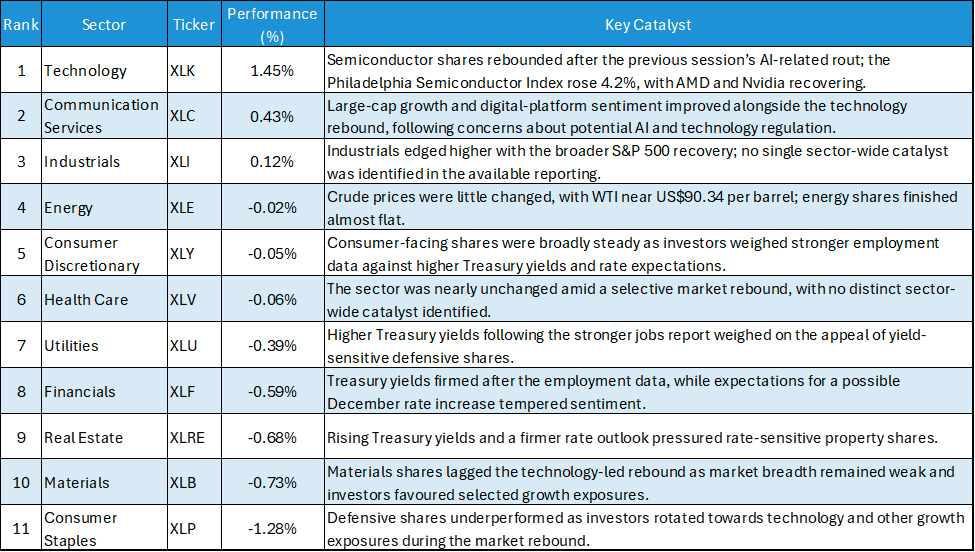
US sector performance on 6 November 2026 reflected a selective rebound following the previous session’s sharp technology-led sell-off. Technology (XLK) led the supplied sector group with a 1.45% gain, followed by Communication Services (XLC), up 0.43%, and Industrials (XLI), which advanced 0.12%. The remaining eight sector ETFs finished lower, with Consumer Staples (XLP) recording the largest decline at 1.28%. The Nasdaq Composite rose 1.1% and the S&P 500 gained 0.31%, while the Dow Jones Industrial Average slipped 0.46%. The rebound was concentrated in technology and semiconductor shares rather than reflecting a broad-based improvement in market breadth.
The technology recovery followed a severe AI-related sell-off on Thursday, when concerns about the potential regulatory direction of a Democratic-led Congress weighed on companies exposed to artificial-intelligence infrastructure. On Friday, semiconductor shares rebounded, with the Philadelphia Semiconductor index rising 4.2%. The October employment report also influenced sentiment: payrolls increased by 165,000, considerably above expectations of 65,000, and the unemployment rate fell to 4.1%. Stronger labour-market data supported equities in some areas but also lifted Treasury yields and expectations for a possible Federal Reserve rate increase in December.
Performance Breakdown by Sector
Technology Leads the Rebound
Technology (XLK) was the strongest sector, gaining 1.45% as investors returned to semiconductor and other technology shares following Thursday’s sharp sell-off. The Philadelphia Semiconductor Index advanced 4.2%, while Advanced Micro Devices rose 11.0% and Nvidia gained 2.8%. The rebound followed a period of intense selling driven by concerns that a Democratic-led Congress could pursue tighter regulation of artificial-intelligence businesses and data-centre development. Friday’s gains indicate that investors were willing to buy selected technology shares after the sharp decline, although the recovery did not erase the broader weakness recorded during the week.
Communication Services (XLC) added 0.43%, also benefiting from the improvement in sentiment towards large-cap growth and digital-platform companies. However, the sector’s modest gain compared with Technology suggests that the recovery was more concentrated in semiconductor and chip-related shares. Industrials (XLI) rose 0.12%, broadly tracking the modest advance in the S&P 500. The limited gains across these two sectors reinforce the view that Friday’s rebound was selective rather than a broad advance across cyclical industries.
Defensive and Rate-Sensitive Sectors Underperform
Consumer Staples (XLP) was the weakest sector, declining 1.28%, as investors shifted towards technology and growth-oriented exposures. Materials (XLB) fell 0.73%, while Real Estate (XLRE) lost 0.68%. The stronger-than-expected employment report contributed to a firmer interest-rate outlook, with Treasury yields rising after the release. This backdrop was less supportive for rate-sensitive property shares and other defensive investments. Utilities (XLU) also declined 0.39%, consistent with the pressure on yield-sensitive sectors.
Financials (XLF) fell 0.59%, while Health Care (XLV) and Consumer Discretionary (XLY) were almost unchanged, declining 0.06% and 0.05%, respectively. Energy (XLE) slipped just 0.02%, with crude prices holding near US$90.34 per barrel. The narrow range of changes in these three sectors contrasts with the stronger technology rebound and the more pronounced weakness in Consumer Staples. Overall, eight of the eleven supplied ETFs declined, indicating that the gains in the major technology sector were not accompanied by broad market participation.
Market Outlook and Risks
Near-term sector Leadership will depend on whether the technology rebound can extend beyond semiconductor shares, alongside developments in AI regulation, corporate Investment and the interest-rate outlook. The stronger October Payroll report may support expectations for resilient economic activity, but it also increases the risk that Monetary Policy remains restrictive for longer. Higher Treasury yields could continue to weigh on Real Estate, Utilities and other yield-sensitive sectors. Technology remains exposed to Volatility around AI infrastructure spending and regulatory policy, while Communication Services may respond to developments affecting major digital platforms. The Nasdaq and S&P 500 both recorded a fourth consecutive weekly decline despite Friday’s gains, highlighting that the latest rebound has yet to reverse the broader deterioration in market sentiment.
Bottom Line
Technology (XLK) led US sector performance on 6 November 2026, gaining 1.45% as semiconductor shares rebounded from the previous session’s steep sell-off. Communication Services (XLC) rose 0.43% and Industrials (XLI) added 0.12%, while the remaining eight sectors declined. Consumer Staples (XLP) was the weakest group, falling 1.28%, followed by Materials and Real Estate. Stronger-than-expected employment data supported the broader market recovery but also lifted Treasury yields and rate expectations. With the Nasdaq and S&P 500 still recording weekly losses, investors will monitor technology-sector follow-through, AI policy developments, labour-market data and Treasury yields to assess whether the rebound can broaden.


 Nov 09, 2026




 Please wait processing your request...