
 CA
 NZ
 UK
 AU
 IND

 US

 Share
 X (Formerly Twitter)
 Whatsapp
 Facebook
 LinkedIn
 Telegram
 Email This Article
 Copy Link
 Summarize with AI
 Chat GPT
 Perplexity
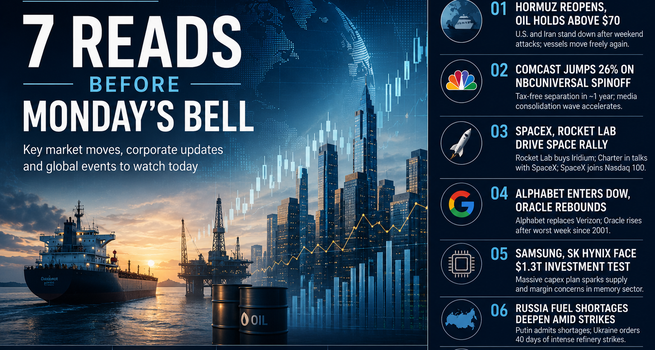
U.S. and Iran agreed to stand down after attacking each other over the weekend, reopening Hormuz to free vessel movement and lifting stock futures; WTI is back above $70. Comcast surged 26% pre-market on a tax-free spinoff of NBCUniversal and Sky into a separate publicly traded company. SpaceX joins the Nasdaq 100 on July 7; Alphabet joins the Dow today, replacing Verizon.
1. IRAN/HORMUZ: U.S. and Iran Agree to "Stand Down" After Weekend Attacks; Hormuz Vessels Moving Freely; Technical Talks Resume; WTI Back Above $70
America and Iran agreed to stand down after attacking each other over the weekend, with a U.S. official confirming both sides would continue technical talks on implementing the ceasefire framework and that vessels could now move freely through the Strait of Hormuz. Iran did not comment on the agreement. The stand-down follows Friday's Iranian attack on a Singapore-flagged cargo ship that halted Hormuz shipping entirely and threatened to collapse the MOU signed at Versailles on June 18. WTI trades at $70.00 (+1.11%) and Brent at $72.58 (+0.82%), recovering from Friday's sub-$70 close; stock futures are jumping on the de-escalation.
• Iran's silence on the stand-down agreement is analytically significant; a framework both sides are not publicly acknowledging is more fragile than one with joint confirmation, and the next Hormuz incident carries higher escalation risk than the first.
• WTI recovering to $70 after Friday's -3.3% drop on the cargo ship attack illustrates how completely oil is now trading on Hormuz incident frequency rather than underlying supply fundamentals.
• Risk note: if Iran conducts a second interdiction before the next formal negotiating session, the stand-down collapses and oil reprices above $80 with no ceasefire framework to contain the move.
2. COMCAST: +26% on NBCUniversal and Sky Spinoff; Tax-Free Separation in 1 Year; Cavanagh to Lead NBCUniversal; Media Consolidation Wave Accelerates
Comcast (NASDAQ: CMCSA) surged as much as 26% pre-market, after announcing a tax-free spinoff of NBCUniversal and Sky into a separate publicly traded company expected to complete in approximately 1 year. Comcast shareholders will own shares in both entities. Co-CEO Mike Cavanagh becomes CEO of NBCUniversal, which will incorporate theme parks, Universal film and television studios, NBC, Telemundo, Peacock, Bravo, and Sky; former CFO Michael Angelakis becomes CEO of the remaining Comcast, which retains cable, wireless, and business services. Comcast will hold up to 19.9% of NBCUniversal for up to 1 year post-completion. The announcement follows a 30% decline in Comcast's share price over the past 12 months. The separation arrives inside a broader consolidation wave: DOJ approved a $110 billion Paramount-Warner Bros. Discovery deal earlier this month and Fox entered a $22 billion agreement to acquire Roku.
• The market's 23% reward reflects how deeply Comcast's cable and media businesses had been discounting each other inside a single conglomerate; the spinoff unlocks 2 independently valued companies from one depressed multiple.
• The remaining Comcast becomes a pure-play connectivity business; NBCUniversal combines broadcast, streaming, theme parks, and Sky into a focused global media vehicle, a structure the market values at higher multiples than diversified conglomerates.
• Risk note: the transaction requires board and regulatory approvals in a media consolidation environment where DOJ scrutiny has been active; any regulatory challenge extends the timeline and reintroduces conglomerate discount risk.
3. SPACE/TECH: Rocket Lab +10% on Iridium Acquisition; Charter +20% on SpaceX Mobile Talks; SpaceX Joins Nasdaq 100 July 7; $25B Debt Sale in Market
Rocket Lab (NASDAQ: RKLB) jumped more than 10% after announcing it will acquire Iridium Communications (NASDAQ: IRDM), which surged more than 20%; the merger combines Rocket Lab's launch capabilities with Iridium's global satellite communications network. Charter Communications (NASDAQ: CHTR) soared nearly 20% on a report that Charter and SpaceX (NASDAQ: SPCX) held exclusive talks on a consumer phone product that would run SpaceX mobile traffic through Charter's ground internet infrastructure. SpaceX rose 2% after Nasdaq announced Friday it will join the Nasdaq 100 before July 7 trading, creating mandatory ETF buying demand. SpaceX separately has a $25 billion debt sale in the market, raising diversification questions for fixed income investors.
• Rocket Lab-Iridium creates a vertically integrated space infrastructure company combining launch with an operational satellite constellation, competing on a different dimension than pure-play launch providers.
• Charter's 20% move prices a structural shift in U.S. wireless competition; if the SpaceX deal proceeds, it creates a fourth major consumer mobile option backed by both satellite and ground infrastructure simultaneously.
• Risk note: SpaceX's $25 billion debt sale, Nasdaq 100 inclusion, and Charter partnership are 3 simultaneous capital markets events for a single company in the same week; execution risk across all 3 is elevated.
4. INDEX/MARKET STRUCTURE: Alphabet Joins Dow Jones Industrial Average Today, Replacing Verizon; Verizon Projects $700M-$800M Q2 Loss; Oracle +3% After Worst Week Since 2001
Alphabet (NASDAQ: GOOGL) joins the Dow Jones Industrial Average at Monday's open, replacing Verizon (NYSE: VZ) on the 30-member blue chip index; shares rose about 1% pre-market. Verizon fell 0.5% after projecting second-quarter losses of $700 million to $800 million, driven by classifying businesses contributed to a joint venture with BT Group as held for sale. Oracle (NYSE: ORCL) rose 3% pre-market, beginning a rebound from its worst week since 2001 after shares fell 19% last week on concerns about its debt load and whether its AI infrastructure bet will generate returns at the scale its capital commitments require.
• Alphabet's Dow inclusion marks a generational index shift: the 30-member blue chip index now contains the company that defines digital advertising, AI search, and cloud infrastructure, displacing the company that defined 20th-century telecommunications.
• Verizon's $700-800M Q2 loss projection is the mechanical explanation for its Dow exit; the BT joint venture held-for-sale classification compresses near-term reported earnings and accelerated the timing of its index removal.
• Risk note: Oracle's 3% pre-market rebound does not resolve the question the market asked last week; if guidance confirms the AI infrastructure bet is not generating returns at pace with capital deployment, the -19% extends.
5. SEMICONDUCTORS: Samsung and SK Hynix Fall on Expected $1.3T Investment Announcement; Memory Sector Digests Last Week's Rout
Samsung Electronics and SK Hynix fell Monday on expectations that both South Korean firms will announce investments worth 2 quadrillion won ($1.3 trillion) over the next 10 years for new chipmaking plants and data centres. The counterintuitive selloff reflects the market reading a decade-long capital commitment as near-term dilution rather than long-term capacity validation. The 2 firms dominate the global high-bandwidth memory market and together represent more than 40% of South Korea's KOSPI benchmark. The move extends a week in which the memory sector ran a full cycle: Micron's blowout earnings Thursday, Apple and Microsoft price hike selloffs the same day, and Micron's -4.5% reversal Friday.
• A $1.3 trillion investment commitment over 10 years is among the largest single-industry capital allocation announcements in history; the market's negative reaction reflects concern that supply expansion will compress the HBM premium that has driven both stocks' 280%+ gains in 2026.
• The simultaneous selloff in both Samsung and SK Hynix confirms the market is reading the investment as sector-wide supply risk rather than a competitive advantage for either firm individually.
• Risk note: if the formal announcement includes specific HBM capacity targets, the market will price the implied supply increase against current demand assumptions and compress multiples further.
6. RUSSIA/UKRAINE: Putin Admits Fuel Shortages From Ukrainian Refinery Strikes; Calls Problem "Not Critical"; Zelensky Orders 40 Days of Intense Strikes
Vladimir Putin publicly acknowledged that Russia is facing fuel shortages following Ukrainian strikes on Russian refineries, a rare admission of battlefield impact, while characterising the problem as "not critical" and stating forces would continue attacking Ukraine. The admission arrives as President Zelensky last week ordered 40 days of intense strikes on Russia to press Putin toward ending the war. The concurrent escalation in Ukraine runs against the de-escalation arc in Iran; markets are navigating 2 simultaneous geopolitical trajectories with opposing oil price implications: Hormuz reopening pushes WTI down, while Russian refinery strikes introduce European energy supply risk.
• Putin's public admission of fuel shortages is significant regardless of the "not critical" framing; Russian leaders historically minimise battlefield constraints publicly while addressing them operationally, making the admission itself the signal.
• Zelensky's 40-day intense strike order on Russian refineries, if sustained, creates structural pressure on Russian fuel production and has read-across for European natural gas supply via pipeline dependency.
• Risk note: if Russian fuel shortages reach operationally critical levels before the 40-day window closes, the pressure on Putin to negotiate increases sharply, but so does the risk of escalatory response targeting Ukrainian infrastructure.
7. PRE-MARKET SETUP: Friday Close Flat; Futures Jumping on Iran Stand-Down; Martin Marietta -3% on $13.5B Lhoist Deal; TeraWulf +3% on Citi Buy; Gold -1.19%
Friday closed flat: DJIA -0.09% at 51,876.11, S&P 500 -0.05% at 7,354.02, NASDAQ -0.24% at 25,297.618, NASDAQ 100 -1.09% at 29,118.238. Monday pre-market: futures are jumping on the Iran stand-down. Martin Marietta Materials (NYSE: MLM) slipped nearly 3% after announcing a $13.5 billion all-cash acquisition of Lhoist North America, expanding its industrial minerals portfolio. TeraWulf (NASDAQ: WULF) rose 3% after Citi initiated with a buy rating, citing its work addressing data center power delivery bottlenecks as an AI infrastructure play. Gold trades at $4,047.60 (-1.19%) as Fed rate-hike bets weigh despite Gulf tensions.
• Martin Marietta's -3% reaction to a $13.5 billion all-cash deal follows the week's pattern: large M&A announcements are being read as capital deployment risk rather than strategic value creation in the current rate environment.
• Gold falling despite an active Hormuz incident over the weekend confirms the dominant price driver is the Fed rate path; Warsh's hawkish debut last week has reset the real yield expectation that underwrites gold's floor.
• Risk note: if the Iran stand-down holds through the week and PCE at 4.1% is confirmed as non-decelerating, rate-hike probability rises further and gold extends its decline toward the $4,000 level tested last Thursday.

 Nov 16, 2026




 Please wait processing your request...