
 CA
 NZ
 UK
 AU
 IND

 US

 Share
 X (Formerly Twitter)
 Whatsapp
 Facebook
 LinkedIn
 Telegram
 Email This Article
 Copy Link
 Summarize with AI
 Chat GPT
 Perplexity

Key Highlights
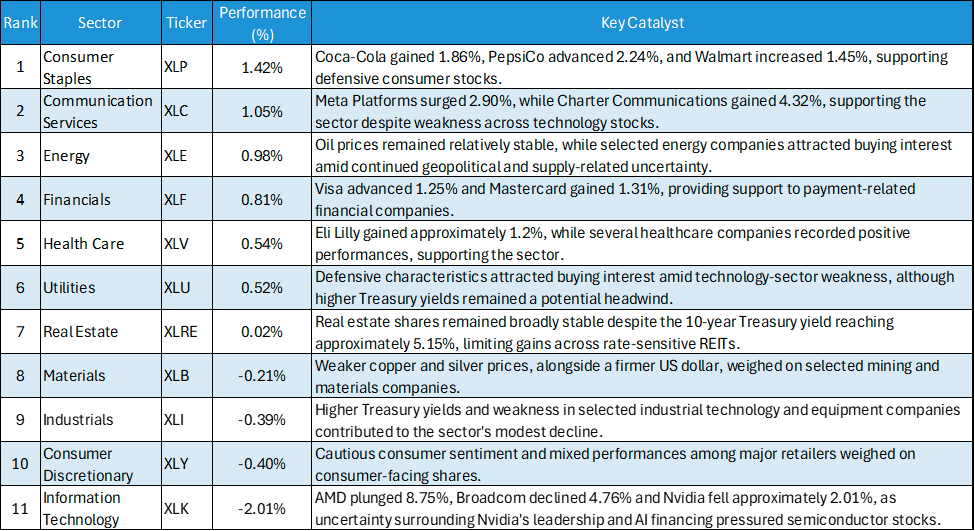
- Consumer Staples Lead Sector Gains: XLP advanced 1.42%, recording the strongest performance among the eleven supplied sector ETFs, supported by gains in Coca-Cola, PepsiCo and Walmart.
- Communication Services and Energy Advance: XLC gained 1.05%, while XLE increased 0.98%, reflecting strength in selected large-cap communication companies and energy producers.
- Financials and Healthcare Strengthen: XLF advanced 0.81%, while XLV gained 0.54%, supported by positive performances from major payment companies and pharmaceutical stocks.
- Defensive Sectors Outperform: Utilities (XLU) increased 0.52%, while Real Estate (XLRE) edged higher by 0.02%, demonstrating relative resilience.
- Technology Records the Largest Decline: XLK fell 2.01%, pressured by continued uncertainty surrounding Nvidia's Leadership transition and substantial selling across semiconductor and artificial intelligence-related companies.
- Wall Street Finishes Mixed: The S&P 500 declined 0.40%, while the Nasdaq Composite lost 0.91%. The Dow Jones Industrial Average advanced 0.10%, reflecting divergent performances across major companies.
US sector performance on Friday, 13 November 2026, reflected a predominantly positive but uneven trading session, with seven of the eleven supplied sector ETFs finishing higher. Consumer Staples (XLP) led the market with a 1.42% advance, followed by Communication Services (XLC), which gained 1.05%, and Energy (XLE), which increased 0.98%. Financials and Healthcare also recorded moderate gains. However, Technology (XLK) experienced substantial selling pressure, declining 2.01% and becoming the weakest-performing sector. Materials, Industrials and Consumer Discretionary also finished lower, although their losses remained relatively modest.
The broader US Equity market delivered mixed results. The S&P 500 declined 0.40% to 7,561.67, while the Nasdaq Composite fell 0.91% to 25,136.27. In contrast, the Dow Jones Industrial Average advanced 0.10% to 52,347.55. Technology-related weakness, particularly across semiconductor companies, weighed on the Nasdaq, while gains in defensive consumer companies and selected financial stocks provided support elsewhere. The 10-year US Treasury Yield increased to approximately 5.15%, maintaining pressure on interest-rate-sensitive investments.
Performance Breakdown by Sector
Consumer Staples and Communication Services Lead Sector Gains
Consumer Staples (XLP) was the strongest-performing sector, advancing 1.42% as investors favoured established consumer businesses amid uncertainty across technology markets. Coca-Cola gained 1.86%, while PepsiCo advanced 2.24%. Walmart also increased 1.45%, demonstrating continued investor interest in companies with relatively defensive Earnings characteristics. Procter & Gamble gained 1.05%, while Costco advanced 1.28%, with both companies reaching new 52-week highs during the session. The broad-based strength highlighted the relative attractiveness of consumer staples during a period of elevated market volatility.
Communication Services (XLC) advanced 1.05%, supported by strong performances among selected large-cap companies. Meta Platforms was a significant contributor, surging 2.90%, while Charter Communications gained 4.32%. The positive performance demonstrated that weakness across artificial intelligence-related companies did not extend uniformly to the entire communication services industry. However, continued uncertainty surrounding technology infrastructure Investment and the AI sector remained a consideration for investors.
Energy (XLE) increased 0.98%, despite relatively limited movements in international Crude Oil prices. West Texas Intermediate crude finished near US$88.92 per barrel, while Brent Crude remained around US$95.84. The sector's positive performance reflected buying interest in selected energy producers, although the absence of a substantial oil-price advance suggested that company-specific factors also contributed to the gains.
Financials, Healthcare and Utilities Record Moderate Gains
Financials (XLF) advanced 0.81%, supported by strength across major payment companies. Visa gained approximately 1.25%, while Mastercard increased 1.31%. These performances demonstrated resilience among established financial services companies despite rising Treasury yields and uncertainty surrounding the Federal Reserve's future monetary policy. However, higher borrowing costs could continue influencing valuations across banking and other interest-rate-sensitive financial businesses.
Health Care (XLV) gained 0.54%, supported by positive performances among selected pharmaceutical and medical companies. Eli Lilly advanced approximately 1.19%, while Edwards Lifesciences gained 1.28%. The healthcare sector also benefited from relatively defensive investment characteristics, although the broader market environment remained challenging.
Utilities (XLU) increased 0.52%, reflecting renewed interest in defensive income-oriented companies. Nevertheless, the 10-year Treasury yield reaching approximately 5.15% remained a potential headwind, as higher government bond yields can reduce the relative attractiveness of Utility dividends. Real Estate (XLRE) recorded a marginal 0.02% advance, indicating relatively stable trading despite continued pressure from elevated financing costs and bond yields.
Materials, Industrials and Consumer Discretionary Underperform
Materials (XLB) declined 0.21%, reflecting relatively modest selling pressure across Mining and commodity-related companies. Weaker copper and silver prices contributed to cautious sentiment, while a firmer US dollar and elevated Treasury yields remained challenging for commodity-linked investments. The relatively small decline suggested that selling pressure was contained compared with the substantial weakness experienced across technology stocks.
Industrials (XLI) decreased 0.39%, reflecting mixed performances among economically sensitive companies. Higher Treasury yields increased concerns about financing costs and the outlook for industrial investment. Weakness in selected technology infrastructure and equipment-related companies also contributed to the sector's negative performance. The decline remained relatively modest, suggesting that selling pressure was not widespread across all industrial businesses.
Consumer Discretionary (XLY) fell 0.40%, reflecting cautious investor sentiment towards economically sensitive companies. Although selected retailers demonstrated resilience, broader concerns about consumer spending, borrowing costs and the economic outlook limited buying interest. The sector's underperformance contrasted with the stronger performance of Consumer Staples, highlighting investors' preference for established businesses with relatively defensive Demand characteristics.
Technology Faces Heavy Selling Pressure
Information Technology (XLK) was the weakest-performing sector, declining 2.01% amid continued uncertainty surrounding Nvidia and the broader artificial intelligence industry. Nvidia's leadership transition remained a major concern following the resignation of chief executive Jensen Huang, raising questions about the company's strategic direction and its central role in the AI investment cycle.
Semiconductor companies experienced particularly substantial selling pressure. Advanced Micro Devices plunged 8.75%, surrendering part of its substantial gains from the preceding sessions. Broadcom declined 4.76%, while Nvidia fell approximately 2.01%. Micron Technology also lost 2.52%, reflecting broader weakness across semiconductor and memory-related companies.
Additional pressure came from AI infrastructure providers and technology equipment manufacturers. Dell Technologies declined 7.18% following reports concerning servers containing restricted Nvidia chips being traced to a data centre in Shanghai. Cisco Systems also fell 6.24%, despite reporting record quarterly revenue, as investors remained concerned about Margin pressures and the outlook for its AI-related business.
The semiconductor sell-off highlighted growing uncertainty surrounding AI infrastructure financing, Capital Expenditure and the sustainability of recent valuations. Consequently, Information Technology underperformed every other supplied sector ETF, contrasting sharply with the gains recorded across defensive consumer and communication services companies.
Bottom Line
Consumer Staples (XLP) led US sector performance on 13 November 2026, advancing 1.42%, followed by Communication Services (XLC) and Energy (XLE), which gained 1.05% and 0.98%, respectively. Financials, Healthcare and Utilities also recorded positive performances, while Real Estate remained virtually unchanged. In contrast, Materials, Industrials and Consumer Discretionary finished modestly lower. Information Technology (XLK) was the weakest sector, declining 2.01% amid substantial selling across semiconductor companies and continued uncertainty surrounding Nvidia's leadership transition and the AI investment cycle. Overall, the session reflected a rotation towards defensive consumer businesses and selected large-cap companies, while technology-related investments experienced renewed pressure. Investors will continue monitoring developments across the AI industry, Treasury yields, corporate earnings and consumer spending to assess the sustainability of the recent sector rotation.


 Nov 16, 2026



 Please wait processing your request...