
 CA
 NZ
 UK
 AU
 IND

 US

 Share
 X (Formerly Twitter)
 Whatsapp
 Facebook
 LinkedIn
 Telegram
 Email This Article
 Copy Link
 Summarize with AI
 Chat GPT
 Perplexity
Index Update
US equities closed higher on Tuesday, led by a strong semiconductor rebound, with the S&P 500 gaining 0.9%, the Nasdaq 100 rising 1.9% and the Dow adding 385 points. Encouraging Asian export data and optimism around AI-chip demand drove sharp gains in Micron, SanDisk, Intel, AMD and Nvidia ahead of Alphabet’s earnings. Broader markets remained resilient despite escalating US–Iran tensions and higher oil prices, while elevated Treasury yields constrained financial stocks. GM advanced after reporting earnings, whereas Charles Schwab declined following an earnings miss.
Market Movers
Among the top-performing stocks of the session Utz Brands Inc. surged 88.72%, while T3 Defense Inc. rallied 54.23%. On the losing side, Zhengye Biotechnology Holding Limited. fell 64.42%, while Lisata Therapeutics, Inc. declined 36.45%, making them the weakest performers during the trading day.
Commodities Update
Crude oil prices surged around 4% on Wednesday, with WTI exceeding USD 87 per barrel and Brent rising above USD 94, as escalating US–Iran tensions intensified concerns over global supply disruptions. The rally followed an 11th consecutive night of US strikes on Iranian military facilities, renewed risks to shipping through the Strait of Hormuz, Houthi threats against Red Sea trade routes, and attacks on the Caspian Pipeline Consortium terminal in the Black Sea. Although Washington remains open to diplomacy, uncertainty over Iran’s nuclear activities, regional militant support, and freedom of navigation kept the geopolitical risk premium elevated.
Gold rose above USD 4,100 per ounce and silver surpassed USD 59 on Wednesday as escalating Middle East tensions, disruptions to key shipping routes and attacks on Black Sea energy infrastructure strengthened safe-haven demand. Rising oil prices also renewed inflation and interest-rate concerns, while slowing US private-sector hiring indicated weaker labour-market momentum. Markets largely expect the Federal Reserve to hold rates steady next week, although the probability of a September rate hike has climbed above 55%.
Macro Updates
US Mortgage Applications Rebound Despite Higher Rates
US mortgage applications rose 1.9% in the week ended July 17, recovering from two consecutive weekly declines despite the benchmark 30-year mortgage rate reaching an 11-month high. Home-purchase applications increased 6% as sellers showed greater willingness to reduce prices, while refinancing applications fell 2% due to their higher sensitivity to rising borrowing costs. Longer-term yields were pressured by renewed Middle East energy-supply disruptions and higher fuel prices.
US Plans Phased Tariffs to Reshore Generic Drug Production
The US government plans to retain a zero tariff on imported generic drugs for two years from August 1, before raising the rate to 100% in August 2028 and 200% the following year. The phased policy is intended to encourage drugmakers to establish domestic manufacturing facilities, while companies that continue producing overseas would face significantly higher import costs. Tariffs on patented and branded medicines would remain unchanged.
Bonds Commentary
The US 10-year Treasury yield remained near a two-month high of 4.63% as escalating US–Iran tensions, Red Sea shipping disruptions and attacks on Black Sea energy infrastructure pushed oil prices higher, intensifying inflation and interest-rate concerns. Meanwhile, slowing private-sector hiring indicated weakening labour-market momentum. Markets expect the Federal Reserve to hold rates steady next week but assign more than a 55% probability to a September rate hike.
Futures Update
US stock futures declined on Wednesday as renewed weakness in AI and semiconductor stocks, escalating US–Iran tensions, higher oil prices and rising bond yields weighed on sentiment. Nasdaq futures fell 1.5%, while S&P 500 and Dow futures slipped 0.3%, with Micron, Intel, SanDisk and Nvidia retreating amid uncertainty over hyperscaler hardware spending. Alphabet and Tesla also declined ahead of their earnings releases, while financial stocks weakened as concerns over energy-driven inflation intensified.
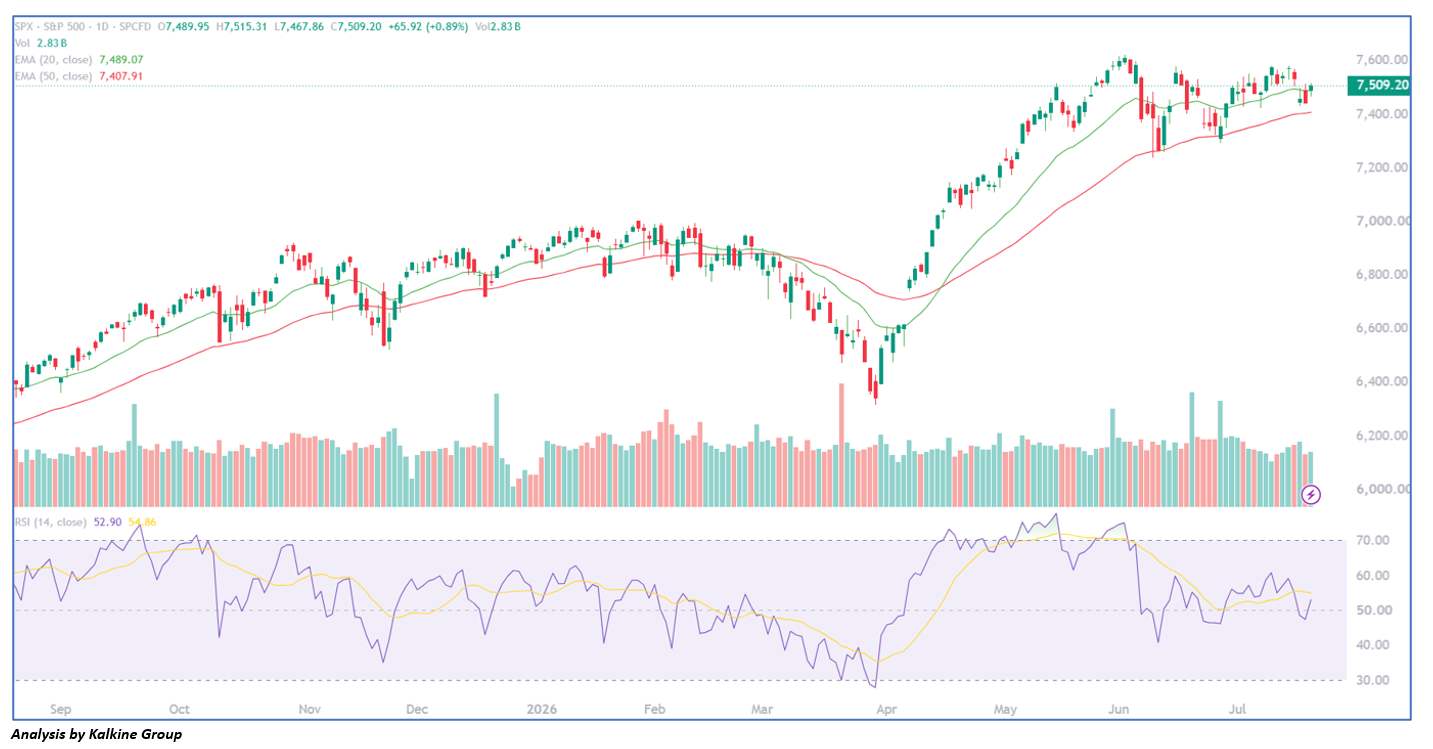
After several sessions of weakness, U.S. stocks rebounded strongly on Tuesday, with the major averages posting solid gains and the Nasdaq leading the advance. Although the indices pulled back from their intraday highs by the close, they still ended the session firmly in positive territory. From a technical perspective, the S&P 500 retains a neutral intraday outlook, holding above both its 20-day EMA (7,489) and 50-day EMA (7,408), keeping the broader trend intact. However, the index continues to consolidate within a narrow range below the 7,580-7,600 resistance zone, reflecting the absence of a decisive directional move. Meanwhile, the 14-day RSI near 53 indicates balanced momentum, reinforcing the current sideways bias. A sustained breakout above 7,560-7,600 would strengthen the bullish case and open the door for further upside, while a drop below the 20-day EMA around 7,490 could lead to a pullback toward the 50-day EMA near 7,410. Until either of these levels is decisively breached, the index is likely to remain range-bound with a neutral intraday bias.

 Nov 05, 2026

 Please wait processing your request...