
 CA
 NZ
 UK
 AU
 IND

 US

 Share
 X (Formerly Twitter)
 Whatsapp
 Facebook
 LinkedIn
 Telegram
 Email This Article
 Copy Link
 Summarize with AI
 Chat GPT
 Perplexity
Key Highlights
- The 15-stock dividend universe spans blue-chip operators, a casino-focused equity REIT, mortgage REITs, tanker shippers, and specialty lenders.
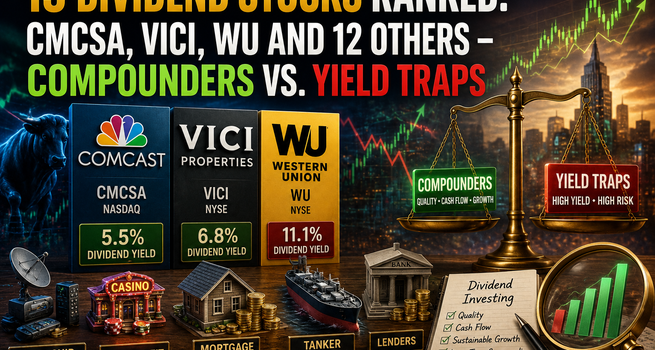
- NASDAQ: CMCSA trades at a 4.7x P/E with a 5.5% yield, while NYSE: WU carries an 11.1% yield against a 49% trailing EPS decline.
- Mortgage REITs including NYSE: NLY, NASDAQ: AGNC, and NYSE: ARR post yields from 10.9% to 17.5%, reflecting leveraged spread risk rather than moat quality.
- NYSE: VICI's 6.8% yield and NYSE: HTGC's 9.9% yield stand out as the most durable, cash-flow-backed distributions in the group.
A high dividend yield is rarely a gift from the market. More often, it is the market's way of signaling that something about the business carries meaningfully more risk than the yield figure alone lets on. A disciplined approach to dividend investing starts not with the yield itself but with the quality of the underlying business: can it earn a high return on capital, reinvest that capital at similarly attractive rates, and keep doing so for years without needing the market's cooperation? Dividend investing, done properly, is really just quality investing viewed through a cash-flow lens.
The universe of 15 names covered here spans blue-chip operating businesses, one casino-focused equity REIT, five mortgage REITs, three tanker-shipping cyclicals, and three consumer and specialty lenders. The sector tags across this list, Finance, Consumer Services, Transportation, and Process Industries, hint at just how varied this basket is despite its modest size. The goal below is not to rank these 15 stocks by which yield is the juiciest, but to separate the ones compounding shareholder capital from the ones that are simply compensating investors for a specific, identifiable risk.
The method for each name is consistent: triangulate the trailing price-to-earnings ratio, the trailing EPS growth rate, and the dividend yield against one another, rather than looking at any single number in isolation. A low P/E paired with strong, repeatable EPS growth is the profile of a genuine bargain. A low P/E paired with collapsing or wildly erratic EPS, however, is usually the market correctly pricing in risk that a yield table alone will never show. Keep that triangulation in mind while going through the list, because it is the thread that ties every one of these 15 names together.
It is worth noting upfront just how concentrated this particular basket is in cyclical and leveraged business models. Of the 15 names, five are mortgage REITs whose earnings are a direct function of interest-rate spreads, three are tanker shippers whose earnings track a global freight-rate cycle, and three more are consumer or mortgage lenders whose earnings move with credit and origination cycles. Only Comcast and VICI Properties operate businesses with genuinely long-duration, contractually protected cash flows. That skew matters: an investor who simply ranked this list by yield, without understanding which businesses are cyclical and which are structurally protected, would end up overweight exactly the names most exposed to a reversal in interest rates, credit conditions, or freight demand.
Blue-Chip Operating Franchises
Comcast Corporation (NASDAQ: CMCSA) is the most recognisable name on this list, and at a trailing price-to-earnings ratio of just 4.7x against diluted EPS of $5.09 (up almost 25% year-on-year) and a market capitalisation of roughly $85 billion, the valuation looks almost too cheap to be true. That is usually a sign of the market pricing in structural decay rather than offering a genuine bargain. Comcast's core cable and broadband franchise remains a formidable cash generator, but cord-cutting, NBCUniversal's uneven media economics, and the ongoing streaming investment cycle mean the earnings base is not as clean as the headline multiple suggests. The 5.5% yield is comfortably covered by free cash flow today; the real question is whether that cash flow is still growing five years out, or is merely being defended.
Western Union Company (NYSE: WU) is the more cautionary tale in this cohort. A single-digit P/E of 6.2x might tempt a value investor, but the trailing EPS decline of nearly 49% is the real story, and an 11.1% yield sitting atop collapsing earnings is a classic yield trap in the making. Fintech remittance players have eaten into Western Union's core agent-network business for a decade, and a payout ratio built on a shrinking earnings base is not sustainable in the way a durable compounder's dividend is. This is not a yield worth touching without first underwriting whether the earnings base has actually stabilised.
Cal-Maine Foods (NASDAQ: CALM), the country's largest egg producer, sits in an unusual spot: a commodity business that briefly enjoyed supernormal profits when avian-flu-driven egg prices spiked, and is now seeing EPS decline 29% off that high base even as the trailing P/E of 6.1x looks statistically cheap. Egg producers have no pricing power of their own, they are price-takers in a commodity cycle, so the 5.5% yield here should be read as a cyclical distribution rather than a durable compounding dividend. This is a business to own opportunistically around the cycle, not to hold as an anchor income position.
Taken together, these three names share a curious feature: all trade at single-digit trailing P/E multiples of roughly 4.7x to 6.2x, and all three carry yields between 5.5% and 11.1%. On a naive value screen, they would look almost identical. Once the P/E is triangulated against the EPS trend, however, the group splits cleanly: Comcast's earnings are growing and its cash generation is real, even if the growth outlook is debated; Western Union's earnings are shrinking sharply, making its yield the riskiest of the three; and Cal-Maine's earnings are simply normalising after a commodity price spike, making its current multiple more a function of where the egg cycle sits than a statement about business quality.
Looked at through a market-capitalisation lens, this trio also spans very different scales. Comcast's roughly $85 billion market value places it firmly among mega-cap franchises, while Western Union's roughly $2.6 billion and Cal-Maine Foods' roughly $4.1 billion market capitalisations put both in small- to mid-cap territory, where earnings swings tend to move the share price far more violently than they would for a business Comcast's size. That scale difference matters for a dividend investor: a wobble in Cal-Maine's egg pricing or Western Union's remittance volumes can move the stock, and therefore the perceived sustainability of its payout, far more sharply than a similar percentage wobble would at Comcast.
REITs: Two Very Different Animals
Real estate names split into two very different categories here, and conflating them is the single biggest mistake retail dividend investors make.
VICI Properties (NYSE: VICI), the triple-net-lease landlord to casino operators such as Caesars and MGM, is the cleanest business in the property bucket. A 9.1x P/E, 16.25% EPS growth, and a 6.8% yield reflect a REIT with long-duration, contractually escalating leases against irreplaceable gaming real estate. This is about as close to a bond-with-growth as commercial real estate gets, and it is the one REIT on this list worth holding through a full cycle.
The mortgage REITs, Annaly Capital Management (NYSE: NLY), AGNC Investment (NASDAQ: AGNC), Dynex Capital (NYSE: DX), Rithm Capital (NYSE: RITM), and ARMOUR Residential REIT (NYSE: ARR), are an entirely different proposition. These are leveraged bets on the spread between short-term borrowing costs and long-duration mortgage assets, and their eye-watering yields of 10.9% to 17.5% are compensation for genuine interest-rate and prepayment risk, not a reward for a wide moat. Look closely at the EPS growth numbers here: Annaly's 237%, AGNC's 487%, and Dynex's 235% are not signs of a business firing on all cylinders, they are base-effect rebounds from a dreadful prior year when rate volatility hammered book values across the sector. Rithm Capital's EPS actually fell almost 9% even as its yield sits at 10.9%, which is the more honest picture of where this cohort's earnings power currently stands. ARMOUR Residential (NYSE: ARR), yielding 17.5%, shows a similar pattern, with a prior-year base too thin to even compute a meaningful growth rate. Mortgage REITs are best understood as trading instruments for institutions that can hedge duration risk professionally, not as compounding vehicles for a retail dividend portfolio. Position sizes here should reflect how binary the outcomes can be.
The structural distinction between VICI Properties (NYSE: VICI) on one hand and the five mortgage REITs on the other is really a distinction between owning real assets and owning a spread. VICI earns rent on physical casino real estate under leases running decades into the future; the mortgage REITs earn the difference between what they pay to borrow and what their mortgage-backed securities yield, a spread that can compress to nothing or turn negative in a matter of quarters when rates move sharply, as investors in this sector learned first-hand in 2022 and again in the volatility since. A dividend backed by a lease is a fundamentally different animal from a dividend backed by a spread, even when the yields on offer look superficially similar on a screener.
For a dividend portfolio, the practical implication is straightforward: an allocation to VICI Properties (NYSE: VICI) can reasonably sit alongside other long-duration income holdings as a core position, while allocations to the five mortgage REITs are better sized as a basket, spread across Annaly Capital Management (NYSE: NLY), AGNC Investment (NASDAQ: AGNC), Dynex Capital (NYSE: DX), Rithm Capital (NYSE: RITM), and ARMOUR Residential REIT (NYSE: ARR), rather than concentrated in any single name, given how similarly exposed all five are to the same interest-rate and spread dynamics.
It is also worth remembering that this entire mortgage REIT cohort has been through one of the sharpest rate-driven drawdowns in a generation over the past several years, and the current run of triple-digit percentage EPS growth across Annaly Capital Management (NYSE: NLY), AGNC Investment (NASDAQ: AGNC), and Dynex Capital (NYSE: DX) needs to be read against that backdrop. Book values across the sector were hammered as long-duration agency mortgage-backed securities lost value while borrowing costs rose sharply, and the current earnings rebound reflects a partial normalisation of that spread rather than a new, structurally higher level of profitability. Investors should size positions with the knowledge that the next rate shock, in either direction, could just as easily reverse the current recovery.
Tanker Shipping: Riding a Cyclical Windfall
Frontline (NYSE: FRO), International Seaways (NYSE: INSW), and DHT Holdings (NYSE: DHT) are all crude and product tanker operators riding an extraordinarily strong freight-rate cycle, evident in EPS growth of 160%, 70%, and 86% respectively, alongside yields between 8% and 9.2%. Shipping is a textbook cyclical industry: rates are a function of vessel supply, which takes years to expand via new orders, against demand, which moves with global oil trade patterns and, lately, with the rerouting of tanker traffic around geopolitical chokepoints. At 8-9x trailing earnings, these stocks are not expensive on paper, but trailing numbers in shipping are close to meaningless, what matters is where the freight-rate cycle currently stands. Tanker owners typically pay out a large share of net income as dividends specifically because management teams know earnings are cyclical and don't want to over-commit capital into new vessels at the top of a cycle. The current yields are best treated as a share of a cyclical windfall, not as a sustainable income stream to underwrite retirement planning.
The global tanker order book has been historically thin for much of the past several years, a legacy of the newbuild drought that followed the 2015-2020 shipping downturn, and that scarcity of new vessel supply is a large part of why day rates, and therefore dividends, have stayed elevated across Frontline (NYSE: FRO), International Seaways (NYSE: INSW), and DHT Holdings (NYSE: DHT). The risk for a dividend investor is not that these companies mismanage their existing fleets, but that a wave of newbuild deliveries a few years out, combined with any moderation in global oil trade disruption, could compress day rates and, with them, distributions that are explicitly tied to a variable payout formula rather than a fixed quarterly dividend.
Demand-side dynamics have added a further layer of support to tanker day rates recently, as the rerouting of crude and product cargoes around geopolitical flashpoints has lengthened average voyage distances and, with them, effective vessel demand even without any increase in the physical volume of oil being shipped. This is a reminder that today's elevated payouts across Frontline (NYSE: FRO), International Seaways (NYSE: INSW), and DHT Holdings (NYSE: DHT) reflect a specific, and potentially temporary, combination of thin vessel supply and disrupted trade routes, rather than a permanent re-rating of the shipping cycle. Investors underwriting these yields as durable income should be comfortable with the idea that the dividend itself is designed to shrink once rates normalise.
Consumer and Specialty Finance
OneMain Holdings (NYSE: OMF) is a subprime and near-prime consumer lender with EPS up 42% and a P/E of 8.9x, translating into a 7% yield. Consumer lenders live and die by credit losses, and the fact that EPS is growing this fast in the current rate environment suggests OneMain's underwriting has held up reasonably well; but this is a business where the tail risk sits in the loan book, not on the income statement, so charge-off trends deserve scrutiny before treating the dividend as durable.
UWM Holdings (NYSE: UWMC), the wholesale mortgage originator, carries the single highest yield of any operating company on this list at 21%. Mortgage origination volumes are almost entirely a function of interest-rate direction, and a company paying out over a fifth of its share price annually is signalling either exceptional confidence in a refinancing wave, or a payout policy that will not survive a weak origination year. This falls firmly under 'trading yield', not 'compounding yield'.
Hercules Capital (NYSE: HTGC), a business development company (BDC) lending to venture-backed technology and life sciences firms, is a cleaner story: EPS growth of 33%, a 9x P/E, and a 9.9% yield. BDCs are structurally required to distribute the bulk of taxable income, so the high yield here is a function of the vehicle's tax structure rather than distress. The real underwriting question is portfolio credit quality across Hercules' venture-lending book, which by nature carries higher risk than a traditional commercial bank loan portfolio.
Ranked purely on the durability of the underlying earnings stream, this trio also splits cleanly. Hercules Capital's (NYSE: HTGC) BDC structure and diversified venture-lending book make its 9.9% yield the most institutionally predictable of the three, since the payout ratio is dictated by tax rules rather than management discretion. OneMain Holdings' (NYSE: OMF) 7% yield sits on a consumer loan book that is more sensitive to the economic cycle, but the company has a multi-decade operating history through prior credit cycles. UWM Holdings' (NYSE: UWMC) 21% yield remains the outlier of the group, a payout tied tightly to mortgage origination volume that could look very different in a higher-for-longer rate environment.
Market capitalisation again tells part of the story here: Hercules Capital and OneMain Holdings both carry market values in the multi-billion-dollar range, giving them scale and diversification across thousands of individual loans or portfolio companies, while UWM Holdings, though itself a multi-billion-dollar business, derives essentially all of its earnings from a single, undiversified activity, wholesale mortgage origination. A single-activity business model paying out the highest yield in the group is precisely the combination that warrants the most scrutiny before sizing a position for income purposes.
Closing Thoughts
Stepping back, the pattern across all 15 names is consistent with what tends to hold across markets over long stretches: the highest yields on any screen are rarely attached to the highest-quality businesses. UWM Holdings' (NYSE: UWMC) 21% yield and ARMOUR Residential's (NYSE: ARR) 17.5% sit at the top of this list, and each is a leveraged or cyclical payout rather than a dividend backed by a wide-moat franchise compounding free cash flow. At the other end, VICI Properties' (NYSE: VICI) 6.8% yield, backed by contractual, escalating rental income, and Hercules Capital's (NYSE: HTGC) 9.9% yield, backed by a regulatory requirement to distribute taxable BDC income, are the two names on this list that qualify as genuinely durable income, alongside a smaller allocation to Comcast (NASDAQ: CMCSA) for its sheer cash-generating scale despite the structural concerns around its core business.
For readers building a dividend portfolio, the practical takeaway is to rank these 15 names not by yield, but by the quality and predictability of the cash flow funding that yield. Ask three questions of every name on this list. First, is the payout funded by genuine free cash flow, or by balance-sheet leverage or a cyclical windfall? Second, is the earnings base actually growing, or is the reported EPS growth simply a mathematical rebound from a weak prior year? And third, would you be comfortable owning the underlying business, the mortgage book, the tanker fleet, the cable network, for the next decade, irrespective of what the dividend happens to be this year?
Apply that filter to this list of 15, and perhaps two or three names survive as genuine long-term holdings, while the rest are better understood as tactical, cyclical, or trading positions to be sized, and eventually exited, accordingly. That, in the end, is the difference between dividend investing and yield chasing.
One final point is worth making about portfolio construction across this specific basket. Because five of the fifteen names share almost identical exposure to interest-rate spreads, and three more share almost identical exposure to the tanker freight cycle, a portfolio built by simply picking the highest-yielding name in each row of a spreadsheet would end up with far less diversification than the number of holdings might suggest. A dividend portfolio built from this list should be sized around genuine sources of risk, rate-spread exposure, freight-cycle exposure, consumer-credit exposure, and durable contractual income, rather than around the number of tickers held, since several of these names will rise and fall together for reasons that have nothing to do with any single company's execution.
Which stock in this group has the highest dividend yield?
UWM Holdings (NYSE: UWMC) has the highest yield in the group at 21%, followed by ARMOUR Residential REIT (NYSE: ARR) at 17.5%.
Why do mortgage REITs like NYSE: NLY and NASDAQ: AGNC carry such high yields?
Mortgage REITs earn a leveraged spread between short-term borrowing costs and long-duration mortgage assets, so their high yields compensate for interest-rate and prepayment risk rather than reflecting a wide business moat.
Which stocks in this list appear to have the most sustainable dividends?
VICI Properties (NYSE: VICI), backed by long-term contractual lease income, and Hercules Capital (NYSE: HTGC), which is structurally required to distribute taxable income as a BDC, appear to have the most durable payouts in this group based on the underlying data.
Why are tanker shipping yields like NYSE: FRO's considered less predictable than they appear?
Tanker dividends are typically tied to variable payout formulas linked to a cyclical freight-rate environment shaped by vessel supply and global trade patterns, rather than fixed quarterly commitments, so today's elevated yield can look very different once the shipping cycle turns.


 Oct 16, 2026





 Please wait processing your request...