
 CA
 NZ
 UK
 AU
 IND

 US

 Share
 X (Formerly Twitter)
 Whatsapp
 Facebook
 LinkedIn
 Telegram
 Email This Article
 Copy Link
 Summarize with AI
 Chat GPT
 Perplexity

Key Highlights
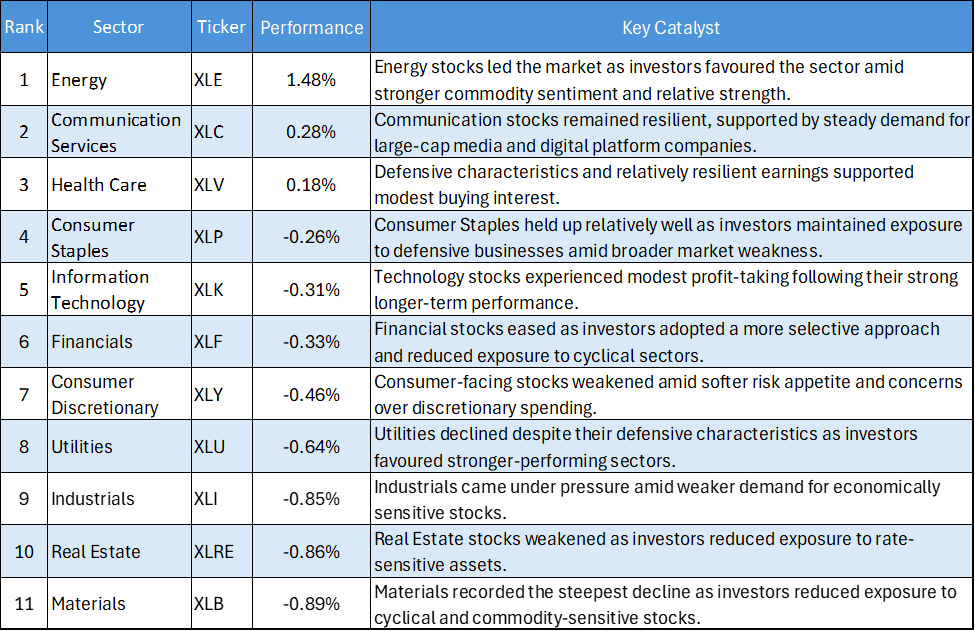
- Energy Tops the Market: Energy (XLE) gained 1.48%, making it the strongest-performing sector as investors favoured energy stocks while most other sectors retreated.
- Communication Services and Health Care Remain Resilient: Communication Services (XLC) advanced 0.28%, while Health Care (XLV) edged higher by 0.18%, making them the only other sectors to finish in positive territory.
- Defensive Sectors Show Mixed Performance: Consumer Staples (XLP) declined 0.26%, while Utilities (XLU) fell 0.64%, indicating that defensive positioning did not fully protect investors from the broader weakness.
- Technology and Financials Ease: Information Technology (XLK) slipped 0.31%, while Financials (XLF) declined 0.33%, reflecting modest profit-taking in two major components of the US equity market.
- Cyclical Sectors Underperform: Industrials (XLI) fell 0.85%, while Materials (XLB) dropped 0.89%, making Materials the weakest-performing sector during the session.
- Market Breadth Turns Negative: Only three of the eleven sectors finished higher, highlighting a broadly defensive and selective trading environment.
The US equity market displayed a broadly negative sector performance on 6 August 2026, with Energy providing the strongest leadership while most other sectors moved lower. The 1.48% gain in Energy stood out against declines across cyclical sectors including Materials, Industrials, Real Estate and Consumer Discretionary. Meanwhile, modest gains in Communication Services and Health Care provided limited support, suggesting investors adopted a more selective approach rather than broadly increasing risk exposure.
Daily US Sector Performance Summary
Energy Takes the Lead
- Energy (XLE) climbed 1.48%, clearly outperforming every other sector and emerging as the main source of strength during the session.
- The sector's strong performance contrasted sharply with weakness across most cyclical groups, suggesting investors were selectively allocating capital toward Energy while reducing exposure elsewhere.
- Energy's outperformance also provided an important counterbalance to declines in Materials and Industrials.
Communication Services and Health Care Remain Resilient
- Communication Services (XLC) advanced 0.28%, making it the second-best-performing sector and demonstrating relative resilience despite the broader market weakness.
- Health Care (XLV) added 0.18%, remaining slightly positive as investors maintained exposure to businesses with relatively defensive characteristics.
- These two sectors, together with Energy, were the only groups to finish higher, highlighting the narrow breadth of the session.
Technology and Financials Retreat Modestly
- Information Technology (XLK) declined 0.31%, indicating some profit-taking following the sector's strong longer-term performance.
- Financials (XLF) slipped 0.33%, also remaining relatively close to the benchmark despite the negative session.
- Consumer Discretionary (XLY) fell 0.46%, adding to evidence of weaker appetite for economically sensitive sectors.
Materials, Real Estate and Industrials Become the Main Laggards
- Materials (XLB) declined 0.89%, recording the weakest performance among all sectors.
- Real Estate (XLRE) fell 0.86%, while Industrials (XLI) dropped 0.85%, placing all three sectors near the bottom of the daily ranking.
- Utilities (XLU) also declined 0.64%, suggesting that defensive positioning was not sufficient to offset the broader selling pressure.
- Consumer Staples (XLP) was relatively resilient, falling just 0.26% and outperforming most cyclical sectors.
Bottom Line
The US equity market showed negative sector breadth on 6 August 2026, with only three of the eleven sectors finishing higher. Energy (XLE) was the clear standout, gaining 1.48%, while Communication Services and Health Care posted modest advances.
At the other end of the spectrum, Materials, Real Estate and Industrials recorded the steepest declines, while Technology and Financials also eased. The sector distribution suggests that investors were adopting a more selective stance, with capital concentrating in Energy and relatively defensive areas rather than supporting a broad-based risk-on move.
Looking ahead, sustained strength in Energy alongside a recovery in Technology, Financials and other cyclical sectors would be important for improving overall market breadth. Conversely, continued weakness across Materials, Industrials and Real Estate could indicate that the recent market advance is entering a more cautious consolidation phase.


 Nov 10, 2026




 Please wait processing your request...