
 CA
 NZ
 UK
 AU
 IND

 US

 Share
 X (Formerly Twitter)
 Whatsapp
 Facebook
 LinkedIn
 Telegram
 Email This Article
 Copy Link
 Summarize with AI
 Chat GPT
 Perplexity
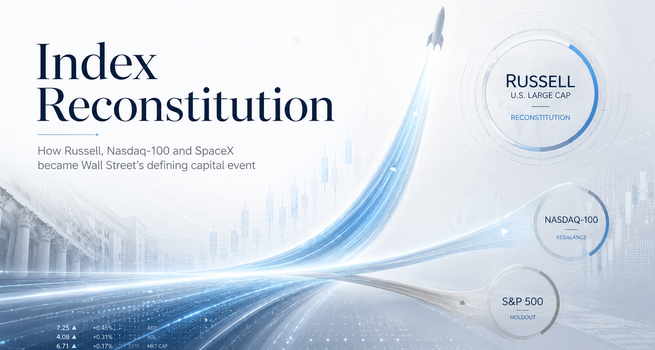
Russell reshuffles $75.6 trillion. Nasdaq-100 sweeps in five AI names. SpaceX enters two indexes within days of its IPO. How index reconstitution became the defining capital event of 2026.
Key Highlights
• Russell 3000 market capitalisation rose 29% to $75.6 trillion at the April 30 rank day, with the top ten constituents now worth $26.4 trillion collectively
• Nvidia displaced Apple as the largest company in the Russell universe with a market capitalisation of $4.8 trillion
• Nasdaq-100 added five AI infrastructure names effective June 22, its first quarterly rebalance under a new 2026 methodology
• SpaceX entered the Russell 1000 on June 26 and is set to enter the Nasdaq-100 on July 6, triggering an estimated $22 to $27 billion in forced mechanical buying
• S&P 500 maintained its 12-month seasoning and profitability requirements, excluding SpaceX until at least mid-2027
When Passive Capital Moves Markets
Index reconstitution has become the most consequential recurring event in US equity markets. Not a central bank decision, not a quarterly earnings release, but a rules-driven reshuffling of benchmark membership that forces trillions of dollars in passive capital to reposition within hours.
The week ending June 26, 2026 produced the clearest illustration of this structural shift yet. Three major index events landed almost simultaneously, the Russell US Indexes reconstitution, the Nasdaq-100 quarterly rebalance, and the S&P 500 quarterly rebalance, all converging in a single week. A fourth event, SpaceX's Nasdaq-100 inclusion, lands on July 6. Together, they represent the largest coordinated capital reallocation event in recent market history.
Russell Reconstitution: $75.6 Trillion Reshuffled
The June 2026 Russell reconstitution, which took effect after market close on June 26, marked two structural firsts. It was the inaugural semi-annual reconstitution since FTSE Russell returned to a twice-yearly schedule for the first time since 1989, and it was the event in which Nvidia formally assumed the position of the largest company in the Russell universe, posting a market capitalisation of $4.8 trillion against Apple's $3.2 trillion reading at last year's recon.
The scale of the 2026 event reflects a US equity market that has expanded significantly. The total market capitalisation of the Russell 3000 rose 29% from $58.4 trillion to $75.6 trillion at the April 30 rank day, while the breakpoint separating the large-cap Russell 1000 from the small-cap Russell 2000 increased 24% to $5.7 billion. The top ten constituents now collectively account for $26.4 trillion, up 48% year on year, with all ten exceeding $1 trillion in market capitalisation for the first time.
The move to semi-annual reconstitution carries structural implications for active managers. A second reconstitution in December 2026 means that institutional repositioning cycles, previously concentrated into a single annual event, now occur twice yearly. That compresses the window available to pre-position around index membership changes and raises tracking error risk for funds benchmarked to Russell.
SpaceX became the most watched individual addition. Under a new fast-entry rule introduced by FTSE Russell in May 2026, companies with investable market caps above the Russell Top 500 breakpoint can enter Russell indexes after just five trading days of listing. SpaceX qualified immediately upon its June 12 IPO, entering the Russell 1000 and Russell Top 200 on June 26 itself.
Nasdaq-100: The AI Infrastructure Sweep
On June 22, the Nasdaq-100 completed its first quarterly rebalance under a revised methodology introduced in May 2026. The change replaced the December annual reconstitution as the sole regular membership review with rank-based quarterly assessments, meaning index composition can now shift in March, June, September, and December.
The June rebalance added Astera Labs (Nasdaq:ALAB), CoreWeave (Nasdaq:CRWV), Nebius Group (Nasdaq:NBIS), Rocket Lab (Nasdaq:RKLB), and Teradyne (Nasdaq:TER), while removing Charter Communications, Cognizant Technology Solutions, Insmed, Verisk Analytics, and Zscaler.
The composition of the incoming class is significant. All five additions are tied directly to AI infrastructure or defense-adjacent technology. CoreWeave operates GPU cloud infrastructure. Nebius builds AI-focused compute platforms. Astera Labs produces connectivity semiconductors for AI data centres. Rocket Lab and Teradyne represent space and semiconductor testing exposure. The five exits, by contrast, are legacy operators across telecommunications, IT services, and analytics with limited AI revenue exposure.
The Nasdaq-100 is tracked by more than 200 investment products with over $800 billion in assets under management globally. Forced buying ahead of the effective date drove pre-announcement gains across the additions. Classic sell-the-news dynamics followed on June 22 itself, with CoreWeave declining approximately 10% and Rocket Lab pulling back sharply from its year-to-date high.
SpaceX: The Largest Forced-Buy Event in ETF History
The SpaceX index inclusion cascade is the dominant market microstructure story of July 2026. Having entered the Russell 1000 on June 26, SpaceX is scheduled to enter the Nasdaq-100 on July 6 under Nasdaq's new Fast Entry rule, which allows companies ranking in the top 40 by market capitalisation to join after just 15 trading days of listing.
Near-term estimates put mechanical forced buying at approximately $25 billion, concentrated into a stock with a public float of only 3% to 5%. The supply-demand imbalance is structurally unusual: passive funds are required to buy at whatever price the stock trades on a predetermined date, regardless of valuation. SpaceX closed its IPO debut at $160.95 on June 12, hit an all-time high of $225.64, and has since pulled back, but the July 6 inclusion date creates a known, concentrated demand event in a thinly floated stock.
SpaceX's float-adjusted market capitalisation of nearly $90 billion places it outside the top 100 constituents by float weight, and it is expected to collect less than 0.20% of the Vanguard Total Stock Market ETF once added, despite a total market capitalisation of $2.11 trillion. The float paradox is consequential: the company is large enough to force billions in mechanical purchases yet small enough in tradeable shares to generate significant price dislocation around the inclusion date.
SpaceX is also the first company in recorded index history to enter two major benchmarks within days of its IPO.
S&P 500: The Holdout
The S&P 500's June 22 quarterly rebalance was comparatively routine. Marvell Technology (Nasdaq:MRVL) and Flex (Nasdaq:FLEX) joined the index, replacing Pool Corp and The Campbell's Company. Both additions reinforce the index's ongoing tilt toward AI infrastructure and semiconductor exposure.
The more consequential S&P story is what did not happen. S&P Global confirmed it will maintain its requirement for positive earnings in the most recent quarter and across the trailing four quarters, a condition SpaceX cannot meet given its $4.9 billion net loss in 2025. Where Nasdaq rewrote its fast-entry rules and FTSE Russell introduced its own five-day provision, S&P held firm. The result is that funds tracking the S&P 500, including SPY and VOO, carry no SpaceX exposure and will not do so until at least mid-2027. As a $2.1 trillion company sits outside the world's most widely tracked benchmark, tracking error risk for S&P 500 funds accumulates with every passing week.
A Structural Shift in Market Architecture
The convergence of these events points to a broader structural development in US equity markets. Index events now generate the largest single-day capital flows of any recurring market calendar event, exceeding the aggregate movement produced by most earnings seasons. The transition to quarterly Nasdaq reviews and semi-annual Russell reconstitutions means these events now arrive every 90 days.
For institutional managers, the implications are material. Pre-positioning windows compress. Tracking error against benchmarks widens during transition periods. And the growing divergence between index providers, with Nasdaq and Russell accelerating inclusion timelines while S&P maintains traditional gates, creates a new form of benchmark fragmentation that active managers will need to navigate carefully into the second half of 2026.
The December Russell reconstitution, now a confirmed calendar event, is already a date worth positioning around.
:


 Nov 10, 2026




 Please wait processing your request...