
 CA
 NZ
 UK
 AU
 IND

 US

 Share
 X (Formerly Twitter)
 Whatsapp
 Facebook
 LinkedIn
 Telegram
 Email This Article
 Copy Link
 Summarize with AI
 Chat GPT
 Perplexity
Key Highlights
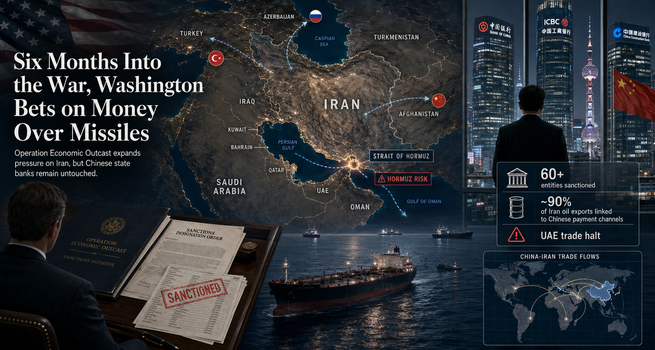
- Treasury sanctioned more than 60 entities, individuals and vessels, expanding secondary sanctions across digital assets, technology, gold, aviation and shipping.
- No major Chinese state bank was named, leaving intact the channel financing roughly 90 percent of Iran's oil exports.
- The UAE has suspended trade with Iran independently; Turkey, Iraq and India continue substantial trade with Tehran.
- Iran has vowed retaliation, while a parallel diplomatic track through Pakistan continued in Tehran the same day.
A Big Name, a Narrower First Step
Six months into a conflict that has strained Iran's economy without resolving the underlying standoff, the Trump administration used Monday to shift its primary instrument from military pressure to financial pressure. Treasury Secretary Scott Bessent framed the announcement in expansive terms, describing an economic onslaught intended to sever Iran's remaining financial connections worldwide. The specifics were narrower than the framing. Bessent declined to name which countries might eventually face secondary sanctions or set a timeline for further action.
What the Treasury did deliver was a list of nearly 60 entities, individuals and vessels connected to Iran's nuclear and missile procurement, cyber operations and oil-smuggling networks, alongside a formal expansion of secondary sanctions into five sector; digital assets, technology, gold, aviation and shipping. More than 20 of the designations target entities and individuals across the Middle East and Asia accused of supporting Iranian nuclear research and missile development, including China-based suppliers of dual-use components.
A separate set of designations covers oil-network brokers, bunkering providers and financial intermediaries based in the UAE, Singapore and Hong Kong, alongside five tankers designated as blocked shadow-fleet property, barring US persons from any financial dealings with them. The Treasury also suspended several licenses that had previously permitted limited Remittance payments to Iran and Iranian access to US cultural and academic institutions.
The Chinese Question
The composition of the list matters as much as its scale. Chinese entities and nationals did appear among Monday's designations, spanning jurisdictions including Hong Kong and mainland China. What did not appear was any major Chinese state bank, the institutions that clear the payments behind roughly 90 percent of Iran's oil exports. Officially, Beijing logged just under 10 billion dollars in trade with Iran last year. That figure is a fraction of the real total: the US-China Economic and Security Review Commission puts unreported Iranian crude flowing into China at roughly 31 billion dollars over the same period, more than triple the declared trade and the clearest evidence that oil, not goods, defines the relationship.
Much of that crude flows through independent Chinese refiners, frequently rebranded as Malaysian or Indonesian in origin and settled through intermediaries outside the dollar system. Treasury has already sanctioned several of those refineries this year, while continuing to spare the financial institutions that fund them. That distinction is central to assessing how far the campaign actually reaches, since individual firms and intermediaries can be substituted relatively easily, while the banks settling those transactions represent the structural chokepoint. Asked directly whether Chinese financial institutions might eventually be designated, Bessent did not rule it out, saying no country sits beyond the reach of US sanctions, but he offered no commitment or timeline.
The hesitation reflects a specific diplomatic calendar rather than a lack of leverage. President Trump is scheduled to host Chinese President Xi Jinping at the White House in late September, a meeting that sits atop an already delicate arrangement involving rare earth exports and Tariff terms. Designating major Chinese banks ahead of that summit risks unravelling the broader negotiation before it convenes. Beijing has publicly rejected the pressure campaign and instructed domestic firms to disregard US sanctions on Iranian oil buyers, a posture reinforced by its own blocking rules. Public defiance and institutional caution are not identical, however. Banks operating in China generally place a high value on continued access to the US dollar clearing system, and that self-interest may ultimately constrain Iranian oil purchases more effectively than a formal designation would. Beijing's own framing of the relationship, offered Tuesday, was that its cooperation with Iran operates within international law and should not face outside interference.
The Rest of the World Is Not Waiting
While Washington calibrates its approach to Beijing, other trade partners have already made independent decisions. The UAE suspended trade and financial dealings with Iran after ballistic missile fire was directed toward Emirati territory, including toward UAE-linked tankers. That represents a meaningful loss for Tehran. Bilateral trade between the two countries ran to roughly 28 billion dollars in 2024, when the UAE was Iran's largest source of imports, contributing more than 30 percent of the total, and its third-largest export market, taking in over 7 billion dollars of Iranian goods, or about 12 percent of Iran's shipments. Officials familiar with the region note that formally suspending trade and dismantling the informal networks that route through Dubai are separate undertakings, since the bulk of Iran's transshipment, smuggling and shadow banking activity is concentrated there, and the latter will take considerably longer than a single policy announcement.
Elsewhere, the picture remains mixed. Turkey's bilateral trade with Iran reached 5.7 billion dollars in 2024, with Ankara exporting machinery, chemicals and agricultural goods while importing energy. Turkey's 25-year gas Supply agreement with Iran lapsed at the end of July, yet Import volumes rose rather than fell this year, pushing Iran's share of Turkey's gas supply to 19 percent. Talk of diversifying toward Azerbaijani and Russian pipeline gas has not yet translated into Ankara actually cutting the volumes it takes from Tehran. Iraq's trade with Iran exceeded 10 billion dollars in 2025, and Baghdad pays Tehran an estimated 4 billion to 5 billion dollars annually for the gas and electricity that account for more than 30 percent of its power generation, a relationship the new sanctions have not yet touched directly, though they could curtail those payments going forward. Trade between India and Iran has contracted by roughly a third over three years, sliding from 2.3 billion dollars in the year to March 2023 to about 1.6 billion dollars in the year to March 2026, a decline largely explained by New Delhi's absence from Iranian crude markets since 2019. That changed in April, when Indian refiners took their first Iranian oil shipments in seven years under a temporary US sanctions Waiver granted to ease a supply crunch; the arrangement stands to be tested if Washington widens secondary sanctions to cover the refiners now buying that crude.
Deliberately Slow Enforcement
Bessent himself signalled that Monday's measures are a starting point rather than an immediate maximum-pressure campaign, noting that entities are being given an opportunity to remedy their conduct before the most severe penalties apply. That is not necessarily a flaw in the strategy. Sanctions campaigns that succeed tend to build gradually, giving trade partners room to quietly comply rather than forcing public confrontation. The administration appears to be betting on that slower mechanism, calculating that sustained economic isolation can achieve what six months of military engagement has not.
Tehran's Response
Tehran's initial response suggests that patience will be tested rather than rewarded quickly. Iran's economy minister said the country was prepared to respond, and a Revolutionary Guards spokesperson vowed retaliation against US interests and energy infrastructure should Iran's own facilities come under threat. Iranian officials expressed confidence that China and Russia would resist the pressure campaign, and that other trading partners would follow. Separately, an oil tanker was struck by an unidentified projectile near the Strait of Hormuz on Tuesday, disabling the vessel close to the strait's entrance, a reminder that the shipping risk underlying the sanctions campaign has not receded even as the diplomatic and financial tracks move forward.
A Quieter Diplomatic Channel
That financial pressure is running alongside a quieter diplomatic channel. Pakistan's army chief travelled to Tehran on Monday at the head of an official delegation, with Islamabad describing the visit as part of a broader effort to prevent further escalation and reopen the Strait of Hormuz. A Pakistani official said Washington had indicated it would be willing to reverse the new sanctions either before or during a renewed round of talks, and Iranian officials described the visit as diplomatically productive without disclosing details. Oman's foreign minister followed with his own visit to Tehran on Tuesday. None of this has yet translated into a public breakthrough, and US public support for the broader conflict has fallen to its lowest point since fighting began, with domestic political pressure building ahead of November's elections.
Outlook
Monday's announcement reflects a strategy still being calibrated rather than one already in motion, and Tehran's response over the following two days shows the calibration cuts both ways. The administration is projecting broad financial pressure while preserving room to negotiate, particularly with Beijing, where the economic costs of overreach cut in both directions, and while a parallel diplomatic channel through Pakistan and Oman remains active. Oil prices fell for a second consecutive day as traders largely looked past the sanctions announcement, even as the tanker strike near the Strait of Hormuz underscored that shipping risk in the Gulf has not eased. The more consequential test lies ahead, in whether Chinese state banks are eventually designated, whether Turkey and Iraq face direct consequences for continued energy purchases, whether India's refiners are drawn into the sanctions net, and whether the quieter diplomatic track produces a result before the financial one forces a confrontation. Given how quickly this situation is developing, this assessment reflects conditions as of Tuesday and may shift materially in the days ahead.

 Nov 10, 2026




 Please wait processing your request...