
 AU
AU
 UK
UK
 CA
CA
 NZ
NZ
 IND
IND

 US
US

 Share
Share
 X (Formerly Twitter)
 Whatsapp
 Facebook
 LinkedIn
 Telegram
 Email This Article
 Copy Link
 Summarize with AI
 Chat GPT
 Perplexity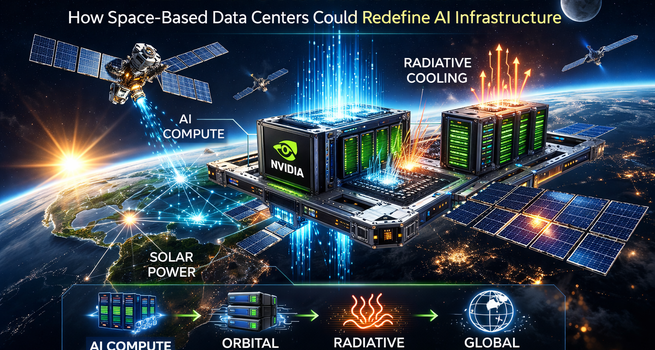
Key Highlights
- NVIDIA signals early ambition to deploy AI data centers in space
- Cooling constraints in orbit present a fundamental engineering challenge
- The concept aligns with rising global demand for AI compute capacity
- Space-based infrastructure could reshape latency, energy, and scalability dynamics
- Execution remains long term with high technical and economic uncertainty
A New Frontier for AI Infrastructure
The next phase of artificial intelligence infrastructure may not be terrestrial. NVIDIA has signaled a bold shift in thinking, with CEO Jensen Huang outlining early plans to explore data centers in space. The announcement, including references to a concept named Vera Rubin Space-1, positions orbital computing as a potential extension of the AI hardware arms race.
The idea may appear speculative, yet it reflects a deeper reality. Global demand for compute is rising at a pace that is straining terrestrial infrastructure. Power availability, cooling efficiency, and land constraints are becoming binding factors for hyperscale expansion. In that context, space is emerging as an unconventional but increasingly relevant frontier.
For investors, the significance lies not in near-term deployment but in the strategic direction of AI infrastructure. NVIDIA is not merely building chips. It is shaping the future architecture of compute itself.
Global AI Infrastructure Trends: Constraints Drive Innovation
Stock Market Outlook on AI Infrastructure Expansion
The AI boom has triggered an unprecedented expansion in data center capacity. Hyperscalers such as Amazon, Microsoft, and Google are investing tens of billions annually to support large language models, generative AI workloads, and inference at scale.
However, this expansion faces three structural constraints:
- Power availability is becoming a limiting factor, particularly in developed markets
- Cooling costs are rising as chip densities increase
- Physical land and regulatory approvals are slowing deployment timelines
Advanced GPUs, particularly those designed for AI workloads, generate immense heat. Traditional air cooling is no longer sufficient at scale. Liquid cooling solutions are being adopted, but they increase complexity and cost.
Against this backdrop, space offers theoretical advantages. Solar energy is abundant in orbit, and the absence of atmospheric resistance simplifies certain aspects of energy harvesting. More importantly, orbital environments remove many terrestrial bottlenecks related to land use and zoning.
The concept is not entirely new. Satellite-based computing has been discussed for decades. What is changing is the economic rationale, driven by exponential AI demand.
Core Analysis: NVIDIA’s Strategic Positioning in Orbital Computing
AI Data Center Strategy and Competitive Positioning
NVIDIA’s announcement must be viewed through its broader strategy. The company has evolved from a GPU manufacturer into a full-stack AI infrastructure provider. Its ecosystem now includes hardware, software, networking, and system-level integration.
By exploring space-based data centers, NVIDIA is extending this vertical integration into infrastructure design itself.
The reference to Vera Rubin Space-1 suggests a long-term research initiative rather than an immediate commercial product. The key challenge identified by Huang is cooling. In space, there is no conduction or convection. Heat dissipation relies entirely on radiation, which is significantly less efficient.
This presents a fundamental engineering problem. High-performance GPUs generate concentrated thermal loads. Without effective cooling, performance and reliability degrade rapidly.
NVIDIA’s focus on this issue indicates that the company is already exploring alternative thermal architectures. Potential approaches may include:
- Advanced radiative cooling systems
- Novel materials with high emissivity
- Modular compute units optimized for orbital conditions
From a competitive standpoint, early exploration provides optionality. If space-based computing becomes viable, NVIDIA would be positioned as a foundational technology provider.
Engineering and Economic Realities of Space-Based Data Centers
Technology Constraints and Scalability Challenges
While the vision is compelling, the practical challenges are significant.
First, launch costs remain high, even with reusable rockets. Deploying large-scale data center infrastructure in orbit would require substantial capital investment. Each kilogram of hardware must justify its economic return.
Second, maintenance and upgrades are complex. Terrestrial data centers benefit from continuous hardware refresh cycles. In space, hardware longevity becomes critical. Systems must be designed for durability and minimal intervention.
Third, latency considerations vary by use case. While space-based data centers could serve global applications, communication delays must be managed carefully. Low Earth orbit systems may mitigate this issue, but it remains a design constraint.
Despite these challenges, certain use cases could justify orbital deployment:
- High-intensity AI training workloads with less sensitivity to latency
- Edge processing for satellite networks and Earth observation systems
- Secure and isolated computing environments for defense applications
The economic model will depend on balancing launch costs, energy efficiency, and operational lifespan.
Financial and Market Implications: Long-Term Optionality
Investment Strategy and Valuation Considerations
For investors, the immediate financial impact of NVIDIA’s announcement is limited. There is no near-term revenue contribution from space-based data centers. However, the strategic implications are meaningful.
First, the initiative reinforces NVIDIA’s positioning as a long-term innovator. The company is not constrained by current infrastructure paradigms. This supports premium valuation multiples, as investors price in optionality and future growth avenues.
Second, the concept highlights the scale of AI demand. If terrestrial infrastructure becomes insufficient, new frontiers will be explored. This underpins sustained demand for high-performance GPUs and associated systems.
Third, it introduces a potential new competitive dimension. Companies involved in space technology, including launch providers and satellite operators, could become part of the AI infrastructure ecosystem.
From a capital allocation perspective, NVIDIA’s ability to invest in exploratory initiatives reflects strong cash flow generation. This financial flexibility is a competitive advantage in a rapidly evolving market.
Market Trends: Intersection of AI and Space Economy
Sector Analysis and Emerging Ecosystems
The convergence of AI and space technology is gaining momentum. Governments and private companies are investing heavily in satellite constellations, Earth observation, and space-based communications.
AI plays a critical role in processing the vast amounts of data generated by these systems. Bringing compute closer to the source of data, in orbit, could enhance efficiency and reduce transmission requirements.
This creates a potential ecosystem where:
- Satellites generate data
- Orbital data centers process it
- Ground stations receive actionable insights
Such an architecture could redefine data flows and reduce dependence on terrestrial infrastructure.
For NVIDIA, this represents an opportunity to extend its influence beyond traditional data centers into a broader space-based computing network.
Strategic Outlook: From Concept to Reality
Long-Term Industry Evolution and Risks
The path from concept to deployment will be long. Several milestones must be achieved:
- Breakthroughs in thermal management for space environments
- Reduction in launch costs to improve economic viability
- Development of modular and resilient hardware systems
- Integration with existing satellite and communication networks
Regulatory considerations will also play a role. Space is governed by international treaties and national regulations. Large-scale infrastructure deployment will require coordination across multiple stakeholders.
Risks remain substantial. Technological hurdles could delay progress, and economic returns may take years to materialize. There is also the possibility that terrestrial innovations, such as advanced cooling or energy solutions, reduce the need for orbital alternatives.
However, the strategic logic remains compelling. As AI demand continues to grow, infrastructure innovation will follow.
Conclusion: A Signal of the Next Infrastructure Cycle
NVIDIA’s exploration of space-based data centers is less about immediate execution and more about signaling the direction of travel. The company is anticipating a future where traditional constraints no longer suffice.
For investors, the key takeaway is not the feasibility of GPUs in space today, but the scale of ambition driving the AI ecosystem. NVIDIA is positioning itself at the center of that evolution, extending its reach from silicon to systems and potentially to orbit.
If even a fraction of this vision materializes, it could redefine the boundaries of computing infrastructure. Until then, it serves as a reminder that the next phase of technological competition may extend far beyond Earth.
FAQ Section
- What did NVIDIA announce about space-based data centers?
NVIDIA indicated early-stage plans to explore deploying AI data centers in space, highlighting engineering challenges such as cooling systems in zero-convection environments and introducing a concept referred to as Vera Rubin Space-1. - Why would data centers be placed in space?
Space offers potential advantages such as abundant solar energy, reduced land constraints, and proximity to satellite data sources. These factors could help address growing demand for AI compute infrastructure. - What are the biggest technical challenges?
The primary challenge is cooling, as space lacks conduction and convection. Heat must dissipate through radiation, which is less efficient and requires innovative engineering solutions. - Does this impact NVIDIA’s near-term financial outlook?
No immediate financial impact is expected. The initiative represents long-term strategic optionality rather than a near-term revenue driver. - How should investors interpret this development?
Investors should view it as a signal of NVIDIA’s ambition and long-term positioning. It reinforces the company’s role in shaping future AI infrastructure, supporting its premium valuation narrative.


 Jun 04, 2026




 Please wait processing your request...