
 AU
AU
 UK
UK
 CA
CA
 NZ
NZ
 IND
IND

 US
US

 Share
Share
 X (Formerly Twitter)
 Whatsapp
 Facebook
 LinkedIn
 Telegram
 Email This Article
 Copy Link
 Summarize with AI
 Chat GPT
 Perplexity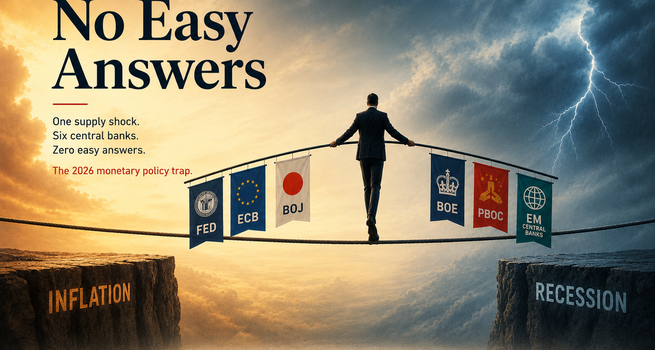
Key Highlights
- Middle East energy shock disrupts the 2026 easing cycle before it began.
- Every major Central Bank faces the same trap: act too early or wait too long.
- Dollar strength is self-reinforcing, amplifying pressure on every emerging market.
- Bond markets are tightening conditions independently of any rate decision.
- The real risk is not a delayed cut; it is a policy error in either direction.
The Trigger: A Supply Shock That Monetary Policy Cannot Fix
Central banks had hoped to move quietly into the second half of 2026. A conflict engulfing the Middle East since late February ended that possibility.
Attacks on energy infrastructure and shipping disruptions in the Strait of Hormuz, which handles roughly 35 percent of global seaborne crude trade, triggered the largest oil supply shock on record. Brent Crude prices remained more than 50 percent higher in mid-April than at the start of the year. The World Bank now projects energy prices to surge 24 percent in 2026, their highest level since Russia invaded Ukraine in 2022. Overall Commodity prices are forecast to rise 16 percent, with precious metals hitting record highs as investors seek safe-haven Assets.
This is the problem monetary policy was not designed to solve. Rate decisions cannot produce oil, reopen the Strait, or stabilise commodity markets. What central banks can control is how the shock transmits into Inflation expectations, wage demands, and embedded price behaviour. That is precisely where the credibility question returns.
The Credibility Trap: A Problem With Historical Roots
The defining challenge for every major central bank in this cycle is not technical. It is about credibility, and history makes clear why that matters.
In the 1970s, central banks in the United States and Europe repeatedly misread oil-driven inflation as transitory, allowing price expectations to become unanchored across the broader economy. The cost of that error fell to Paul Volcker, whose Federal Reserve drove the federal funds rate above 19 percent in 1981, triggering a severe Recession before inflation psychology was finally broken. The lesson took a decade and significant economic damage to absorb.
After 2008, the same institutions moved to the opposite extreme, holding rates near zero and expanding balance sheets for years. That post-crisis Liquidity regime shaped the expectations of an entire generation of investors. When inflation returned sharply after the Pandemic, the initial assessment that it was transitory proved costly. Central banks were forced into one of the fastest tightening cycles in modern history to recover credibility they had allowed to erode.
That history casts a long shadow over 2026. The Middle East energy shock has recreated the conditions in which a central bank must choose between two uncomfortable paths. Cut too early, before inflation is demonstrably under control, and risk reigniting price pressure and a painful policy Reversal. Wait too long, and risk inflicting unnecessary damage on growth, employment, and Credit conditions. The IMF has stated plainly that central banks can afford to wait for now, provided inflation expectations remain anchored, but must communicate their readiness to act decisively. The word "provided" is carrying considerable weight.
Communication has therefore become as consequential as the policy rate itself. A single speech from a central bank governor can now move bond markets more than a rate decision might have in a prior cycle. That is a measure of how much uncertainty remains embedded in the system.
The Federal Reserve: Where the Global Rate Debate Begins
The Federal Reserve sits at the centre of the global monetary policy debate not only because U.S. inflation matters, but because the dollar is the world's primary transmission mechanism. Fed decisions do not stop at U.S. borders.
The FOMC held rates steady at 3.5 to 3.75 percent in January 2026, defying political pressure from the White House to cut more aggressively. The April statement noted that inflation remains elevated, in part reflecting the recent increase in global energy prices, and that Middle East developments are contributing to a high level of uncertainty about the economic outlook. J.P. Morgan now expects the Fed to hold rates steady for the rest of 2026, with the next move likely a 25 basis point hike in the third quarter of 2027. That is a dramatic reversal from the multiple rate cuts markets were pricing less than a year ago.
Services inflation has proven more persistent than models anticipated. Labour markets, while cooling at the Margin, have not softened enough to give the Fed clear runway for easing. The FOMC's use of the phrase "extent and timing" in its policy statement, language added back after a period of relative confidence, signals the restraint officials will bring to any future adjustment.
When the Fed holds, dollar strength tends to follow. A stronger dollar tightens financial conditions for every economy carrying dollar-denominated Debt, raises Import costs in countries with weak currencies, and compresses global liquidity. Dollar tightening hits faster and harder than dollar easing relieves. The transmission is asymmetric, and it reaches every corner of the global financial system.
Europe and the UK: Growth Weakness Meets Inflation Pressure
The European Central Bank and Bank of England are navigating a structurally similar problem to the Fed but with weaker growth foundations and less room for manoeuvre.
The ECB held rates unchanged at its March 2026 meeting, noting that the Middle East war has made the economic outlook significantly more uncertain, creating upside risks for inflation and downside risks to growth simultaneously. ECB staff now project headline inflation averaging 2.6 percent in 2026, revised sharply upward from December projections. Economic growth for the eurozone has been revised down to 0.9 percent for the year. The ECB faces the classic stagflationary policy dilemma: the growth data argues for easing, the inflation data argues against it.
The Bank of England faces perhaps the most uncomfortable combination of any major central bank. Wage growth has moderated significantly in 2026, with average weekly Earnings rising 3.4 percent in the three months to March, down from above 4 percent at end-2025. Services inflation has remained sticky, running at 4.5 percent in March, well above the 2 percent target. The housing market, heavily exposed to variable and short-term fixed Mortgage rates, is sensitive to any delay in rate relief. Sterling weakness adds a further constraint. A depreciating pound raises the cost of imports at precisely the moment the Bank is attempting to contain domestic price pressures. The room to ease is narrower than the growth data alone might suggest.
Bank of Japan: A Liquidity Variable the World Cannot Ignore
The Bank of Japan's situation is uniquely complex, and its consequences extend far beyond Japan.
At its April 2026 meeting, the BoJ held its policy rate steady at 0.75 percent in a split 6-3 vote. The dissenting members argued for a hike to 1 percent, citing upside inflation risk from the Middle East conflict. The BoJ raised its Core Inflation forecast to 2.8 percent while cutting its growth forecast for fiscal 2026 to 0.5 percent from 1 percent, reflecting a Stagflation-like dynamic driven by the oil price shock.
For years, Japan's near-zero rate environment made it one of the most important sources of cheap Capital in global markets. Investors borrowed in yen at minimal cost and deployed those funds into higher-yielding assets elsewhere. As the BoJ normalises policy, that carry trade dynamic shifts. Yen strength reduces the profitability of those positions and can trigger disorderly unwinding across global asset classes. Japanese institutional investors, holding substantial positions in U.S. Treasuries, European bonds, and global equities, may reassess their allocations as domestic yields become more competitive.
The BoJ has committed to conducting an interim assessment of its JGB purchase reduction plan at the June 2026 meeting. Any signal of faster normalisation would be a global liquidity event, not a domestic one.
Bond Markets: The Tightening That Arrives Before the Decision
Central banks set overnight policy rates. Bond markets decide how tight financial conditions actually feel across the economy. In 2026, those two are moving in different directions.
Rising long-term yields, even without a policy rate move, tighten mortgage costs, raise the discount rate applied to Equity cash flows, increase corporate borrowing costs, and pressure sovereign fiscal positions. The term premium, the extra Yield investors Demand for holding long-duration debt, has returned as a key variable in the macro debate as government borrowing in major economies increases the supply of sovereign bonds at precisely the moment central banks running quantitative tightening programs are reducing their holdings.
The IMF has warned that one of the three principal transmission channels of the current geopolitical shock is financial tightening, with lower asset valuations, higher risk premia, capital flight, and dollar appreciation all capable of dampening demand before any central bank formally changes its policy stance. Bond markets, in other words, can tighten conditions faster than policymakers can respond. That lag creates risk that is not fully captured in policy rate expectations alone.
For equity markets, the implication is direct. Higher long-duration yields compress the valuation multiples of growth-oriented stocks, increase the relative attractiveness of fixed income, and raise the bar for capital deployment into risk assets at precisely the moment earnings outlooks are being revised downward by the energy shock.
Emerging Markets: The Currency Constraint Returns
The Federal Reserve's inability to cut rates as anticipated has reactivated a familiar pressure point for emerging market economies. Dollar strength, when sustained, raises the cost of servicing dollar-denominated sovereign and corporate debt, compresses import purchasing power, and forces local central banks into an uncomfortable choice: defend the currency with higher domestic rates or accept Depreciation and its inflationary consequences.
The World Bank projects inflation in developing economies to average 5.1 percent in 2026, a full percentage point higher than expected before the Middle East conflict and up from 4.7 percent in 2025. Economies with significant external financing needs, including Indonesia and Mexico, face the sharpest sensitivity to shifts in dollar funding conditions. India has navigated this environment with relative discipline, supported by manageable current account dynamics and meaningful foreign exchange reserves, but remains exposed to energy import costs given its structural dependence on oil.
China presents a distinct dynamic. The People's Bank of China is managing both growth support and Exchange Rate stability simultaneously, attempting to stimulate domestic demand while working through structural stress in its property sector. A weaker renminbi offers export competitiveness but complicates trade relationships and can trigger capital outflow pressure. With growth projected at 4.4 percent in 2026, below the trajectory markets had anticipated, the PBOC faces its own version of the policy credibility dilemma.
The common thread is that Fed restraint does not stay in Washington. It sets the baseline financial conditions against which every other central bank must operate.
What This Means for Capital Allocation
For institutional investors, the return of central banks as the primary market variable has specific implications for how capital is deployed across asset classes, sectors, and geographies.
Rate-sensitive sectors including real estate, utilities, and long-duration fixed income instruments may face renewed valuation pressure if the anticipated easing cycle is delayed or reversed. Growth-oriented equities, which carry high duration in their discounted Cash Flow profiles, may experience multiple compression even if underlying earnings remain resilient in nominal terms. In an inflationary environment, nominal resilience and real resilience are not the same thing.
Geography matters more than it has in recent years. Economies with lower inflation, stronger fiscal positions, and central banks with greater room to ease may attract capital flows at the expense of those facing tighter constraints. Currency dynamics amplify these differences. The energy shock has also restored commodity-exporting economies to a position of relative macro advantage, a structural shift that portfolio construction may need to reflect.
The investors who may navigate this environment most effectively are those who separate the question of where rates are going from the equally important question of how much uncertainty around that path is already embedded in current asset prices. In a world where J.P. Morgan is modelling a rate hike in 2027 rather than the cuts markets expected, the distance between consensus pricing and the realistic policy range has rarely been wider.
Conclusion: The Policy Error Risk Is Now the Central Variable
Central banks are back in the spotlight because the conditions that allowed investors to treat monetary policy as a settled variable have gone. The soft-landing trade is not dead, but it is no longer a low-cost position, and the distribution of outcomes has widened on both sides.
The underappreciated risk is not simply that central banks cannot cut quickly enough; it is the asymmetry of the policy error calculus. Easing too early risks reigniting second-round inflation effects and requiring a sharper correction. Tightening too long into a supply shock risks engineering demand destruction the shock itself would not have caused. History suggests central banks tend to err in one direction until forced to correct.
Which direction they err in this cycle remains genuinely unresolved, and that question, more than the rate path itself, is what markets have not yet fully priced.


 Jun 04, 2026




 Please wait processing your request...