
 CA
 NZ
 UK
 AU
 IND

 US

 Share
 X (Formerly Twitter)
 Whatsapp
 Facebook
 LinkedIn
 Telegram
 Email This Article
 Copy Link
 Summarize with AI
 Chat GPT
 Perplexity
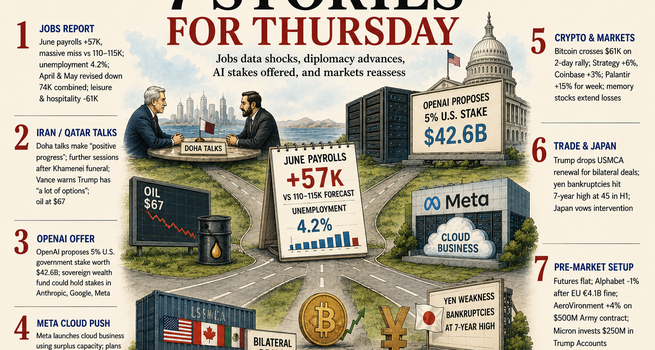
June nonfarm payrolls came in at +57,000, less than half the 110-115K consensus and the weakest print of the cycle; April and May were revised down a combined 74,000. The unemployment rate ticked to 4.2% as participation fell. Doha talks made "positive progress" with further sessions after the Khamenei funeral this weekend. OpenAI proposed handing the U.S. government a 5% stake worth $42.6B as part of a broader AI sovereign wealth fund arrangement.
1. NFP: June Payrolls +57K, Massive Miss vs 110-115K Forecast; Unemployment Ticks to 4.2%; April and May Revised Down 74,000 Combined; Leisure and Hospitality -61K
June nonfarm payrolls came in at +57,000, less than half the 110-115K consensus and the weakest monthly print in the current cycle. The unemployment rate ticked down to 4.2% from 4.3%, but labour force participation fell 0.3 percentage points to 61.5%, meaning the improvement partly reflects workers leaving the labour force rather than finding jobs. Average hourly earnings rose 0.3% M/M and 3.5% Y/Y, both in line with forecast. The headline miss is compounded by revisions: April was revised down 31,000 to 148K and May was revised down 43,000 to 129K, meaning the prior 2 months are 74,000 lower than previously reported. Leisure and hospitality lost 61,000 jobs in June on weaker than usual seasonal hiring. Professional and business services added 36,000, social assistance 25,000, and health care 22,000.
• At 57K, June payrolls are less than half the prior 12-month average of 36,000 monthly change adjusted upward by the revisions; combined with yesterday's 98K ADP miss and 74,000 in downward revisions to prior months, the labour market deceleration is now confirmed across 3 consecutive data points.
• Leisure and hospitality losing 61,000 jobs in a single month reverses the seasonal pattern that typically supports summer hiring; this is the sector that drove the consumer stress narrative throughout June and the -61K figure is the most alarming single-sector data point in this print.
• Risk note: the 57K print collapses the September rate-hike probability that stood at 64% last week; Warsh now enters July with a sub-100K ADP, a 57K NFP, and 74,000 in downward revisions: the data case for a September hike has materially weakened in a single week.
2. IRAN/QATAR: Doha Talks Make "Positive Progress"; Further Sessions After Khamenei Funeral; Vance Warns Trump Has "A Lot of Options"; Oil at $67, Fourth Straight Weekly Loss
A Qatari spokesman said separate meetings with American and Iranian negotiators in Doha made "positive progress," with further talks planned after the funeral of Ali Khamenei, Iran's former supreme leader, beginning this weekend. JD Vance agreed discussions were going well but warned Trump had "a lot of options" if Iran did not comply. WTI trades at $67.08 (-2.19%) and Brent at $70.18 (-1.94%), on pace for a fourth straight weekly loss as the wartime premium continues to unwind.
• The Khamenei funeral timing is a known procedural pause rather than a diplomatic collapse; scheduling further talks around a state funeral preserves the framework, which is analytically distinct from Wednesday's Ghalibaf war warning.
• WTI at $67.08 has now fallen more than $22 from its wartime high above $89 in early June; oil is fully pricing the ceasefire as durable despite the implementation friction.
• Risk note: Vance's "a lot of options" warning introduces deliberate ambiguity at the same moment Doha talks are described as progressing; if Iran reads the warning as a threat, the Khamenei funeral pause could extend into a formal breakdown.
3. OPENAI: Proposes 5% Government Stake Worth $42.6B; Altman Envisions Sovereign Wealth Fund Holding Stakes in Anthropic, Google and Meta
OpenAI has proposed handing the U.S. government a 5% stake worth approximately $42.6 billion, based on its $852 billion post-money March valuation, to defuse mounting political pressure in Washington. CEO Sam Altman argued that giving the public a financial interest is the best way to share the upside of AI. The arrangement envisions a sovereign wealth fund vehicle through which Washington would hold 5% of each leading U.S. AI developer, potentially including Anthropic, Google, and Meta; it is not clear whether any of these companies would agree.
• A 5% government stake in every leading U.S. AI developer would be an unprecedented restructuring of the relationship between U.S. technology companies and the federal government, converting regulatory pressure into equity ownership at the frontier of the most consequential technology in decades.
• The $42.6 billion implied value of OpenAI's 5% stake makes this the largest proposed voluntary government equity stake in a private U.S. company in history; the broader arrangement across Anthropic, Google, and Meta would aggregate into a position worth hundreds of billions.
• Risk note: if Anthropic, Google, or Meta decline, OpenAI's unilateral offer creates a competitive disadvantage in regulatory relationships without securing the political protection the arrangement was designed to provide.
4. META: +9% Wednesday on Cloud-Computing Business Launch; $145B AI Spend This Year; Surplus Data Centre Capacity Converted to Revenue
Meta Platforms (NASDAQ: META) rose 9% on Wednesday after reports it is launching a cloud-computing business selling surplus data-centre capacity to external customers. Meta expects to spend $145 billion on AI infrastructure this year; the cloud business converts a portion of that capex into a revenue stream rather than a pure cost. The move follows Amazon Web Services, Microsoft Azure, and Google Cloud in establishing hyperscaler infrastructure as a commercial product, arriving as UBS flagged AI capex sustainability concerns at the start of Q3.
• Meta's $145 billion AI infrastructure spend is the largest single-year capital commitment by any company in this briefing series; selling surplus capacity at commercial rates changes the return profile from a defensive AI positioning cost to a partially self-funding infrastructure asset.
• The 9% single-day gain is the largest megacap move of the week; at Meta's market capitalisation, a 9% move represents more dollar value creation than most companies' entire market caps.
• Risk note: hyperscaler cloud margins depend on utilisation rates; if Meta's build creates more surplus capacity than the market can absorb at commercial pricing, the revenue offset is smaller than Wednesday's move has priced.
5. CRYPTO/MARKETS: Bitcoin Crosses $61K on 2-Day 4.5% Rally; Strategy +6%, Coinbase +3%; Palantir +15% for Week; Memory Stocks Extend Losses
Bitcoin crossed $61,000, pacing for a 2-day rally totalling 4.5%; Strategy (NASDAQ: MSTR) rose 6% and Coinbase (NASDAQ: COIN) gained more than 3%. Palantir (NASDAQ: PLTR) jumped more than 3% pre-market after D.A. Davidson upgraded to buy, citing the most attractive valuation in some time; the stock is up more than 15% for the shortened trading week. Memory stocks are extending Wednesday's selloff: Sandisk fell 3.5% pre-market after dropping more than 10% Wednesday; Western Digital and Seagate Technology each fell 2.5% pre-market after -6% and -5% Wednesday respectively.
• Bitcoin at $61,000 alongside Strategy's 6% gain reflects renewed institutional crypto appetite entering the July 4th weekend without a specific fundamental catalyst, suggesting the move is positioning-driven.
• Memory stocks' continued selloff into a second session confirms Q3 rotation out of the AI memory trade that tripled both Sandisk and Micron in Q2; the pace of reversal relative to the original gain will determine whether this is profit-taking or a structural de-rating.
• Risk note: the 57K NFP miss collapses September hike pricing, which is supportive for Bitcoin near term; but thin pre-holiday volume ahead of the July 4th close amplifies moves in both directions without fundamental anchoring.
6. TRADE/JAPAN: Trump Drops USMCA Renewal for Bilateral Deals; Yen Bankruptcies Hit 7-Year High at 45 in H1; Finance Minister Vows Intervention
The Trump administration said it would pursue separate trade deals with Canada and Mexico rather than renew the USMCA for 16 years; the agreement will be reviewed annually until expiry in 2036. Trump had previously called the USMCA "the best agreement we've ever made." Japan's weak yen caused 45 firms to go bankrupt in the first half of 2026, the highest since 2022; wholesalers with limited pricing power were most affected as import costs surged on a 40-year low yen. Finance Minister Satsuki Katayama vowed "decisive steps" with U.S. Treasury to prop up the currency.
• Dropping the USMCA renewal in favour of bilateral deals introduces annual review risk into North American supply chains that the existing framework had resolved; companies with cross-border manufacturing in autos, agriculture, and semiconductors face structural uncertainty the 16-year renewal would have eliminated.
• Japan's 45 yen-related bankruptcies in H1 move the yen story from a currency market concern to a documented economic damage figure; the finance minister's intervention vow signals the government views the current level as unsustainable.
• Risk note: if U.S. Treasury declines to co-ordinate yen intervention, Japan's unilateral currency defence creates friction in the bilateral trade relationship at the same moment USMCA restructuring is raising questions about U.S. trade partner reliability.
7. PRE-MARKET SETUP: Wednesday Close Modest Loss; Futures Flat; Alphabet -1% on EU €4.1B Fine; AeroVironment +4% on $500M Army Contract; Micron Invests $250M in Trump Accounts
Wednesday closed modestly lower: DJIA -0.03% at 52,305.24, S&P 500 -0.22% at 7,483.23, NASDAQ -0.66% at 26,040.031, NASDAQ 100 -1.54% at 29,809.133. Thursday pre-market: futures are little changed. Alphabet (NASDAQ: GOOGL) fell 1% after a court upheld Google's €4.1 billion ($4.67 billion) EU fine from a 2018 EC decision on Android anticompetitive practices. AeroVironment (NASDAQ: AVAV) rose 4% after winning a $500 million U.S. Army counter-drone contract. Micron Technology (NASDAQ: MU) said it will invest $250 million in Trump Accounts, the president's tax-advantaged investment accounts for children that officially launch July 4 this weekend; Bank of New York Mellon will manage the initial accounts and Robinhood (NASDAQ: HOOD) built the app. Babies born 2025-2028 receive a $1,000 Treasury pilot contribution; children born 2016-2024 in lower-income ZIP codes are eligible for $250 from Michael Dell's $6.25 billion pledge.
• Alphabet's EU fine confirmation removes an overhang but establishes a precedent cost for Android ecosystem practices that regulators in other jurisdictions can reference in their own proceedings.
• Robinhood's role as the Trump Accounts app builder connects directly to Mizuho's upgrade yesterday citing cross-border brokerage dominance potential; the app gives Robinhood a federally-anchored distribution channel for a new generation of account holders.
• Risk note: markets close early Thursday for the July 4th weekend; the 57K NFP miss into thin pre-holiday volume is amplifying the rate-dovish reaction; any reversal of that repricing before the close has no Friday session to absorb it, carrying the full impact into Monday's open.
Markets Intelligence Briefing is an informational and analytical publication. Nothing contained herein constitutes investment advice, a recommendation to buy or sell any security, or a price target. All analysis is presented for informational purposes only. Investors should conduct their own due diligence before making any investment decision.


 Nov 20, 2026





 Please wait processing your request...