
 CA
 NZ
 UK
 AU
 IND

 US

 Share
 X (Formerly Twitter)
 Whatsapp
 Facebook
 LinkedIn
 Telegram
 Email This Article
 Copy Link
 Summarize with AI
 Chat GPT
 Perplexity

Key Highlights
- Consumer Discretionary Leads the Market: XLY advanced 1.79%, supported by stronger-than-expected retail results from Target and TJX Companies, alongside gains in Amazon.
- Technology Posts a Modest Gain: XLK increased 0.34%, as gains in selected semiconductor and Cybersecurity shares offset weakness in Nvidia.
- Utilities and Communication Services Edge Higher: XLU and XLC each gained 0.30%, while Real Estate (XLRE) added 0.07%.
- Industrials and Consumer Staples Remain Near Flat: XLI slipped 0.05%, while XLP declined 0.31%, indicating limited movement in these groups.
- Financials and Healthcare Underperform: XLF fell 1.14%, while XLV declined 2.20%, with health insurers pressured by a proposed Medicare Advantage audit rule.
- Energy Records the Largest Loss: XLE dropped 3.27% as Crude Oil prices fell and major energy companies and refiners recorded substantial declines.
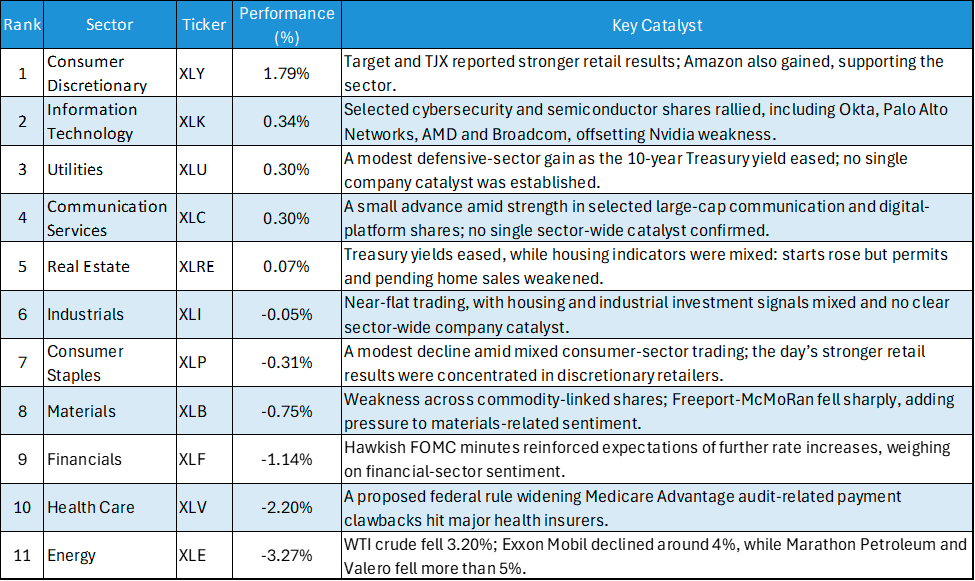
US sector performance on Wednesday, 18 November 2026, was mixed, with seven of the eleven supplied sector ETFs finishing higher and four recording losses. Consumer Discretionary (XLY) led the market, advancing 1.79%, followed by Information Technology (XLK), which gained 0.34%. Utilities (XLU) and Communication Services (XLC) each added 0.30%, while Real Estate (XLRE) edged 0.07% higher. Industrials (XLI) was virtually unchanged, slipping 0.05%.
The weaker sectors were led by Energy (XLE), which fell 3.27%, followed by Healthcare (XLV), down 2.20%. Financials (XLF) declined 1.14%, while Materials (XLB) and Consumer Staples (XLP) lost 0.75% and 0.31%, respectively. The wide gap between the leading and weakest sectors points to selective buying rather than a broad-based advance. Retail Earnings provided support to consumer-facing shares, while lower crude prices and regulatory uncertainty weighed on energy and healthcare stocks.
Performance Breakdown by Sector
Consumer Discretionary and Technology Lead the Advance
Consumer Discretionary (XLY) was the strongest-performing sector, rising 1.79%. Retail earnings were an important positive catalyst. Target and TJX Companies delivered stronger-than-expected results, while Target’s performance and the improvement in comparable sales at TJX helped reinforce confidence in selected consumer-facing businesses. Amazon also advanced, adding further support to the sector. The gains suggest investors were willing to reward companies demonstrating resilient Demand and execution, although the performance of individual retailers should not be interpreted as evidence that all areas of household spending are equally strong.
Information Technology (XLK) gained 0.34%, despite mixed trading among large technology companies. Cybersecurity shares rebounded, with Okta and Palo Alto Networks recording strong gains, while AMD and Broadcom also advanced. These moves helped offset a decline in Nvidia, which fell despite reporting results above market expectations. The divergent performance indicates that buying interest was selective, favouring certain semiconductor and cybersecurity names rather than the technology sector uniformly. Utilities (XLU) and Communication Services (XLC) each gained 0.30%, while Real Estate (XLRE) edged higher by 0.07%. The 10-year Treasury Yield eased during the session, offering some support to interest-rate-sensitive groups, although the move in these ETFs remained modest.
Industrials, Consumer Staples and Materials Show Mixed Performance
Industrials (XLI) was almost unchanged, declining just 0.05%, while Consumer Staples (XLP) slipped 0.31%. The limited moves indicate that neither sector experienced a decisive repricing. Consumer Staples lagged the stronger discretionary retailers, highlighting the difference between company-specific earnings momentum and the broader defensive consumer category. Materials (XLB) declined 0.75%, with weakness in commodity-linked shares contributing to the softer performance. Freeport-McMoRan was among the notable decliners, falling nearly 7%, adding pressure to materials-related sentiment.
Financials and Healthcare Face Policy and Rate Concerns
Financials (XLF) declined 1.14%. The release of the Federal Reserve’s October meeting minutes added to interest-rate uncertainty, as almost all participants considered further rate increases likely to be appropriate. Some policymakers had discussed the possibility of a larger move if Inflation remained persistent, while the minutes also identified AI-related demand as a potential source of inflation pressure. The prospect of tighter Monetary Policy may influence bank funding costs, Loan demand, Credit conditions and market valuations, contributing to a cautious tone across financial shares.
Healthcare (XLV) fell 2.20%, making it the second-weakest sector. Health insurers faced significant selling pressure after a proposed federal rule sought to extend Medicare Advantage audit findings to broader payment clawbacks. Humana, UnitedHealth and Elevance Health all recorded substantial declines, with UnitedHealth and Humana among the weakest Large-Cap Stocks of the session. The proposed changes raised concerns about potential reimbursement exposure and the profitability of Medicare Advantage operations, creating a direct policy-related catalyst for the sector’s underperformance.
Energy Records the Largest Sector Decline
Energy (XLE) was the weakest-performing sector, falling 3.27%. The decline coincided with a sharp drop in crude oil prices, with West Texas Intermediate falling approximately 3.20% to US$83.26 per barrel. Lower crude prices weighed on major integrated producers, including Exxon Mobil, while refiners Marathon Petroleum and Valero Energy also recorded losses exceeding 5%. The sector’s decline was therefore consistent with broad weakness across oil-linked equities, although refining margins and company-specific factors can cause individual energy shares to diverge from movements in crude prices.
Bottom Line
US sector performance on 18 November 2026 was mixed, with Consumer Discretionary (XLY) leading gains at 1.79%, supported by stronger retail results from Target and TJX and a gain in Amazon. Technology, Utilities and Communication Services also advanced modestly, while Industrials and Consumer Staples were close to unchanged. In contrast, Energy (XLE) recorded the largest decline, falling 3.27% as crude oil prices dropped, followed by Healthcare (XLV), which lost 2.20% amid proposed Medicare Advantage audit changes. Financials also weakened as hawkish Federal Reserve minutes reinforced interest-rate uncertainty. The session highlighted a clear divergence between resilient retail-related shares and pressure on energy and health insurers. Investors will continue monitoring retail earnings, oil prices, Federal Reserve policy signals and healthcare regulation for indications of whether this sector rotation persists.


 Nov 19, 2026





 Please wait processing your request...