
 CA
 NZ
 UK
 AU
 IND

 US

 Share
 X (Formerly Twitter)
 Whatsapp
 Facebook
 LinkedIn
 Telegram
 Email This Article
 Copy Link
 Summarize with AI
 Chat GPT
 Perplexity
Key Highlights
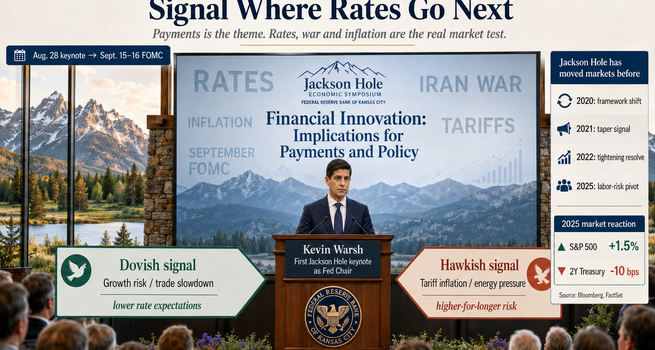
- Jackson Hole 2026 runs August 27-29 under the theme "Financial Innovation: Implications for Payments and Policy," with roughly 120 central bankers from over 70 countries attending
- Kevin Warsh delivers his first keynote as Federal Reserve Chair on Friday, August 28, just three weeks before the September FOMC meeting
- A tariff-driven Inflation shock and an unresolved US-Iran war are complicating the Fed's policy calculus well beyond the symposium's stated payments agenda
- History shows Jackson Hole keynotes routinely outgrow their printed theme, from the 2020 rate framework shift to last year's labor market pivot that moved Equity and bond markets sharply
A Payments Theme Arrives at an Inconvenient Moment
The Federal Reserve Bank of Kansas City will host the 2026 Jackson Hole Economic Policy Symposium from August 27 to 29 at the Jackson Lake Lodge in Wyoming. This year's theme, "Financial Innovation: Implications for Payments and Policy," is expected to draw heavy participation from central banks working through Central Bank Digital currency frameworks and regulators overseeing Stablecoin and tokenized asset markets. Around 120 central bankers, policymakers, economists, and academics from more than 70 countries are expected to attend, consistent with the symposium's typical scale.
On paper, this reads as a technical, forward-looking agenda about payment infrastructure rather than near-term monetary policy. That framing undersells what the event has historically delivered. The academic papers and the keynote address serve different audiences: staff economists advance structural research, while markets focus almost entirely on a single twenty-minute address, regardless of what the surrounding programme covers. That asymmetry is the central tension this year's symposium embodies.
Inside the Symposium: Origins and Purpose
Jackson Hole has convened annually since 1978, bringing together central bankers, policymakers, economists, and academics from around the world to discuss long-term economic and policy challenges. The event spans three days, typically Thursday through Saturday, and is funded through attendee fees rather than public subsidy. Sessions are largely closed to the press, though officials often speak informally with reporters throughout.
Despite this closed, academic format, the symposium carries market-moving weight almost entirely because of the keynote address, typically delivered on Friday morning. That address is drafted with unusual care, and every phrase is parsed for policy signal well beyond what the surrounding papers suggest. The keynote slot has effectively become an independent communication channel for the Fed chair, distinct from the conference it is nominally part of.
The Keynote Has Always Outgrown the Agenda
Precedents from prior years
The pattern of keynotes exceeding their stated theme is well established. In 2020, the Fed used the venue to announce a new framework for setting interest rates, no longer based simply on joblessness or inflation expectations alone. In 2021, officials used the platform to hint at tapering quantitative easing ahead of any formal announcement. In 2022, despite acknowledging clear Recession risk, most central bankers signaled continued resolve to raise rates and curb inflation, setting the tone for the following year's tightening cycle.
The 2025 precedent
Last year offered the clearest recent example. The 2025 theme was "Labor Markets in Transition: Demographics, Productivity, and Macroeconomic Policy." Officials acknowledged that labor market risks were rising and signaled that policy adjustments might be warranted. That single acknowledgment lifted the implied probability of a September rate cut from around 75 percent to nearly 90 percent in futures markets within hours.
Why "Financial Innovation" Was Chosen for 2026
This year's theme has a genuine basis in current developments. Stablecoins and tokenized deposits have moved from experimental instruments into practical, widely used means of payment, making the question of how central banks should regulate and integrate them increasingly unavoidable. Central banks across major economies are actively assessing CBDC frameworks, giving the programme genuine policy relevance in its own right.
Compared with years such as 2022 and 2024, when the stated theme was already central to prevailing Monetary Policy questions, 2026's theme sits at a greater distance from the immediate concerns of rate-setters. That distance is precisely what makes this year unusual: the academic programme is arguably more disconnected from what markets are bracing for than in almost any recent year.
A Fed Boxed In by War, Tariffs, and Trade Policy
The tariff-driven inflation impulse
The backdrop against which Warsh will speak is considerably more fraught than the printed agenda implies. Import tariffs continue to function as a supply-side price shock, raising consumer prices independent of underlying Demand conditions. This forces the Federal Reserve to weigh the risk of entrenching inflation expectations against the risk of tightening policy into a trade-driven slowdown, a dilemma with no clean resolution. Market pricing for Fed decisions through August 2026 reflects this tension, with Implied Rate paths showing unusually wide confidence intervals. Trade policy remains active and unresolved heading into the symposium, with new Tariff actions and renewed negotiation activity continuing through August.
An active war compounding the risk
Layered on top of this is an active military conflict. Since February 2026, the United States and Israel have been engaged in a war with Iran that has disrupted regional trade and travel and forced shipping reroutes away from the Strait of Hormuz. A memorandum of understanding aimed at ending hostilities lapsed this week, with Iranian officials indicating no decision has been made to resume negotiations. The conflict has already strained global shipping routes and introduced a live energy-price risk into an economy already absorbing tariff-driven cost pressure.
Warsh therefore steps to the podium into a genuine stagflationary bind, shaped simultaneously by trade policy and geopolitical conflict, even as the symposium he is addressing is officially organized around payment infrastructure. Tariff-driven cost pressure and war-driven energy risk together mean the Fed is confronting two independent supply-side shocks at once, a considerably harder problem than either alone would present.
Warsh's Debut and the September Calendar
This year's keynote carries additional weight as Kevin Warsh's first Jackson Hole address since becoming Federal Reserve Chair. His remarks are scheduled for Friday morning, August 28, the traditional slot for the symposium's most closely watched address. A new chair's initial keynote is typically scrutinized for both policy content and communication style, and how closely it tracks or departs from his predecessor's approach.
The timing matters beyond the novelty of a new chair. The September Federal Open Market Committee meeting takes place September 15 and 16, accompanied by updated economic projections. Because Jackson Hole falls roughly three weeks before that meeting, it functions as the last major opportunity for the Fed to shape expectations ahead of a decision that will be scrutinized against a live trade dispute and an unresolved war, not merely against payments-sector papers.
What History Suggests About Market Sensitivity
Last year's reaction offers a useful reference point, treated here as precedent rather than prediction. When officials acknowledged rising labor Market Risk in August 2025, the S&P 500 rose 1.5 percent on the day, the Dow Jones and Nasdaq each gained close to 2 percent, and the two-year Treasury Yield fell 10 basis points as rate-cut odds surged. That reaction illustrates how sensitive markets remain to a single sentence of acknowledged risk, independent of the symposium's stated academic theme.
Whether 2026 produces a similar move depends on how directly Warsh addresses the current inflation and growth tension. A dovish acknowledgment of trade- and war-driven growth risk could prompt a comparable repricing of September expectations. A more cautious emphasis on entrenched inflation risk could just as easily produce the opposite reaction. Both remain plausible outcomes, and neither should be treated as the base case ahead of the address itself.
Outlook: Reading the Signal, Not the Programme
The printed agenda for Jackson Hole 2026 concerns payments infrastructure, stablecoins, and the mechanics of financial innovation. The actual market event, as in most years, will be a single keynote address delivered against a backdrop the agenda does not mention: an unresolved tariff dispute and an active war affecting one of the world's most important energy transit routes. History suggests the keynote will speak to that backdrop regardless of the symposium's theme. Investors would do well to read the signal Warsh sends about growth and inflation risk, rather than the programme he is nominally there to discuss.

 Oct 27, 2026




 Please wait processing your request...