
 CA
 NZ
 UK
 AU
 IND

 US

 Share
 X (Formerly Twitter)
 Whatsapp
 Facebook
 LinkedIn
 Telegram
 Email This Article
 Copy Link
 Summarize with AI
 Chat GPT
 Perplexity
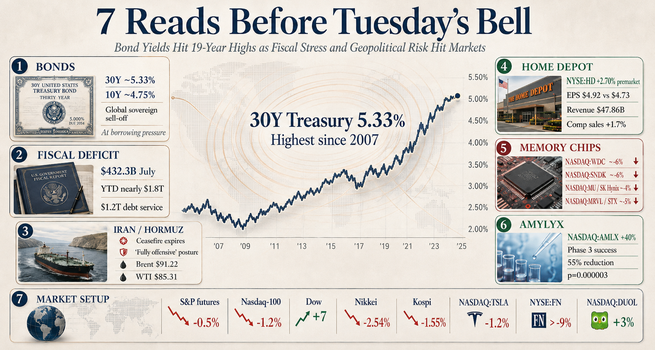
A global government bond sell-off pushed the 30-year Treasury Yield to its highest level since 2007 as the US-Iran ceasefire expired with no deal and Tehran shifted to a fully offensive posture. The July fiscal Deficit hit $432.3 billion, its highest since March 2021, while Home Depot beat estimates and reaffirmed guidance, memory chip stocks slid on the risk-off tone, and Amylyx Pharmaceuticals surged on positive late-stage trial results.
1. BONDS: 30-Year Treasury Yield Hits a 19-Year High as Global Sovereign Debt Sells Off; Strategists Tie the Move Partly to AI Infrastructure Borrowing
The 30-year US Treasury yield climbed to around 5.33%, its highest level since 2007, while the 10-year yield rose to roughly 4.75%, also its highest since 2007, as a broad sell-off swept global government bonds. Germany's 10-year bund yield touched its highest level since 2011, French yields reached their highest since 2009, and Britain's 30-year borrowing costs neared the peaks hit in May, which marked the highest levels since 1998. In Japan, Inflation concerns and expectations of a possible September rate hike pushed 10-year borrowing costs to a three-decade high just under 3%. There's no single catalyst behind the sell-off. With little sign of a US-Iran deal, markets are now pricing in a more extended closure of the Strait of Hormuz and a longer stretch of elevated oil prices. Rising long-dated yields point less to inflation expectations and more to concerns about high government borrowing levels.
A separate dynamic is also in play: roughly $600 billion has been borrowed for AI infrastructure buildout over the past year, with another $200 billion in financing already in the pipeline. This emerging "collective AI enterprise" borrower is now crowding out smaller businesses and pulling global savings toward the US.
- Yields rising in lockstep across the US, Europe, and Japan simultaneously suggests this is a broad repricing of long-duration sovereign risk rather than a US-specific reaction to the Iran conflict alone.
- Risk note: if the AI-borrowing crowding-out thesis holds, AI infrastructure financing needs could keep upward pressure on long-end yields independent of how the Hormuz standoff resolves, meaning even a surprise Iran deal might not fully reverse this week's bond move.
2. FISCAL DEFICIT: July Shortfall Hits $432.3 Billion, Highest Since March 2021, as Debt Service Costs Approach $1.2 Trillion for the Year
The US fiscal deficit jumped to $432.3 billion in July, its highest monthly total since March 2021, pushing the year-to-date shortfall to nearly $1.8 trillion. Interest paid to finance the nearly $40 trillion National Debt has cost the government about $1.2 trillion so far this year. The widening deficit landed the same week as the broader bond sell-off, with strategists linking elevated government borrowing needs directly to the pressure on long-dated yields discussed in story one. Recent inflation readings have shown relatively low monthly price increases in June and July, but the annual rate remains well above the Federal Reserve's 2% target.
- A monthly deficit at its highest level in more than four years arriving alongside a Global Bond sell-off compounds rather than merely coincides with the yield pressure, since higher borrowing needs directly increase the Supply of Treasurys the market must absorb.
- Risk note: with debt service costs already approaching $1.2 trillion for the year, any further rise in long-end yields would mechanically increase future interest expense, creating a feedback loop between the deficit and borrowing costs.
3. IRAN/HORMUZ: Ceasefire Expires as Iran Shifts to "Fully Offensive" Posture; Vessel Struck by Projectile, Houthis Attack in the Red Sea
The 60-day ceasefire between the US and Iran expired Monday after Washington ruled out an extension and a senior Iranian official told Reuters that Tehran would adopt a fully offensive military stance now that efforts toward a permanent end to the war have stalled. A cargo vessel transiting the Strait of Hormuz was struck by a projectile overnight, the latest in a series of attacks that have kept crossings in the single digits. Yemen's Houthis separately launched a missile attack on a vessel they described as a Saudi military ship and its escorts in the Red Sea. Saudi Aramco has resumed oil loadings from inside the strait and is offering cargoes via ship-to-ship transfers off Fujairah in the UAE as an alternative to direct transit. Iran has continued separate talks with Oman on managing the strait and says a deal is close, but Trump responded by threatening to bomb Oman, a longstanding US security partner, if it "gets in the way." Oil extended its rally for a third straight session, with Brent up 0.39% to $91.22 and WTI up 0.96% to $85.31.
- Iran's shift to explicitly offensive language, combined with the Houthi attack opening a second active front in the Red Sea, signals the conflict is broadening geographically even as the Oman talks suggest a partial diplomatic track remains alive.
- Risk note: Trump's threat against Oman, the same country brokering the Hormuz management talks Iran describes as close to completion, risks collapsing the one channel that has kept any de-escalation possibility open.
4. HOME DEPOT: Beats on Both Lines With Best Comparable Sales Since 2022, Reaffirms Guidance, and Rolls Out Nationwide Express Delivery
Home Depot (NYSE:HD) reported fiscal second-quarter adjusted Earnings of $4.92 per share against a $4.73 estimate, with Revenue of $47.86 billion topping a $47.27 billion consensus; comparable sales rose 1.7%, beating an expected 0.9% gain and marking the company's best comparable sales performance since the fiscal third quarter of 2022. The company reaffirmed its full fiscal 2026 guidance, including total sales growth of 2.5% to 4.5%, citing IEEPA Tariff refunds expected to partially offset unplanned fuel, energy, and other input costs. Chief Financial Officer Richard McPhail said the company continues to operate in what he called frozen housing market conditions, with customers telling the company they have the means to spend but remain hesitant on larger projects due to inflation and general uncertainty. Separately, Home Depot announced the nationwide rollout of Express Delivery, using more than 2,000 US stores as fulfillment hubs to deliver trade and DIY essentials in three hours or less for a flat fee with no membership required. Shares rose as much as 2.70% premarket to $347.00.
- Reaffirming rather than raising guidance despite a clean beat suggests management is treating the broader uncertainty McPhail described as a genuine constraint on visibility rather than a hedge against an otherwise strong quarter.
- Risk note: the Express Delivery rollout represents a meaningful new operating cost layered onto a Business still waiting for large-project Demand to return, meaning the investment's payoff depends on the housing market unfreezing before added fulfillment costs pressure margins.
5. MEMORY CHIPS: Western Digital, Sandisk, Micron All Slide as Risk-Off Tone From Rising Yields Hits AI-Linked Semiconductor Names
Memory chip stocks fell sharply premarket Tuesday, reversing recent gains as the broader bond sell-off weighed on risk assets. Western Digital (NASDAQ:WDC) led declines, falling more than 6%, while Sandisk (NASDAQ:SNDK) dropped around 6% and Micron Technology (NASDAQ:MU) and SK Hynix each fell more than 4%. Marvell Technology (NASDAQ:MRVL) and Seagate Technology (NASDAQ:STX) were both down more than 5%. The declines came despite no company-specific negative news, suggesting the moves reflect broader positioning around rising Treasury yields rather than any change to the underlying AI infrastructure demand narrative driving the sector's gains in recent weeks.
- Memory names falling in unison without a specific catalyst indicates investors are treating the sector as a high-beta proxy for risk appetite broadly, meaning further yield increases could pressure these stocks independent of any change in AI capex fundamentals.
- Risk note: if today's decline proves to be yield-driven profit-taking rather than a fundamental reassessment, the same names could snap back quickly on any stabilization in bond markets, making near-term direction more a function of Treasury yields than of company-specific earnings this week.
6. AMYLYX: Shares Surge 40% After Phase 3 LUCIDITY Trial Hits Primary and All Secondary Endpoints for Post-Bariatric Hypoglycemia Drug
Amylyx Pharmaceuticals (NASDAQ:AMLX) shares jumped as much as 40% premarket after the company announced its Phase 3 LUCIDITY trial met its FDA-agreed primary endpoint, showing a 55% reduction in the composite rate of Level 2 and Level 3 hypoglycemic events compared to placebo, with a p-value of 0.000003. The trial also met all secondary endpoints, showing statistically significant and clinically meaningful reductions across multiple measures of hypoglycemic events. Avexitide, a first-in-class GLP-1 receptor antagonist, was generally well tolerated with no serious treatment-related adverse events. Amylyx plans to submit a New Drug Application to the FDA by the end of 2026, with a potential commercial launch in 2027 if approved; the drug already holds FDA Breakthrough Therapy and Orphan Drug designations. Post-bariatric hypoglycemia affects an estimated 8% of people who have undergone common bariatric surgeries, or roughly 160,000 people in the US, with no currently approved treatments.
- A p-value of 0.000003 on the primary endpoint is an unusually strong statistical result, reducing the likelihood that regulators will raise efficacy concerns during NDA review relative to trials with more marginal significance.
- Risk note: Amylyx previously withdrew its ALS drug Relyvrio from the market in 2024 after disappointing Phase 3 results despite an earlier approval, a history that underscores the binary nature of clinical-stage biotech even when topline data appears strong.
7. MARKET SETUP: Futures Fall as Chip Weakness Offsets Home Depot's Gains; Asia and Europe Broadly Lower, Tesla Slips on Cybercab Report
S&P 500 futures fell 0.5% and Nasdaq 100 futures dropped 1.2% Tuesday, pressured by the Treasury yield spike and the memory chip selloff, while Dow futures managed a slight gain of 7 points on Home Depot's earnings beat. Asian markets ended broadly lower: Japan's Nikkei 225 dropped 2.54%, South Korea's Kospi fell 1.55%, and mainland China's CSI 300 declined 0.32%, while Australia's S&P/ASX 200 closed flat. European markets slipped as well, with the Stoxx 600 down 0.51% and Germany's DAX off 0.38%. Tesla (NASDAQ:TSLA) shares dipped 1.2% after a report said the company is preparing an August launch of its Cybercab robotaxi without a steering wheel. Fabrinet (NYSE:FN) fell more than 9% despite beating on both lines, as the company flagged a temporary Margin headwind from usual first-quarter expense seasonality. Duolingo (NASDAQ:DUOL) rose 3% after analyst upgraded the stock to buy, citing a turning point after the market had effectively priced in user growth and monetization concerns. The rally still has room to broaden beyond big technology names, noting the equal-weight S&P has lagged the Nasdaq and semiconductor index even in recent weeks.
- Dow futures holding roughly flat while the S&P and Nasdaq both fell shows Tuesday's weakness is concentrated in technology and semiconductor exposure rather than reflecting a broad risk-off move across all sectors.
- Risk note: with Import and export pricing data, housing starts, and pending home sales all due Tuesday, any additional inflation or housing-market surprise would land directly on top of an already fragile session shaped by rising yields and geopolitical uncertainty.


 Nov 20, 2026





 Please wait processing your request...