
 CA
 NZ
 UK
 AU
 IND

 US

 Share
 X (Formerly Twitter)
 Whatsapp
 Facebook
 LinkedIn
 Telegram
 Email This Article
 Copy Link
 Summarize with AI
 Chat GPT
 Perplexity
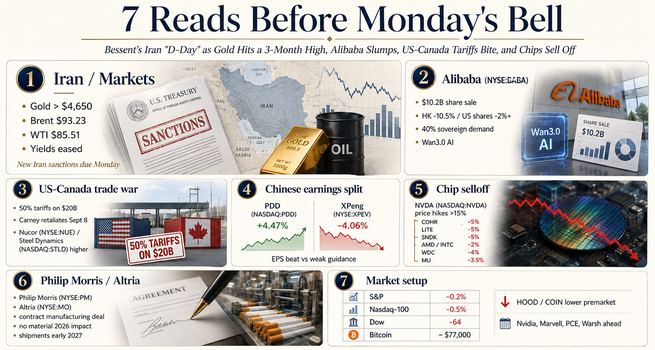
Treasury Secretary Scott Bessent is set to unveil the greatest financial offensive ever marshaled against Iran, sending gold to a three-month high as oil eased on profit-taking. Alibaba slumped after a discounted $10.2 billion share sale for AI spending, US-Canada trade talks collapsed into a Tariff war, and chip stocks fell broadly even as PDD staged a relief rally and XPeng sold off on weak guidance.
1. IRAN/MARKETS: Bessent to Unveil "Greatest Financial Offensive Ever Marshaled" Against Iran; Gold Hits a Three-Month High as Oil and Yields Ease
Treasury Secretary Scott Bessent is scheduled to detail new sanctions against Iran Monday, calling them the toughest in history; Trump has separately threatened sanctions against Iran's trading partners. Pakistan's army chief was in Tehran attempting to mediate, while China said it remained committed to peace talks. Oil pulled back on profit-taking ahead of the announcement, with Brent falling 1.23% to $93.23 and WTI down 1.78% to $85.51, even after both posted a second straight weekly gain above 5%; fewer than 20 vessels transited the Strait of Hormuz over the weekend. Gold rose nearly 1% to above $4,650, its highest since mid-May, as a softer dollar supported bullion. Treasury yields eased after reports the department could tap its General Account to fund bond buybacks. Markets now await the July PCE print Wednesday and Fed Chair Kevin Warsh's Jackson Hole speech Friday.
- Gold's rally and oil's pullback moving in opposite directions shows crude has already priced in Hormuz disruption, while gold draws support from the separate Debt and dollar-weakness narrative.
- Risk note: $93 Brent, rather than $120-150, signals sufficient oil is still flowing through Hormuz; a genuine Iranian move to close the strait would represent the actual turning point markets have not yet priced in.
2. ALIBABA: Shares Slump After $10.2 Billion Discounted Share Sale to Fund AI Buildout; Sovereign Wealth Funds Drove $28 Billion in Demand
Alibaba (NYSE:BABA) shares fell as much as 10.5% in Hong Kong before paring losses to the discount level, after pricing a HK$80 billion ($10.2 billion) share sale at HK$112.70, an 8.4% discount, to fund chips, AI infrastructure, and models; US shares fell more than 2%. The 710 million-share offering is the largest-ever Hong Kong follow-on and the third-largest globally this year, behind Alphabet's $85 billion raise and Intel's $20 billion. The sale drew $28 billion in orders, with roughly 40% going to sovereign investors including the Qatar Investment Authority, Norges, and Hillhouse. Chairman Joe Tsai and CEO Eddie Wu both bought shares in the placement. A day later, Alibaba Cloud rolled out Wan3.0, an upgraded AI video model, underscoring how quickly fresh Capital is being put to work. The raise follows last week's 75% profit drop tied to AI spending.
- Sovereign funds committing 40% of a $28 billion book to a company that just reported a 75% profit decline suggests institutional investors are Underwriting the AI transition on a multi-year horizon.
- Risk note: with Tsai and Wu's combined purchases totaling only about $15 million against a $10.2 billion raise, the stock's performance will depend on execution rather than management's own modest stake.
3. US-CANADA TRADE WAR: Talks Collapse as US Imposes 50% Tariffs on $20 Billion of Canadian Goods; Carney Vows "Dollar for Dollar" Retaliation From September 8
The US imposed 50% tariffs on roughly $20 billion of Canadian imports spanning dairy, wine, wood, furniture, cement, and ceramics after talks collapsed over the weekend; Carney pledged matching retaliatory tariffs from September 8, targeting steel, dairy, agricultural equipment, paper, and electronics. Trump said Canada wanted the benefits of statehood without being a state; Carney said the US had asked too much. A Capital Economics analyst said the targeted goods represent only 0.6% of Canadian GDP, but a collapse in exports could push already-weak growth toward zero. Steel producers Nucor (NYSE:NUE) and Steel Dynamics (NASDAQ:STLD) rallied on the news.
- Removal of the prior USMCA compliance exemption marks a structural escalation beyond earlier tariff rounds.
- Risk note: if Trump retaliates by extending 50% tariffs to a fifth of Canadian exports, from roughly 5% now, the GDP hit could approach 2%, pushing Canada toward recession.
4. CHINESE Earnings SPLIT: PDD Rallies Nearly 4% on an EPS Beat Despite a Revenue Miss While XPeng Falls on Weak Guidance
PDD Holdings (NASDAQ:PDD) rose as much as 4.47% after non-GAAP EPS of roughly RMB19.33 beat a RMB18.45 estimate, even as revenue of RMB112.4 billion missed a RMB115.1 billion consensus; the relief rally follows a 21% year-to-date decline amid downgrades tied to competition. XPeng (NYSE:XPEV) fell as much as 4.06% after a wider-than-expected loss and third-quarter guidance of RMB21.7-23.4 billion, well below a RMB26.69 billion consensus, even as revenue rose 14%. XPeng's robotics division raised over $900 million, valuing the unit above $6.3 billion.
- Both stocks had already priced in substantial pessimism before reporting, so today's divergence reflects which results changed the narrative rather than broad sector sentiment.
- Risk note: the robotics round succeeding despite weak core guidance shows investors funding AI ambitions somewhat independently of near-term vehicle Business performance.
5. SEMICONDUCTORS: Chip Stocks Fall Broadly as Nvidia Reportedly Plans Price Hikes of More Than 15% on Vera Rubin and Blackwell Chips
Semiconductor and tech stocks fell broadly Monday after the sector's ETF dropped 5.5% last week. Coherent (NYSE:COHR) and Lumentum (NASDAQ:LITE) each fell 5%, Sandisk (NASDAQ:SNDK) shed 5%, Corning (NYSE:GLW) and Seagate (NASDAQ:STX) fell roughly 3%, Marvell (NASDAQ:MRVL) declined 3.5%, AMD (NASDAQ:AMD) and Intel (NASDAQ:INTC) fell about 2%, and Western Digital (NASDAQ:WDC) and Micron (NASDAQ:MU) fell 4% and 3.5%. The selloff follows a report that Nvidia (NASDAQ:NVDA) notified clients of price increases above 15% on Vera Rubin and Blackwell chips.
- The broad selloff ahead of Nvidia's own earnings suggests investors are reading the price hikes as a signal of tightening Supply and rising costs across the AI hardware chain.
- Risk note: this week's earnings could either validate the weakness or reverse it quickly depending on whether guidance confirms Demand strength or reveals cost pressure outpacing what customers will absorb.
6. PHILIP MORRIS/ALTRIA: PMI's Non-US Affiliates Enter Contract Manufacturing Deal With Philip Morris USA to Exploit a Tobacco Export Tax Rebate
Philip Morris International (NYSE:PM) said its non-US affiliates entered a contract manufacturing arrangement for combustible cigarettes with Philip Morris USA, an Altria (NYSE:MO) operating company, with first shipments expected early 2027; PMI said it expects no material 2026 impact. Altria said the deal enhances Philip Morris USA's operational efficiency, supporting its 2028 Enterprise Goals, and likewise expects no material 2026 impact. The deal is understood to help Altria grow cigarette imports and exports to take advantage of the double duty drawback, a rebate allowing US tobacco companies to claw back federal excise taxes on exported products. Both companies will continue operating independently; PMI reiterated it has no plans to sell cigarettes in the US.
- The deal's benefits are framed in operational terms in both companies' own disclosures, while the tax-rebate rationale sits outside their official language.
- Risk note: with both ruling out a material 2026 impact and shipments contingent on regulatory approval, the deal's actual benefit remains unquantified.
7. MARKET SETUP: Futures Pare Losses as Yields Ease; Bitcoin Stalls Near $77,000 After Last Week's 22% Rally
S&P 500 futures fell about 0.2% and Nasdaq 100 futures lost 0.5%, paring earlier losses as yields eased; Dow futures were down 64 points. In Asia, the Nikkei fell 0.74% and the Kospi dropped 3.12%, while the ASX 200 rose 0.49% and the CSI 300 fell 1.21%. Bitcoin stalled around $77,000 after last week's 22% rally; Robinhood (NASDAQ:HOOD) and Coinbase (NASDAQ:COIN), both up sharply over the rally, each fell in premarket. A Jefferies strategist described the Treasury's buyback program as an "Operation Twist" rather than QE, though one that may still deliver some reflationary effects.
- Bitcoin stalling after a 22% weekly rally suggests traders are assessing whether its drivers have further room to run or are already priced in.
- Risk note: with Nvidia and Marvell earnings, the PCE print, and Warsh's speech all landing this week, markets face a concentrated stretch of potentially conflicting catalysts.

 Nov 04, 2026



 Please wait processing your request...