
 CA
 NZ
 UK
 AU
 IND

 US

 Share
 X (Formerly Twitter)
 Whatsapp
 Facebook
 LinkedIn
 Telegram
 Email This Article
 Copy Link
 Summarize with AI
 Chat GPT
 Perplexity
Key Highlights
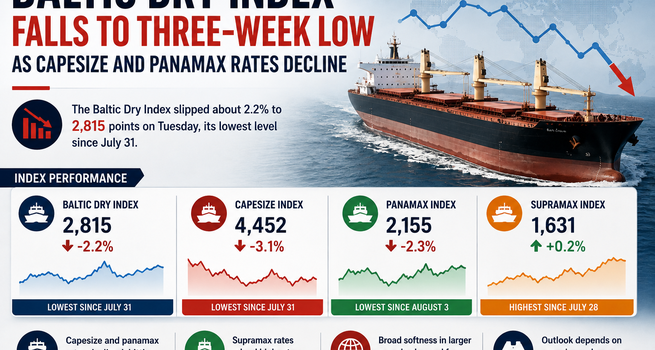
- The Baltic Dry index slipped about 2.2% to 2,815 points, its lowest level since July 31.
- The capesize index dropped 3.1% to 4,452 points, also its lowest since July 31.
- The panamax index declined 2.3% to 2,155 points, its lowest since August 3.
- The supramax index bucked the trend, rising 0.2% to 1,631 points, its highest since July 28.
The Baltic Exchange's dry bulk freight index, which monitors rates for ships carrying dry bulk commodities, slipped about 2.2% to 2,815 points on Tuesday, its lowest level since July 31, snapping a two-day advance.
What Happened
The capesize index, which typically transports 150,000-ton cargoes including iron ore and coal, also halted a two-session winning streak, dropping 3.1% to its lowest since July 31 at 4,452 points.
The panamax index, which tracks vessels carrying around 60,000 to 70,000 tons of coal or grain, declined 2.3% to its lowest since August 3 at 2,155 points.
The supramax index moved in the opposite direction, rising 0.2% to 1,631 points, its highest level since July 28.
Market Reaction
The declines in the capesize and panamax segments, both hitting multi-week lows on the same day, point to broad-based softness in the larger vessel classes that carry bulk commodities like iron ore, coal, and grain over long-haul routes.
The supramax index's modest gain, in contrast, suggests Demand for smaller vessels has held up even as rates for larger ships have retreated, a divergence that highlights how conditions can vary meaningfully across different vessel size classes within the same overall freight market.
Outlook
Whether the capesize and panamax segments stabilize or continue to soften is likely to remain the key Factor shaping the overall Baltic Dry Index's near-term direction, given how heavily the composite reading depends on rates across these larger vessel classes.


 Nov 10, 2026





 Please wait processing your request...