
 AU
AU
 UK
UK
 CA
CA
 NZ
NZ
 IND
IND

 US
US

 Share
Share
 X (Formerly Twitter)
 Whatsapp
 Facebook
 LinkedIn
 Telegram
 Email This Article
 Copy Link
 Summarize with AI
 Chat GPT
 Perplexity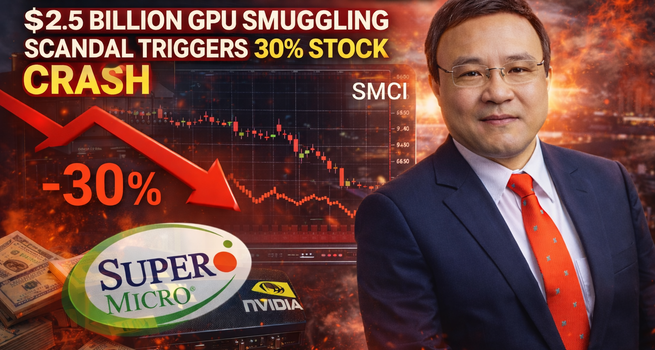
Key Highlights
- Super Micro (NASDAQ:SMCI) shares plunged nearly 30% following arrest of co-founder
- Allegations involve $2.5 billion in Nvidia server shipments to China
- U.S. authorities accuse use of shell entities and compliance evasion tactics
- Incident raises major concerns over export controls and AI supply chains
- Investor confidence shaken amid governance and regulatory risks
Why It Tumbled Today: A Governance Shock Hits the Market
Super Micro Computer experienced a sharp and immediate selloff after reports emerged that co-founder Yih-Shyan “Wally” Liaw had been arrested in connection with a large-scale alleged smuggling operation involving advanced computing hardware.
According to enforcement authorities, the case centers on the illegal diversion of high-performance servers embedded with Nvidia GPUs to Chinese buyers, bypassing U.S. export controls. The scale of the alleged activity is significant, with shipments totaling approximately $2.5 billion.
Markets reacted swiftly. The stock dropped nearly 30% in early trading, reflecting a sudden reassessment of regulatory risk, corporate governance concerns, and potential operational disruption.
The speed and magnitude of the decline highlight how sensitive semiconductor and AI-linked equities have become to compliance and geopolitical developments.
Export Controls and AI Supply Chains: A Growing Fault Line
The allegations come at a time when U.S. export restrictions on advanced semiconductors and AI hardware have tightened considerably. Washington has placed strict limits on the sale of high-performance GPUs and server systems to China, citing national security concerns.
Companies operating in the AI infrastructure ecosystem are now navigating a complex regulatory environment. Compliance is no longer a back-office function but a strategic priority.
The alleged use of Southeast Asian shell entities to reroute restricted hardware, if proven, would represent a direct violation of these controls. It also underscores the challenges regulators face in tracking hardware flows across global supply chains.
For investors, the case raises a broader issue. The AI boom is deeply intertwined with geopolitics, and supply chains are increasingly subject to policy risk rather than purely economic logic.
Core Analysis: What the Allegations Mean for Super Micro
The accusations against a co-founder introduce several layers of risk for Super Micro.
Leadership and Governance Risk
The involvement of a senior figure with substantial equity holdings introduces immediate concerns about oversight and internal controls. Liaw reportedly holds hundreds of millions of dollars in company stock, aligning the case directly with shareholder interests.
Even if the company itself is not formally charged, the reputational impact is material. Institutional investors often reassess exposure when governance integrity is questioned.
Operational Disruption
If authorities expand their investigation, supply chain operations could face scrutiny. This may include:
- Audits of historical shipments
- Review of customer contracts
- Increased regulatory oversight on future exports
Such processes can slow business momentum, particularly in a sector where speed and execution are critical.
Customer and Partner Risk
Super Micro operates within a tightly integrated ecosystem that includes chip suppliers, cloud providers, and enterprise clients. Allegations of compliance breaches could lead partners to reassess relationships, at least temporarily.
In a market where trust and reliability are essential, even perceived risk can impact order flows.
AI Infrastructure Market Trends: High Growth Meets High Scrutiny
The incident comes amid explosive growth in demand for AI infrastructure. Companies supplying servers and GPU-enabled systems have benefited from rising investments in generative AI, data centers, and cloud computing.
However, this growth has also drawn regulatory attention.
Governments are increasingly focused on controlling access to advanced computing power. The rationale is clear. AI capabilities are seen as strategically important, both economically and militarily.
This creates a structural tension in the market:
- On one side, surging demand and capital inflows
- On the other, tightening restrictions and enforcement
Companies operating in this space must balance growth ambitions with strict compliance frameworks. Any failure in this balance can have immediate market consequences, as seen in the current situation.
Financial Market Implications: Valuation Reset and Risk Premium Expansion
The sharp decline in Super Micro’s share price reflects more than just headline risk. It represents a broader repricing of uncertainty.
Valuation Compression
Before the incident, companies linked to AI infrastructure were trading at elevated multiples, supported by strong growth expectations. Events like this introduce a new variable, regulatory risk, which can compress valuations.
Investors may now demand a higher risk premium for companies exposed to export controls and geopolitical tensions.
Earnings Visibility
If investigations lead to operational disruptions or restrictions on shipments, revenue forecasts could come under pressure. Even temporary pauses in shipments can affect quarterly performance in high-growth sectors.
Capital Allocation Shifts
Institutional investors may rotate capital toward companies with clearer compliance track records or lower geopolitical exposure. This could lead to divergence within the AI hardware ecosystem.
Market Sentiment: From Euphoria to Caution
The broader sentiment shift is notable. Over the past year, AI-related stocks have benefited from strong momentum, driven by optimism around technological transformation.
However, the current episode serves as a reminder that:
- Regulatory risks can materialize अचानक and with force
- Governance issues can override strong fundamentals
- Market narratives can shift rapidly
The selloff in Super Micro may not remain isolated. It could prompt investors to reassess risk across the sector, particularly among companies with complex international exposure.
Strategic Outlook: What Comes Next for the Stock and Sector
Looking ahead, several factors will determine how the situation evolves.
Legal and Regulatory Developments
The progression of the case will be critical. Key questions include:
- Whether charges extend beyond individuals to the company
- The scope of alleged violations
- Potential penalties or restrictions
Clarity on these issues will influence investor confidence.
Company Response
Super Micro’s handling of the situation will also be closely watched. Steps such as:
- Strengthening compliance frameworks
- Enhancing transparency with investors
- Cooperating with authorities
could help stabilize sentiment over time.
Sector-Wide Implications
The incident may accelerate broader changes in the industry, including:
- Tighter internal controls across companies
- Increased investment in compliance systems
- Greater scrutiny from regulators
In the long term, this could lead to a more disciplined but slower-moving supply chain.
Conclusion: A Defining Moment for AI Hardware Markets
The alleged smuggling case involving a Super Micro co-founder marks a significant moment for the AI infrastructure sector. It highlights the growing intersection of technology, geopolitics, and regulation.
While the immediate impact has been a sharp decline in the company’s stock, the broader implications extend beyond a single firm. The incident underscores the importance of governance, compliance, and transparency in an industry that is central to future economic growth.
For investors, the lesson is clear. High-growth sectors can deliver substantial returns, but they also carry evolving risks that require careful assessment.


 Jun 04, 2026




 Please wait processing your request...