
 AU
AU
 UK
UK
 CA
CA
 NZ
NZ
 IND
IND

 US
US

 Share
Share
 X (Formerly Twitter)
 Whatsapp
 Facebook
 LinkedIn
 Telegram
 Email This Article
 Copy Link
 Summarize with AI
 Chat GPT
 Perplexity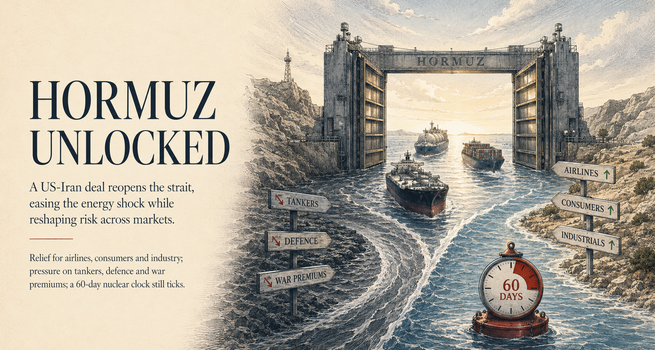
The US-Iran MOU reopens the Strait of Hormuz and reshapes risk across energy, defense, shipping, consumer, LNG, airlines, industrials and equities. Here is what the deal unlocks sector by sector.
Key Highlights
- The US-Iran MOU reopens the Strait of Hormuz and starts a 60-day nuclear negotiation window.
- Goldman Sachs cut its Brent forecast as markets price gradual supply normalisation.
- Tanker, defense and marine insurance premiums face pressure as conflict risk unwinds.
- Airlines, consumer, LNG, logistics and industrial names may benefit from lower energy stress.
- The deal’s durability depends on nuclear talks and regional escalation risks.
A Deal Signed, A Risk Map Redrawn
The memorandum of understanding signed by the United States and Iran in Geneva on June 19, 2026, formally ends a conflict that had shuttered the world's most critical energy chokepoint for nearly four months. The agreement includes a 60-day ceasefire, the reopening of the Strait of Hormuz without transit restrictions, and a commitment by both sides to lift their respective blockades on maritime traffic through the strait. Iran enters a structured nuclear negotiation window and receives immediate oil export waivers, with frozen asset releases contingent on demonstrated compliance.
For institutional investors, the deal is less a geopolitical resolution than a reconfiguration of the risk landscape. The macro tail risk that had threatened to push crude toward $200 per barrel and tip the global economy into recession has been removed for now. What replaces it is a sector-differentiated set of opportunities and reversals that will define capital allocation decisions through the remainder of 2026.
Energy: The Deflation Catalyst Is Real, the Recovery Is Not Instant
Oil prices initially dipped below $80 per barrel on news of the agreement, as traders looked ahead to the restoration of oil, LNG and other goods blocked during the conflict. Goldman Sachs revised its Brent forecast to $80 per barrel for Q4 2026, from $90 previously, and to $75 for the 2027 average, reflecting expectations of gradual supply normalisation.
The pace of that recovery will disappoint anyone expecting an immediate supply flood. Oil tanker and cargo ship traffic will not return to prewar levels within days. Sea mines remain a risk, vessels anchored outside the Gulf require inspection and repositioning, and production facilities need time to restart fully. Tight inventories, residual demand pressure and lingering inflation could keep fuel prices elevated even as crude futures ease.
For US energy majors ExxonMobil (NYSE:XOM) and Chevron (NYSE:CVX), the normalisation of crude represents a compression of extraordinary margin tailwinds, though both companies' domestic production base provides meaningful insulation from Gulf-specific supply dynamics.
Shipping: War Premiums Begin to Unwind
The tanker sector was among the most direct financial beneficiaries of the Hormuz closure. Higher oil prices and longer rerouted shipping lanes generated elevated revenue per voyage for tanker operators, with Frontline (NYSE:FRO), Nordic American Tankers (NYSE:NAT), and DHT Holdings (NYSE:DHT) each benefiting from elevated crude tanker rates and strong fleet utilisation during the conflict period.
As Hormuz traffic stabilises and rerouting reverses, the structural tailwind sustaining exceptional spot rates will begin to compress. For shipping investors, this is a mean-reversion event rather than a structural collapse. Long-term charters signed during the conflict provide some buffer, but the scarcity pricing that lifted tanker equities is no longer the dominant market setup.
Airlines and Travel: Fuel Relief Reopens the Margin Trade
Airlines present the inverse dynamic to tankers. Lower crude and improved Gulf supply visibility reduce jet fuel cost pressure, supporting margin expectations for carriers such as Delta Air Lines (NYSE:DAL), United Airlines (NASDAQ:UAL), American Airlines (NASDAQ:AAL), and Southwest Airlines (NYSE:LUV).
The benefit will not be immediate if hedging, refining spreads and airport costs remain elevated, but the direction of travel is clearly more supportive than during the Hormuz closure. For travel-linked equities, the secondary effect is also important. Lower fuel volatility improves pricing visibility, reduces pressure on ticket margins and can support demand if consumers see gasoline and transportation costs ease over time.
LNG and Natural Gas: Supply Anxiety Eases
LNG markets face a similar reset. The Strait of Hormuz is not only a crude chokepoint but also a critical route for Gulf LNG cargoes, especially those tied to Qatar and Asian import demand. Reopening the strait eases supply anxiety for energy importers in Asia and Europe, while reducing the geopolitical premium embedded in spot gas pricing.
For US-listed energy infrastructure and gas names, the impact is mixed but important. Cheniere Energy (NYSE:LNG), one of the most direct US LNG export plays, may benefit from improved shipping confidence and stronger long-term contract visibility, even if lower global panic premiums reduce near-term pricing pressure. Pipeline and gas infrastructure companies such as Kinder Morgan (NYSE:KMI) and Williams Companies (NYSE:WMB) are less exposed to spot LNG volatility but remain tied to broader gas-flow expectations. EQT (NYSE:EQT), as a major US natural gas producer, could face a more nuanced setup if lower global risk premiums weigh on gas pricing while demand stability improves.
For utilities and gas-sensitive industries, the reopening reduces the probability of a sustained supply shock, even if prices remain above prewar levels during the early stages of normalisation.
Consumer and Retail: Lower Energy Inflation Supports Demand
Consumer and retail equities also gain a cleaner macro setup if lower crude begins feeding through to gasoline, freight and delivery costs. Walmart (NYSE:WMT), Target (NYSE:TGT), Amazon (NASDAQ:AMZN), Costco (NASDAQ:COST), restaurants, travel platforms and delivery-linked businesses could benefit from lower transportation pressure and improved household spending power if energy inflation cools.
The impact is indirect, but important. Cheaper fuel acts like a tax cut for consumers and reduces logistics costs across import-heavy supply chains. The durability of the benefit depends on whether lower crude becomes visible in household budgets before broader demand slows.
Industrials and Chemicals: Feedstock Relief Matters
Industrials and chemicals are another beneficiary group. Energy-intensive manufacturers, fertilizer producers, packaging companies and petrochemical names typically gain when oil and gas feedstock costs ease. Lower crude can support margins for companies exposed to plastics, transport equipment and heavy manufacturing, although the benefit will vary depending on contract structures and regional input costs.
US-listed chemical and fertilizer companies such as Dow (NYSE:DOW), LyondellBasell (NYSE:LYB), Eastman Chemical (NYSE:EMN), and CF Industries (NYSE:CF) give investors a clearer way to track this repricing. Dow and LyondellBasell are tied to petrochemical and plastics chains, Eastman is exposed to specialty materials and industrial demand, while CF Industries is more directly linked to fertilizer and natural-gas-linked input economics.
For US industrial companies, the deal lowers the probability of a prolonged energy-cost shock at the same time investors are already focused on margins, capital spending and demand visibility. The repricing is unlikely to be dramatic in a single session, but it improves the operating backdrop for sectors that had been absorbing higher transport and input costs.
Insurance and Logistics: Scarcity Pricing Starts to Fade
Marine insurance and freight logistics also move from scarcity pricing toward normalisation. War-risk premiums, rerouting costs, port delays and inspection bottlenecks had inflated the cost of moving goods through and around the Gulf. As Hormuz traffic stabilises, those premiums should begin to compress.
For logistics companies such as FedEx (NYSE:FDX), UPS (NYSE:UPS), C.H. Robinson Worldwide (NASDAQ:CHRW), and Expeditors International (NYSE:EXPD), the reopening can reduce pressure from rerouting, fuel volatility and shipment delays. The benefit is not uniform, because contract terms and customer mix matter, but the direction is more supportive for freight networks and import-heavy supply chains.
For insurers and reinsurers, the trade is more complicated. AIG (NYSE:AIG), Chubb (NYSE:CB), and Arch Capital (NASDAQ:ACGL) may lose part of the conflict-driven pricing tailwind as war-risk premiums cool. However, the reset will be gradual rather than instant, because mines, inspections, vessel repositioning and regional security checks will keep a residual risk premium in place.
Emerging Markets: Oil Importers Get Breathing Room
Emerging markets add one more layer to the trade. Oil-importing economies such as India, Turkey and parts of Asia stand to benefit from lower crude prices through improved current-account balances, softer inflation pressure and reduced subsidy burdens.
For Gulf oil exporters, the effect is less straightforward. Lower prices ease global recession risk and support regional trade flows, but they also reduce the fiscal windfall created by the conflict-era crude spike. That makes the MOU broadly positive for global risk appetite, but uneven for commodity-linked emerging-market assets.
Defense: Geopolitical Premium Comes Off the Table
The defense sector's repricing on deal confirmation was immediate and broad-based. Northrop Grumman (NYSE:NOC), Lockheed Martin (NYSE:LMT), RTX (NYSE:RTX), General Dynamics (NYSE:GD), and Boeing (NYSE:BA) all came under pressure as investors marked down the conflict premium embedded in the group.
The selloff reflects a straightforward mechanism: conflict-era multiples had incorporated assumptions of sustained elevated demand for precision munitions, missile defense systems and military replenishment. A ceasefire structurally weakens that near-term demand narrative.
The longer-cycle question is more nuanced. Northrop Grumman carries a record backlog anchored by the B-21 bomber and Sentinel ICBM programme, while Lockheed Martin continues to benefit from F-35 demand and expanding Indo-Pacific defense commitments. These are decade-scale programmes. The Iran peace removes a near-term catalyst but does not alter the structural trajectory of Western rearmament driven by NATO commitments and Indo-Pacific posture.
Broad Markets and the 60-Day Clock
US equity futures rose on the deal announcement, with S&P 500 futures and Nasdaq futures both gaining as investors priced in lower energy inflation, softer recession risk and reduced pressure on the Federal Reserve. Lower crude reduces inflation expectations, eases rate-path assumptions and expands the multiples available to growth equities.
The durability of the rally rests on two variables the MOU does not resolve. The first is the nuclear negotiation outcome at the end of the 60-day window. The second is Israel's independent military posture in Lebanon. A previous ceasefire collapsed in part when Iran suspended strait access following Israeli strikes in Lebanon, and that dynamic has not been resolved in the current framework.
Markets are pricing the reopening. Whether the deal holds long enough to become a durable repricing event depends entirely on what the nuclear negotiation window produces.

 Jun 18, 2026



_06_18_2026_21_18_06_001449.jpg)
 Please wait processing your request...