
 AU
AU
 UK
UK
 CA
CA
 NZ
NZ
 IND
IND

 US
US

 Share
Share
 X (Formerly Twitter)
 Whatsapp
 Facebook
 LinkedIn
 Telegram
 Email This Article
 Copy Link
 Summarize with AI
 Chat GPT
 Perplexity
index Update
US Equity indices pulled back from record highs on Wednesday as escalating Middle East tensions, rising oil prices, and stronger US economic data fueled concerns over Inflation and a more hawkish Federal Reserve. The S&P 500 fell 0.7%, the Nasdaq 100 declined 0.9%, and the Dow dropped 619 points, with pressure led by software and financial names. Oracle and Palantir lost over 5%, Microsoft fell 3%, while Blackstone and KKR declined around 4% each. After hours, Broadcom and CrowdStrike also weakened following disappointing Earnings updates and guidance.
Market Movers
Among the top-performing stocks of the session Xos, Inc. surged 234.53%, while Wellchange Holdings Company Limited rallied 179.35%. On the losing side, Republic Power Group Limited. fell 73.09%, while Ascent Solar Technologies, Inc. declined 22.01%, making them the weakest performers during the trading day.
Commodities Update
Commodity markets eased on Thursday as improving diplomatic signals in the Middle East reduced some risk premium, with WTI crude falling nearly 1% to around $95 per barrel and Brent slipping below $97, snapping three-day rallies. Investors reacted to reports of a potential Israel-Lebanon ceasefire, ongoing US-Iran negotiations, and President Trump’s comments that progress with Iran could emerge as soon as this weekend, although regional tensions remain elevated following recent military exchanges and spillover into Bahrain and Kuwait. On the Supply side, US crude inventories declined for a sixth consecutive week, providing underlying support to oil prices. Meanwhile, precious metals weakened, with gold trading around $4,450 per ounce and silver near $73 per ounce, as persistent energy-driven inflation concerns fueled expectations that central banks, including the Federal Reserve, may need to tighten Monetary Policy further. Market Participants are now closely watching Friday’s US nonfarm payrolls report for additional clues on the interest-rate outlook.
Macro Updates
US Job Cuts Rise to Highest May Level Since 2020 as AI-Driven Restructuring Accelerates
US employers announced 97,006 job cuts in May 2026, up from 83,387 in April, marking the highest May total since 2020 and the third consecutive monthly increase. Artificial intelligence remained the leading driver of workforce reductions for a third straight month, with the technology sector accounting for 38,242 cuts, its highest monthly total since August 2024. Other heavily impacted sectors included transportation, services, and Fintech. According to Challenger, Gray & Christmas, companies are increasingly restructuring through AI adoption, mergers and acquisitions, and Bankruptcy-related cost reductions as they adapt to an evolving economic landscape. Despite the recent rise, total announced job cuts for 2026 stand at 397,755, down 43% year-over-year, although that comparison is influenced by unusually large federal workforce reductions in 2025. Excluding that Factor, job-cut activity is broadly tracking 2024 levels.
Dollar Holds Near Two-Month High on Strong Labor Data and Fed Rate Hike Bets
The US Dollar Index traded around 99.4 on Thursday, staying close to a two-month high as stronger US labor market data strengthened expectations of tighter Federal Reserve policy. The ADP report showed private-sector jobs rose by 122,000 in May, beating forecasts and marking the strongest reading since January 2025, while JOLTS data showed Job Openings climbed to their highest level since November 2024. Elevated oil prices amid Middle East tensions also supported the dollar by adding to inflation concerns. Investors now await Friday’s nonfarm payrolls report, with markets pricing in an 85% chance of a 25-basis-point Fed rate hike by year-end, up from 60% a week earlier.
Bonds Commentary
The US 10-year Treasury Yield hovered around 4.48% on Thursday after rising in the previous session, supported by stronger-than-expected labor market data and growing expectations of further Federal Reserve tightening. The ADP report showed private-sector employment increased by 122,000 in May, exceeding forecasts and reaching its strongest level since January 2025, while JOLTS data revealed job openings climbed to their highest level since November 2024. Elevated oil prices driven by ongoing Middle East tensions have also added to inflation concerns, reinforcing the case for tighter monetary policy. Investors are now focused on Friday’s nonfarm payrolls report, with markets currently pricing in an 85% probability of a 25-basis-point Fed rate hike by year-end, up from 60% just a week ago.
Futures Update
US stock futures moved lower on Thursday as weak earnings updates from major technology companies pressured investor sentiment. Broadcom fell nearly 14% after missing fiscal second-quarter Revenue expectations, while CrowdStrike dropped over 11% on softer sales guidance. The selloff spread across key tech names including Intel, AMD, Palantir, Qualcomm, and Arm Holdings. Markets were also weighed down by renewed US-Iran tensions, which raised concerns over inflation and higher interest rates. The weakness followed Wednesday’s decline, when the Dow fell 1.21%, the S&P 500 lost 0.74%, and the Nasdaq dropped 0.89%, led by losses in technology, financials, and consumer discretionary sectors.
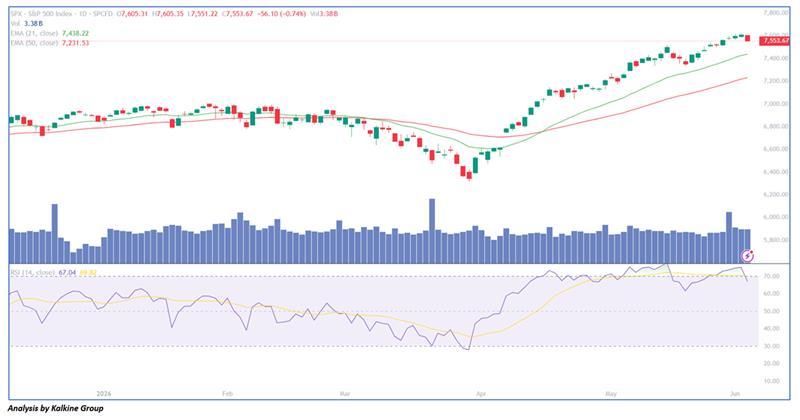
U.S. stocks closed lower on Wednesday as investors took profits following several sessions of gains, with the Dow leading the decline. Despite the pullback, the S&P 500 remains technically bullish, continuing to trade well above its rising 21-day and 50-day EMAs. The recent weakness appears to be a healthy consolidation after the strong rally from April lows, while RSI remains elevated but below overbought extremes, indicating momentum is moderating rather than reversing. The prevailing higher-high, higher-low trend structure suggests buyers remain in control, and as long as the index holds above the 7,500–7,450 support zone, the broader uptrend remains intact with potential for another test of the 7,600–7,650 resistance area.

 Jun 04, 2026
 Please wait processing your request...