
 CA
 NZ
 UK
 AU
 IND

 US

 Share
 X (Formerly Twitter)
 Whatsapp
 Facebook
 LinkedIn
 Telegram
 Email This Article
 Copy Link
 Summarize with AI
 Chat GPT
 Perplexity
Key Highlights
- Figma closed at $21.49 on Oct. 16, about 35% below its $33 IPO price, and Adobe closed at $245.20, down about 30% this year
- Figma’s adjusted Operating Margin fell to 10% from 16% in one quarter as AI costs rose, despite 48% Revenue growth
- Wells Fargo cut Adobe to Underweight with a $225 target, and HSBC moved to Hold, citing AI risks
- Adobe trades at a forward P/E of about 10.3 and has $24.55 billion left on its buyback authorization
- Investors will look to Figma’s next report and Adobe’s fiscal fourth-quarter results for direction
Figma Inc. (NYSE: FIG) and Adobe Inc. (NASDAQ: ADBE) are being punished by investors for the same reason: a growing belief that artificial intelligence will make design software cheaper to replace and costlier to run.
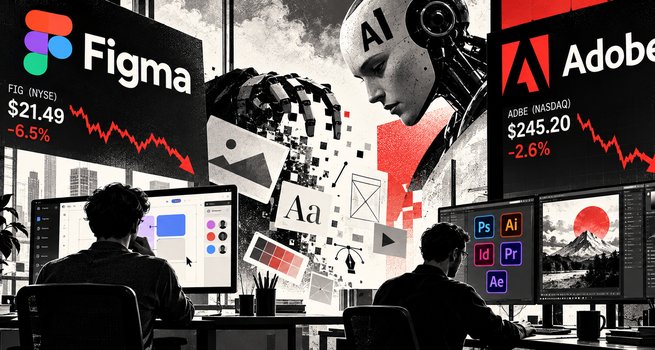
Figma shares closed at $21.49 on Oct. 16, down 6.5% on the day, after AI-financing fears spread across software stocks. That is about 35% below its $33 IPO price from July 2025 and far under the first-day highs above $100. Adobe fell 2.6% to $245.20 the same session, leaving it down about 30% this year, while the S&P 500 lost 1.1% and the Nasdaq Composite dropped 2.1%.
The two stocks are being hit from different directions. Figma is a fast-growing company whose spending on AI is squeezing profit. Adobe is a mature, highly profitable one whose valuation has collapsed on fears that its core products will be displaced.
At Figma, the damage dates to its second-quarter report on Aug. 5. Revenue rose 48% to $370.1 million, beat the company’s own guidance, and the outlook for the year was raised. The shares still fell about 16% after hours. Adjusted operating margin dropped to 10% from 16% in a single quarter, and third-quarter revenue guidance of $373 million to $375 million implied slower sequential growth that analysts at Goldman Sachs and Citigroup pressed management on.
Chief Financial Officer Praveer Melwani told investors that more than 80% of paid customers with over $10,000 in annual Recurring Revenue were using AI credits weekly, evidence that Demand for the new tools is real. But he also said several new products in Beta do not yet draw paid credits, so the cost of running them lands before any revenue does. Management said gross margin can vary from quarter to quarter while it funds that usage, and it kept full-year non-GAAP Operating Income guidance at $125 million to $135 million, or about a 9% margin at the midpoint.
The report also carried a Leadership shock. The Information reported that the chief Marketing officer and chief product officer were both leaving, a departure that added to unease about execution at a company still adjusting to life as a public company.
Competition is the other worry. Analysts have pointed to AI-powered design and coding tools, including Claude Design and Vercel, as potential threats to Figma’s market share. The stock had lost about 59% over a year as of a September market summary, even as the Business kept growing quickly. Figma is profitable on an adjusted basis, but that has not been enough for investors who bought at much higher prices.
Adobe’s problem looks different. Revenue has been hitting records, yet the shares ended last year near $350 and now trade near $240. The stock touched a 52-week low of $220.17 in late September, and a close below roughly $224.67 would break the September and October lows, according to one technical analysis.
October brought a pair of downgrades. Wells Fargo analyst Michael Turrin cut Adobe to Underweight from Overweight and lowered his target to $225 from $270, after a survey showed three out of five companies plan to shift part of their IT budgets toward AI. The shift, he argued, hurts makers of front-end tools such as Adobe. HSBC moved to Hold and trimmed its target to $267 from $310, citing the risk that AI tools could be used to build clones of existing software, along with security and legal concerns.
That left Adobe trading at a forward price-to-earnings ratio of about 10.3 on Oct. 16, against an industry average near 16.8, according to Zacks. Its trailing multiple of about 13.3 compares with a five-year median above 37. In other words, the market is no longer paying for growth. It is pricing in the possibility that growth ends.
Adobe has leaned on buybacks. Its board approved a new $25 billion authorization in April, running through April 2030, and $24.55 billion was still unused at the end of the fiscal third quarter. That is roughly 26% of the company’s Market Value at recent prices. Shares outstanding have fallen, though employee stock awards have offset part of the effect. Insiders, meanwhile, sold about $31 million of stock over three months, according to one data provider.
The common thread is how quickly sentiment toward software has turned. When Figma reported in August, shares of Salesforce, ServiceNow, Intuit and Adobe also slipped, as investors read the results as a sign that AI is squeezing margins across the industry. Two months later, the concern has widened from costs to relevance, and the broader market’s anxiety over AI financing has made every software rally harder to sustain.
There are counterarguments. Figma’s growth is accelerating and its non-GAAP gross margin was 85% in the second quarter, up 2.5 percentage points from the prior quarter, with management pointing to model routing and first-party models as ways to cut inference costs. Adobe’s valuation sits well below its history, and it is generating the cash to keep repurchasing shares. Bulls on both stocks argue the sell-off prices in a worst case that may not arrive.
But the bear case does not require a collapse in demand. It requires only that AI tools lower the price customers will pay, raise the cost of delivering the product, or both. Figma shows the cost side already. Adobe shows the price-and-relevance side, where the evidence is less visible in reported results than in analyst notes and share prices.
The next tests are earnings. Investors will look at Figma’s next Quarterly Report for whether margins stabilize and Credit monetization broadens, and at Adobe’s fiscal fourth-quarter results for signs that AI is helping rather than hurting its subscription business. Until then, both stocks are likely to trade on sentiment about AI as much as on their own numbers.
This content is for informational purposes only and does not constitute Investment advice. Readers should do their own research before making any investment decision.


 Nov 06, 2026





 Please wait processing your request...