
 CA
 NZ
 UK
 AU
 IND

 US

 Share
 X (Formerly Twitter)
 Whatsapp
 Facebook
 LinkedIn
 Telegram
 Email This Article
 Copy Link
 Summarize with AI
 Chat GPT
 Perplexity

Key Highlights
• BXP signed about 1.8 million square feet of leases at 129% of its ten-year second-quarter average, raising full-year 2026 FFO guidance to $6.99-$7.05 per share.
• Alexandria signed more space, 1,038,917 square feet, but rents on renewed and re-leased space fell 4.3% on a cash basis, and operating occupancy slipped to 86.9%.
• Alexandria recorded $222.5 million of real estate impairments and priced $1 billion of 7.25% junior subordinated notes, reflecting a higher Cost of Capital than BXP.
Both landlords depend on signing tenants to long leases, which is why leasing Demand is central to BXP (NYSE:BXP) and Alexandria Real Estate Equities (NYSE:ARE), and their latest results show that demand is diverging. BXP, which owns premier offices in six US gateway cities, raised its 2026 guidance after a strong leasing quarter. Alexandria, the life-science laboratory specialist, signed more space but reported lower occupancy, falling Revenue and weaker rents on re-leased space. Both are NYSE-listed real estate Investment trusts classified as office REITs, and both remain S&P 500 constituents after the September 2026 rebalance.
Two Landlords, Two Kinds of Tenant
BXP, Inc., formerly Boston Properties, owns 164 properties totalling 51.1 million square feet across Boston, Los Angeles, New York, San Francisco, Seattle and Washington DC. Its tenants are largely law firms, financial groups and technology companies seeking high-quality space in central Business districts.
Alexandria owns laboratory and office campuses let to life-science and advanced-technology companies in clusters such as Greater Boston, the San Francisco Bay Area and San Diego. It says 57% of annual rental revenue comes from investment-grade or publicly traded large-cap tenants, and 80% from its Megacampus platform of large, amenity-rich clusters.
The distinction matters. Demand for top-tier offices has been recovering as employers consolidate into better buildings, whereas laboratory demand follows biotech funding cycles and is still absorbing Supply added earlier in the decade.
BXP: Volume, Occupancy and a Guidance Upgrade
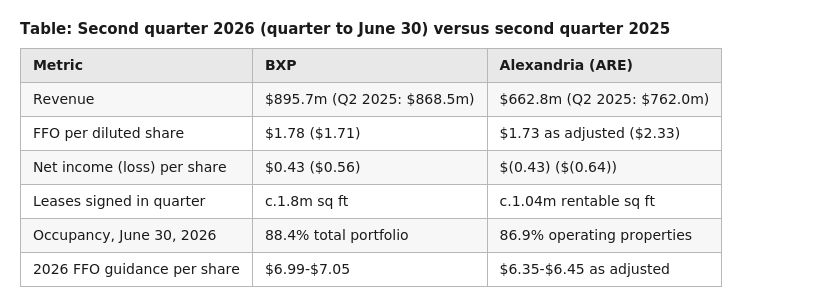
In the three months to June 30, 2026, reported on July 28, 2026, BXP signed about 1.8 million square feet of leases across 106 transactions, with a weighted average term of 9.9 years. The company said this was 129% of its ten-year second-quarter average. Notable deals included 322,000 square feet for Boston Dynamics at Reservoir Place in Waltham, Massachusetts, and 148,000 square feet for law firm McDermott Will & Schulte at its 343 Madison Avenue development in New York.
Total portfolio occupancy rose to 88.4% from 86.7% at December 31, 2025, while the leased figure, which includes signed leases that have not yet commenced, reached 91.3%. That gap is useful: it represents rent that should start flowing as tenants move in.
Funds from operations was $1.78 per diluted share, up from $1.71 a year earlier. Net Income attributable to BXP fell to $0.43 per share from $0.56. Management raised full-year 2026 FFO guidance to $6.99-$7.05 per share, lifting the midpoint by $0.05, and guided to $1.80-$1.82 for the third quarter.
Alexandria: More Signings, Weaker Economics
Alexandria's second-quarter release, dated August 3, 2026, tells a more mixed story. Leasing reached 1,038,917 rentable square feet, 60% more than in the first quarter, taking first-half Volume to about 1.69 million. The company said 75% of leasing over the past twelve months came from existing tenants.
However, rents on renewed and re-leased space fell 0.7% on a GAAP straight-line accounting basis and 4.3% on a cash basis, and operating occupancy slipped to 86.9% from 87.7% at March 31, 2026. Revenue fell to $662.8 million from $762.0 million a year earlier, and FFO per share, as adjusted, dropped to $1.73 from $2.33. Real estate impairments of $222.5 million contributed to a net loss of $0.43 per share.
Guidance for 2026 FFO per share, as adjusted, was narrowed to $6.35-$6.45 from $6.30-$6.50, leaving the midpoint unchanged. Executive chairman Joel Marcus told analysts that Alexandria was winning an outsized number of shares of transactions.
How Signed Leases Reach the Income Statement
For both companies the mechanism is similar, but the Leverage differs. A signed Lease adds rent only once the tenant takes possession, often after months of fit-out partly funded by landlord concessions. BXP's widening gap between leased and occupied space therefore points to future revenue, and its long lease terms lock in income for close to a decade.
For Alexandria, volume alone is not enough. When new leases replace expiring ones at lower cash rents, revenue per square foot falls even as space is filled. Vacancy also costs money: operating expenses and property taxes on empty space are not recovered from tenants, and developments that lease slowly can require write-downs, as the Impairment charge showed.
The two markets also overlap. BXP's Boston Dynamics lease, described by the company as supporting robotics and AI innovation, is the kind of advanced-technology requirement Alexandria also courts. Competition for such tenants between office owners and laboratory specialists could shape rents in Greater Boston, where both landlords have significant holdings.
Funding, Asset Sales and Dividends
Both companies are tapping Debt markets while recycling assets. Alexandria priced $1 billion of 7.25% junior subordinated notes due 2057 on August 12, 2026, with proceeds available for general purposes including reducing credit-line and Commercial Paper borrowings. It is targeting $2.1-$3.7 billion of 2026 dispositions, of which $170.4 million had completed and $1,158.6 million were pending. Its quarterly Dividend is $0.72 per share.
BXP is also selling selected assets, including an anticipated disposal of Sumner Square in Washington DC, while completing developments: 290 Binney Street in Cambridge, Massachusetts, fully leased to AstraZeneca, was placed in service during the quarter.
Risks to the Interpretation
One strong quarter of signings does not guarantee a sustained recovery. BXP's net income declined year on year, and gateway office markets remain sensitive to employment in finance, law and technology. Occupancy of 88.4% also leaves room for setbacks if large tenants shrink at lease expiry.
For Alexandria, asset sales will remove future income, and the 7.25% coupon on its new notes signals a higher cost of capital. Biotech funding and federal research spending remain uncertain, and further impairments are possible if projects lease slowly. Its occupancy fell even as leasing rose, a reminder that move-outs can outpace new signings.
Leasing-Recovery Signals Ahead
For BXP, the key indicators are whether the leased-versus-occupied gap narrows as tenants take possession, delivery against third-quarter FFO guidance of $1.80-$1.82, and pre-leasing progress at 343 Madison Avenue. For Alexandria, watch cash rental spreads on renewals, whether operating occupancy stabilises, completion of the $1,158.6 million of pending sales, any further impairment charges, and whether 2026 guidance holds at $6.35-$6.45.


 Nov 02, 2026





 Please wait processing your request...