
 AU
AU
 UK
UK
 CA
CA
 NZ
NZ
 IND
IND

 US
US

 Share
Share
 X (Formerly Twitter)
 Whatsapp
 Facebook
 LinkedIn
 Telegram
 Email This Article
 Copy Link
 Summarize with AI
 Chat GPT
 Perplexity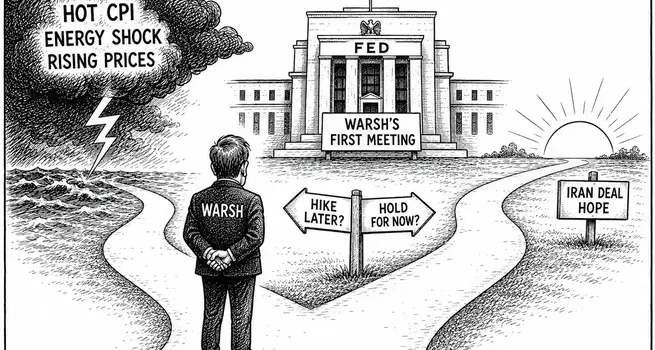
U.S. markets face their most consequential policy week of the year as Kevin Warsh chairs his first Federal Reserve meeting on Wednesday, May retail sales and industrial production round out the data calendar, and signs of a US-Iran deal converge with a shortened trading week ahead of the Juneteenth holiday.
A suddenly rocky U.S. stock market enters the week with the S&P 500 nearly 3% below its record close from June 2 and the Nasdaq Composite down almost 5% from the same session, with the Cboe Volatility Index hitting two-month highs. Technology shares, which drove the rally off the March low, have led the recent declines, and investors now confront the year's most closely watched policy event: Kevin Warsh's first meeting as Federal Reserve chair on Wednesday. May CPI released this week showed consumer inflation rising at its fastest pace in three years, and Fed funds futures already imply a rate hike by year-end despite the central bank being widely expected to hold steady this week. The question is not whether the Fed moves on Wednesday, but how Warsh communicates the path forward.
Monday, June 15
Economic Data
Industrial production for May, prior at 0.7%, is forecast to slow sharply to 0.2%, a deceleration that would mark a meaningful loss of momentum in the goods-producing economy just two days before the Fed's decision. Capacity utilisation, prior at 78.1%, provides context for whether the slowdown reflects demand softening or supply-side constraints. A weak print would introduce a growth-versus-inflation tension directly into the data the Fed is weighing as it prepares its projections.
Tuesday, June 16
Earnings
La-Z-Boy (NYSE:LZB) reports in the afternoon, offering a discretionary furniture spending read that will be interpreted against the housing data from Monday and the broader question of whether elevated energy costs are compressing big-ticket household purchases.
Economic Data
Housing starts for May, prior at 1.6 million, and import prices, prior at 1.9%, are both forecast to show further softening. Housing starts and building permits are both expected to have declined in May, extending the trend visible in Monday's NAHB reading. Import prices remain a direct channel through which energy cost pass-through from the Strait of Hormuz closure feeds into the broader inflation picture, and any acceleration here would reinforce the hot CPI print from earlier this month heading into Wednesday's Fed decision.
Wednesday, June 17
Earnings
Jabil Circuit (NYSE:JBL) and CarMax (NYSE:KMX) both report before the open. Jabil provides a read on electronics manufacturing services demand across the AI hardware supply chain, a segment that has been a direct beneficiary of the data centre buildout. CarMax offers a used vehicle and consumer credit read, with its results watched for evidence of whether elevated borrowing costs and energy prices are affecting big-ticket consumer purchases ahead of the Fed's afternoon decision.
Economic Data
Retail sales for May, prior at 0.6%, are forecast at 0.5%, matching the previous month's pace. A reading in line with or above forecast would reinforce the resilient labour market narrative from the May jobs report and add to the case for a more hawkish Fed posture. Manufacturing and trade inventories and sales for April, prior at 0.9%, and pending home sales, prior at 1.4%, round out the morning's releases.
Federal Reserve
The Federal Reserve's interest rate decision arrives at 2:00 pm ET, prior at 3.8%, in what is the week's defining event and the most closely watched FOMC meeting of the year. The Fed is widely expected to hold rates steady, with LSEG market pricing implying little prospect of a hike on Wednesday itself. The focus is entirely on the accompanying projections and on Kevin Warsh's first press conference as chair. Officials are expected to give updated projections on the path of interest rates and the economy, including inflation, and investors will scrutinise every word for signals on whether the committee is leaning toward a hike later this year given May's hot CPI print and the resilient May jobs report. Warsh has expressed a desire to pare the Fed's $6.7 trillion balance sheet and may seek to change how the Fed communicates policy guidance, either of which could introduce meaningful volatility regardless of the rate decision itself. A hawkish hold, where rates are left unchanged but the language signals openness to a hike, would represent a surprise to markets currently positioned for a more neutral tone.
Thursday, June 18
Earnings
Kroger (NYSE:KR) reports before the open, providing the week's primary grocery retail read. Its results will be parsed for evidence of how food price inflation, layered on top of the energy cost shock, is affecting volume trends and margin management at the consumer staples level. Methode Electronics (NYSE:MEI) also reports Thursday afternoon, offering a smaller-cap industrial and automotive components read.
Economic Data
Initial jobless claims for the week ending June 13, prior at 229,000, provide the first labour market read following Wednesday's Fed decision. Leading indicators for May, prior at 0.1%, close Thursday's calendar with a forward-looking composite read on the broader economy in the immediate aftermath of the Fed's decision.
Friday, June 19
Market Holiday
U.S. financial markets are closed for the Juneteenth holiday. No data releases are scheduled. The shortened trading week means markets will have only Thursday's session to digest Wednesday's Fed decision before the weekend, potentially amplifying any post-meeting volatility into a single compressed trading day.
Geopolitical Backdrop
Signals that the United States and Iran are converging toward a deal to end their conflict represent the most significant positive development on the geopolitical front in recent weeks. The trajectory of energy supply from the Middle East remains the dominant variable shaping the inflation outlook that Warsh's Fed must navigate in his first meeting. Even with positive signals on a deal, the energy price shock stemming from the Strait of Hormuz closure has already worked its way into May's CPI print, which came in at its fastest pace in three years, meaning the inflationary consequences of the conflict are now embedded in the data the Fed must respond to regardless of how quickly diplomatic progress translates into lower oil prices.
The policy backdrop this week extends well beyond the Federal Reserve. The Bank of England, Bank of Japan, Reserve Bank of Australia, Riksbank, Swiss National Bank, Norges Bank, and the Central Bank of Brazil all set rates this week, with the BoE widely expected to mirror the Fed's hold-but-watch posture. In Asia, the prolonged Middle East conflict is adding pressure on regional currencies, with Japan, Australia, and Indonesia all making policy decisions against this backdrop. The breadth of simultaneous central bank action underscores that the energy price shock is a globally synchronised inflation event, not a U.S.-specific phenomenon, which raises the stakes for how coordinated or divergent the policy responses prove to be.
The Week in Context
By Thursday's close, before the Juneteenth holiday extends the weekend, the market will have its first real read on how a Warsh-led Federal Reserve communicates under pressure. The S&P 500's nearly 3% pullback from its June 2 high and the Nasdaq's nearly 5% decline reflect a market that has already begun pricing some probability of a hawkish surprise. If Wednesday's decision delivers a hold with dovish-leaning language, the cooling rally could find its footing again. If Warsh delivers a hawkish hold, acknowledging the inflationary consequences of the energy shock and signalling openness to a hike later this year, the market's recent volatility could extend meaningfully into the holiday-shortened close. Retail sales and industrial production data earlier in the week will have already shaped the baseline expectations the Fed walks into the room with, making Monday through Wednesday's data sequence as consequential as the decision itself.


 Jun 14, 2026
_06_12_2026_23_00_13_327450.jpg)



 Please wait processing your request...