
 CA
 NZ
 UK
 AU
 IND

 US

 Share
 X (Formerly Twitter)
 Whatsapp
 Facebook
 LinkedIn
 Telegram
 Email This Article
 Copy Link
 Summarize with AI
 Chat GPT
 Perplexity
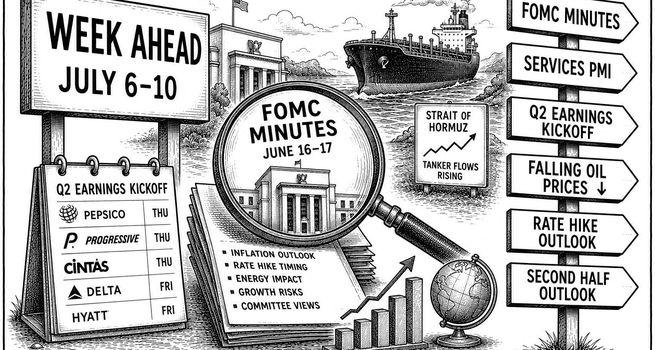
The second half of 2026 opens with the same tension that defined the first: a technology-driven rally wobbling under the weight of rate hike expectations, even as the macro backdrop has begun to shift materially in the market's favour. Tanker flows through the Strait of Hormuz picked up sharply in early July, driving energy prices lower, but long-term Treasury yields have remained elevated, keeping the monetary policy debate squarely in focus.
The S&P 500 delivered its best quarter since 2020 in Q2, rising 14.9%, and is now up more than 9% for the year. But semiconductor and technology shares have swung dramatically in recent weeks, and the question of whether sector rotation into healthcare, industrials, and financials can sustain the broader rally is one the week's data and earnings will begin to answer.
FOMC minutes from the June 16-17 meeting land Wednesday and will be the most closely parsed Fed communication since Warsh's first press conference, with investors seeking to understand how the new committee thinks about the inflation-versus-growth trade-off now that energy prices are receding.
Monday, July 6
Economic Data
Three services sector readings open the week and collectively provide the most current picture of the economy's dominant engine.
The S&P Global US Services PMI for June, prior at 50.7, lands at 9:45 am ET alongside the ISM Report on Business Services PMI for June, with a consensus of 54.3 against a prior of 54.5. The Global Services PMI, prior at 51.3, provides an international cross-check. Services activity has remained resilient despite moderating growth, and the prices-paid sub-index across both surveys will receive particular attention for any re-acceleration signal following the energy price repricing from the Strait of Hormuz ceasefire.
A meaningful deterioration in the ISM Services headline would be the first evidence that the services sector, the dominant engine of U.S. economic growth, is beginning to feel the cumulative weight of elevated borrowing costs.
Tuesday, July 7
Market
No economic data or earnings are scheduled. Attention turns to Wednesday's FOMC minutes and the early Q2 earnings reports arriving Thursday and Friday.
Wednesday, July 8
Economic Data
Monthly wholesale trade for May, prior at 0.6%, lands at 10:00 am ET. Consumer credit for May, prior at $20.7 billion and forecast at $15 billion, arrives at 3:00 pm ET and provides a read on household borrowing appetite under elevated interest rates and gradually easing energy costs.
Federal Reserve
The FOMC minutes from the June 16-17 meeting are released at 2:00 pm ET in the week's most consequential event. The meeting produced a hold decision but was widely interpreted as surprisingly hawkish, with Chair Warsh emphasising the Fed's commitment to price stability and explicitly abandoning forward guidance on the near-term rate path. Investors will examine the minutes for the distribution of views on inflation, the extent of any division among officials on the timing of a potential rate hike, and how policymakers were thinking about the inflationary impact of energy prices heading into the meeting as Iran war-related spikes were beginning to recede.
Warsh's decision to jettison forward guidance means future FOMC minutes will carry more informational weight than in recent years, making Wednesday's release the most important regular Fed communication channel of the new regime. Fed funds futures currently suggest roughly even odds of a September rate hike following Thursday's cooler-than-expected June jobs report, and the minutes will either reinforce or reduce that probability.
Thursday, July 9
Earnings
PepsiCo (NASDAQ:PEP) reports before the open as one of the week's two anchor earnings events and among the first major Q2 results of the season. As a bellwether for both consumer staples spending and global food and beverage demand, its organic revenue growth and volume trends will be parsed for evidence of how easing energy costs and persistent core inflation are affecting household purchasing behaviour. Pricing power commentary will be particularly relevant given the broader question of whether consumer staples companies can sustain the margin recovery visible in Q1 results.
Progressive (NYSE:PGR) also reports Thursday, providing an insurance sector read on claims trends and underwriting conditions. Cintas (NASDAQ:CTAS) rounds out Thursday's earnings with a uniform and workplace services read that functions as a proxy for U.S. employment health and small business activity levels.
Economic Data
Weekly jobless claims for the week ending July 4, prior at 215,000 and consensus at 218,000, provide the most current labour market read of the week following Thursday's cooler-than-expected June payrolls print. Existing home sales for June, prior at 4.2 million and forecast to hold at 4.2 million, the highest level this year, offer a housing demand read under gradually easing mortgage rate pressure.
Friday, July 10
Earnings
Delta Air Lines (NYSE:DAL) reports before the open as the week's second anchor earnings event and the most direct early read on the Q2 consumer travel and airline cycle. Delta's results will be watched for evidence of whether leisure travel demand has held firm despite four months of elevated fuel costs, and whether the recent decline in oil prices is beginning to translate into margin recovery at the operating level. Its forward guidance on capacity, load factors, and fuel cost assumptions will set the tone for the broader airline sector heading into the peak summer travel season.
Hyatt Hotels (NYSE:H) also reports Friday morning, extending the travel and hospitality read alongside Delta.
Geopolitical Backdrop
Tanker flows through the Strait of Hormuz picked up sharply in early July, the most tangible operational evidence yet that the US-Iran ceasefire is translating into physical normalisation of energy supply routes. Energy prices have declined materially as a result, with the disinflationary impulse now beginning to work its way through the data pipeline.
However, long-term Treasury yields have remained elevated despite the oil price decline, suggesting that markets are attributing a portion of the yield move to structural fiscal and monetary policy factors rather than purely to the energy shock. The durability of the ceasefire and the pace at which Strait normalisation feeds through into headline inflation remain the two variables most likely to determine whether the Fed's September meeting produces a hike or an extended hold.
OPEC meets this week to define output levels on the backdrop of improved trade routes and lower oil prices, a decision that will be watched for any signal that the cartel is prepared to reduce supply to defend price floors at a moment when the geopolitical premium driving prices above $100 a barrel has been largely unwound. Any production cut announcement would represent a counter-pressure on the disinflationary trend that the ceasefire has set in motion.
The Week in Context
The second half opens with two questions that the week will begin to answer. First, how hawkish was the June FOMC meeting behind closed doors, and does the full minutes record suggest a committee moving toward a September hike or one that is genuinely data-dependent on the energy disinflation now underway. Second, whether PepsiCo and Delta's early Q2 results confirm that the earnings growth trajectory visible in Q1, where S&P 500 profits jumped more than 28% year-on-year, is decelerating toward the 24% consensus estimate for Q2 or holding at a higher level. Either answer will materially shape positioning ahead of the major bank earnings that open the full reporting season the following week.


 Nov 20, 2026





 Please wait processing your request...