
 CA
 NZ
 UK
 AU
 IND

 US

 Share
 X (Formerly Twitter)
 Whatsapp
 Facebook
 LinkedIn
 Telegram
 Email This Article
 Copy Link
 Summarize with AI
 Chat GPT
 Perplexity
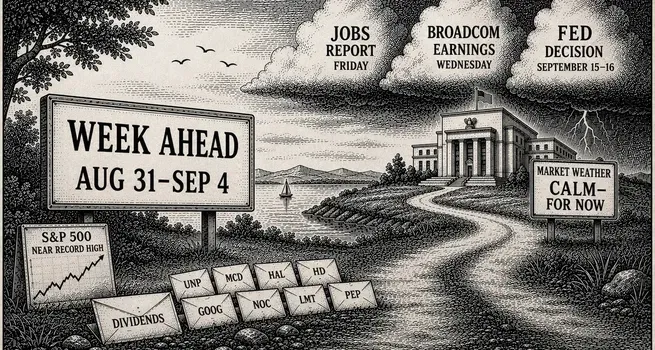
The S&P 500 closed out August within 1% of its August 13 all-time high, buoyed by Nvidia's Blowout Quarterly Report and a 70% Revenue growth forecast for its next fiscal year, a disclosure that lifted sentiment after Treasury yields had dented stocks earlier in the month. The index is up approximately 13% for the year, with strong corporate profit growth from the AI infrastructure buildout fuelling a bull run now nearing its fourth year. Markets have been unusually calm heading into September, with the Cboe Volatility Index near its yearly low and trading Volume below average. That calm faces its first real test this week. The August nonfarm payrolls report on Friday follows a surprise July decline of 23,000 jobs and will be scrutinised for whether that weakness was an aberration or the start of a genuine trend, with direct implications for whether the Fed hikes at its September meeting. Broadcom reports Wednesday in the most consequential Earnings event of the week, with investors watching for whether it can match the extraordinary forward guidance Nvidia just delivered.
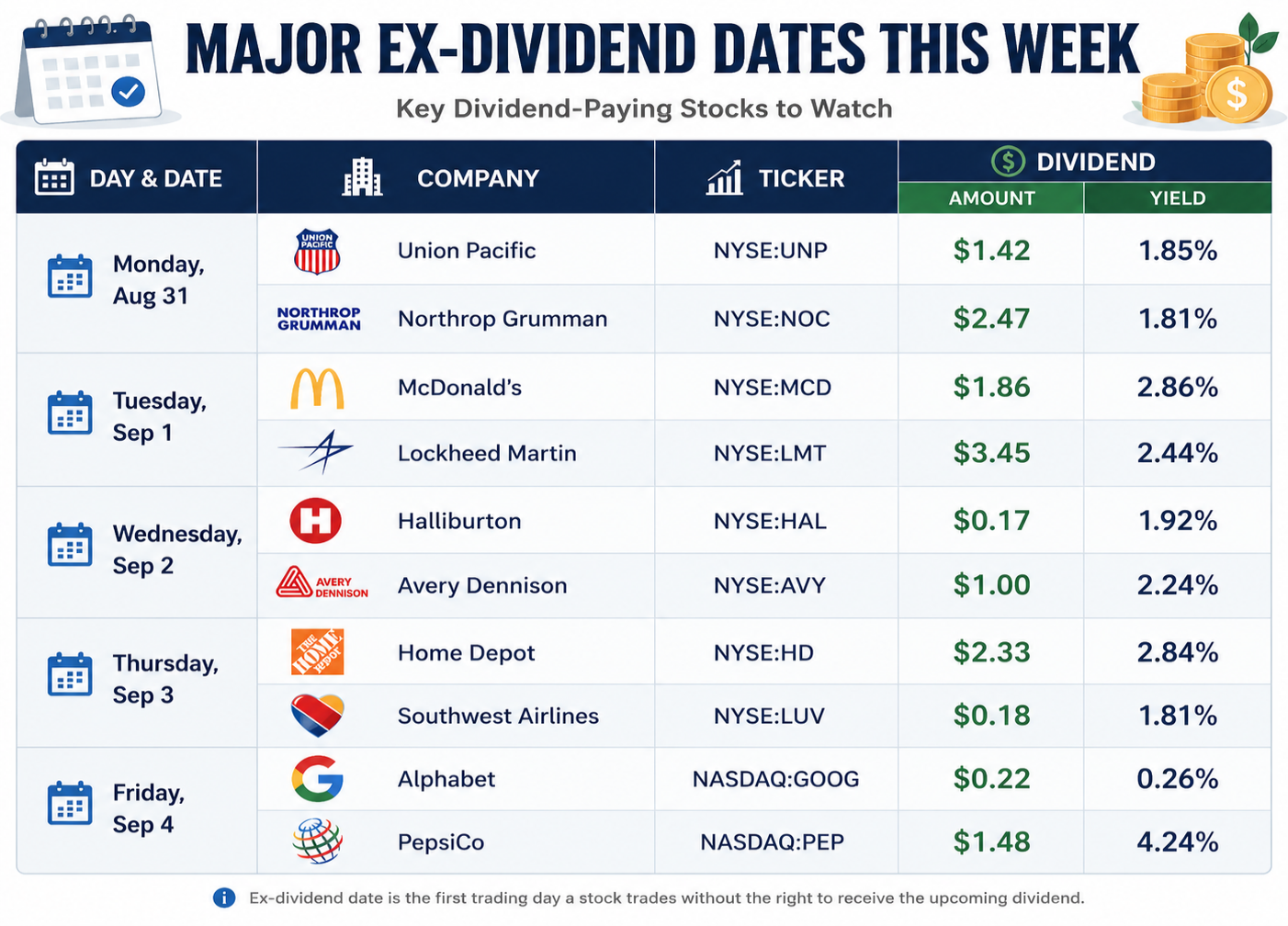
Monday, August 31
Market
No economic data or earnings are scheduled. Markets close out August on a high note, with attention turning immediately to Tuesday's ISM Manufacturing PMI and the week's broader labour data sequence culminating in Friday's jobs report.
Tuesday, September 1
Earnings
Ambarella (NASDAQ:AMBA) reports in the afternoon, providing a semiconductor and computer vision read on AI edge-processing demand, a smaller but closely watched corner of the broader AI infrastructure theme heading into Broadcom's Wednesday results.
Economic Data
The US Manufacturing PMI for August, prior at 63.9, and the ISM Report on Business Manufacturing PMI, prior at 66.6, open the week's data calendar at 9:45 am and 10:00 am ET respectively. The prior ISM reading showed manufacturing activity at its highest level in more than four years, and continuing that momentum into September is considered a genuinely noteworthy signal for the broader growth narrative. Construction spending for July, prior at -0.1%, and JOLTS Job openings for July, prior at 7.36 million and forecast to rise to 7.39 million, round out Tuesday's releases, with JOLTS providing the first labour market data point ahead of Friday's payrolls.
Wednesday, September 2
Earnings
Broadcom (NASDAQ:AVGO) reports in the afternoon as the week's single most consequential earnings event. With a Market Value over $1.7 trillion, its results arrive directly in the wake of Nvidia's blowout quarter and rare 70% revenue growth forecast, and investors will be watching closely for whether Broadcom offers similar visibility into its own AI infrastructure Demand pipeline. Any divergence between the two companies' guidance would raise questions about whether Nvidia's strength is company-specific or reflective of the broader AI semiconductor cycle. Hewlett Packard Enterprise (NYSE:HPE) also reports Wednesday afternoon, providing an enterprise server and AI infrastructure hardware read. NetApp (NASDAQ:NTAP) and Five Below (NASDAQ:FIVE) round out the day, offering data storage and discount retail reads respectively.
Economic Data
ADP private employment for August, prior at 44,000, arrives at 8:15 am ET as the directional preview for Friday's official payrolls, following July's surprise contraction. Factory orders for July, prior at -0.3%, land at 10:00 am ET. The Federal Reserve releases its Beige Book at 2:00 pm ET, providing a qualitative district-by-district assessment of economic conditions in the run-up to the September meeting, at a moment when FOMC members have noted the U.S. economy is at full employment.
Thursday, September 3
Earnings
Dell Technologies (NYSE:DELL) reports in the afternoon, extending the AI infrastructure hardware read from Wednesday's Broadcom and HPE results. Dell's server and storage demand commentary, particularly around AI-optimised infrastructure, will be interpreted alongside Broadcom's guidance as a cross-check on the durability of enterprise AI capital expenditure. Ciena (NYSE:CIEN) reports before the open, providing an optical networking and data centre interconnect read tied to the same AI infrastructure buildout theme. Restoration Hardware (NYSE:RH) also reports Thursday afternoon, offering a high-end discretionary consumer read.
Economic Data
The US trade balance for July, prior at -$73.38 billion, lands at 8:30 am ET. Weekly jobless claims for the week ending August 29, prior at 203,000, provide the most current labour market read ahead of Friday's payrolls. US Services PMI for August, prior at 64.6, and the ISM Report on Business Services PMI, prior at 64.1, arrive at 9:45 am and 10:00 am ET respectively, with services PMI carrying particular weight given that services Inflation remains the most persistent component above the Fed's 2% target.
Federal Reserve
Federal Reserve Governor Christopher Waller speaks at 8:30 am ET at a Reuters NEXT Newsmaker interview. Cleveland Fed President Beth Hammack and Chicago Fed President Austan Goolsbee speak at 3:00 pm ET at a "Connecting Communities" online event. Both appearances arrive one day before the jobs report and will be watched for any signal on how officials are weighing the July employment surprise against inflation still running well above target.
Friday, September 4
Economic Data
The August nonfarm payrolls report is the week's defining release. Consensus points to 45,000 jobs added, following July's surprise decline of 23,000, with the Unemployment rate expected to edge up to 4.2% from 4.1%. Average hourly earnings are forecast to accelerate to 0.2% month-on-month from 0.1%, a modest wage signal that would still keep inflation pressure in view for the Fed. The composition of the report carries outsized weight this week: a bounce back toward or above consensus would suggest July's weakness was noise rather than a genuine labour market breakdown, while a second consecutive weak or negative print would raise more serious questions about underlying economic momentum. Fed funds futures currently price a 35% chance of a September rate hike, and what the stock market most wants to see is a number that gives the Fed room to remain on hold rather than a hot print that revives hike bets or a weak one that stokes Recession concern.
Geopolitical Backdrop
Long-term interest rates remain elevated entering September amid a confluence of structural pressures: high energy prices, ample AI-related corporate Debt issuance, and wide budget deficits, even against signs of resilient economic growth. This combination has kept the Bond Market a persistent source of volatility risk for equities throughout August, and the same dynamic will condition how markets interpret this week's data. A soft jobs report combined with continued elevated yields would present a genuinely difficult scenario for the Fed, unable to ease on growth concerns without risking further inflation pressure while unable to hold firm without further straining a labour market showing early signs of cracking. FOMC members have noted the U.S. is at full employment, a characterisation this week's data will directly test.
The Week in Context
Two events will determine whether the rally's approach to record highs is durable or overextended. Broadcom's Wednesday results will either confirm that Nvidia's extraordinary guidance reflects a broad-based AI infrastructure cycle or reveal that the strength is more concentrated than markets currently assume. Friday's jobs report will determine whether July's surprise weakness was an aberration or the beginning of a trend that complicates the soft-landing narrative the market has priced in. With S&P 500 second-quarter earnings on pace to climb 33.5% year-on-year and the reporting season demonstrating what analysts describe as robust core earnings power, the fundamental underpinning for the rally remains strong. Whether the labour market and the AI Capital Expenditure cycle can sustain that strength into the fourth quarter is precisely what this week's two defining events will reveal.


 Nov 04, 2026



 Please wait processing your request...