
 CA
 NZ
 UK
 AU
 IND

 US

 Share
 X (Formerly Twitter)
 Whatsapp
 Facebook
 LinkedIn
 Telegram
 Email This Article
 Copy Link
 Summarize with AI
 Chat GPT
 Perplexity

Key Highlights
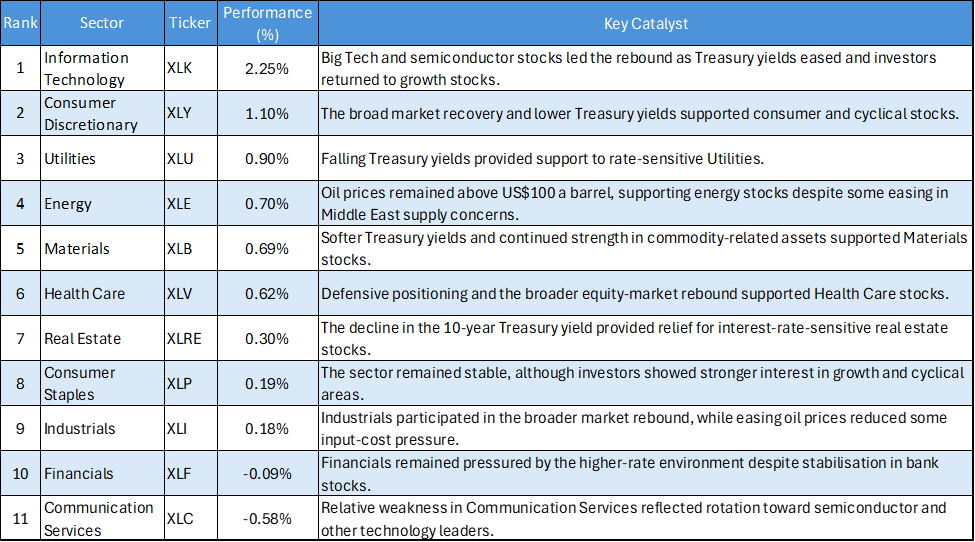
- Technology Leads: XLK gained 2.25%, recording the strongest sector performance.
- Consumer Discretionary Advances: XLY rose 1.10%, ranking second.
- Utilities Strengthen: XLU increased 0.90%.
- Energy and Materials Gain: XLE and XLB advanced 0.70% and 0.69%, respectively.
- Health Care Rises: XLV gained 0.62%, adding to broad market participation.
- Broad Positive Breadth: Ten of the 11 tracked sectors advanced.
- Communication Services Lags: XLC fell 0.58%, recording the largest decline.
- Financials Nearly Flat: XLF declined only 0.09%.
- Performance Gap Widens: The difference between XLK and XLC reached 2.83 percentage points.
The US sector performance data for 17 September 2026 showed a broadly positive trading session, with buying interest concentrated particularly in Technology and Consumer Discretionary. Technology led with a 2.25% gain, while Consumer Discretionary and Utilities also recorded gains of more than 0.90%. The advance was broad, with ten of the 11 tracked sectors finishing higher.
Performance Breakdown by Sector
Technology Leads While Consumer Discretionary Advances
Information Technology (XLK) was the strongest-performing sector on 17 September, gaining 2.25%. The advance placed Technology well ahead of the other sectors and made it the primary source of sector-level strength during the session.
Consumer Discretionary (XLY) followed with a 1.10% gain. The positive performance of both Technology and Consumer Discretionary indicates that growth-oriented areas participated strongly in the broader market advance.
Utilities (XLU) also performed strongly, rising 0.90%. Its gain added a defensive component to the session, indicating that positive participation extended beyond growth-sensitive sectors.
Energy, Materials and Health Care Move Higher
Energy (XLE) gained 0.70%, while Materials (XLB) increased 0.69%. Both sectors remained among the stronger performers, suggesting continued buying interest across commodity-linked areas.
Health Care (XLV) advanced 0.62%, further contributing to the broad market gains. The sector's performance was stronger than that of several traditionally defensive and cyclical groups lower in the rankings.
The combined gains across Energy, Materials and Health Care demonstrate that sector strength was relatively widespread rather than concentrated exclusively in Technology.
Real Estate, Consumer Staples and Industrials Edge Higher
Real Estate (XLRE) rose 0.30%, followed by Consumer Staples (XLP) at 0.19% and Industrials (XLI) at 0.18%.
The relatively modest gains in these sectors indicate that buying interest extended across the market, although the magnitude of their advances was considerably smaller than that of Technology and Consumer Discretionary.
Consumer Staples' positive performance also added to the defensive participation of the session, while Industrials remained marginally higher despite ranking near the bottom of the advancing group.
Financials and Communication Services Lag
Financials (XLF) declined 0.09%, making it effectively unchanged compared with the larger movements recorded elsewhere. The small decline suggests limited selling pressure rather than a significant deterioration in the sector.
Communication Services (XLC), however, fell 0.58%, making it the weakest-performing sector. It was the only sector to decline by more than half a percentage point and the only sector to record a clearly negative performance among the tracked groups.
The contrast between XLK and XLC was particularly significant. Technology gained 2.25%, while Communication Services declined 0.58%, producing a 2.83-percentage-point performance gap.
Strategic Summary
The US sector performance picture on 17 September 2026 was characterised by strong Technology Leadership and exceptionally broad market participation. Ten of the 11 tracked sectors advanced, with Technology gaining 2.25%, Consumer Discretionary 1.10% and Utilities 0.90%.
Energy, Materials and Health Care also recorded gains of more than 0.60%, while Real Estate, Consumer Staples and Industrials posted smaller advances. Financials were nearly unchanged, while Communication Services was the sole significant laggard.
Overall, the session showed broad positive sector breadth with particularly strong leadership from Technology. The key development for subsequent sessions will be whether the strength in Technology remains supported by participation from the other advancing sectors or becomes increasingly concentrated in the leading group.

 Nov 02, 2026


 Please wait processing your request...