
 CA
 NZ
 UK
 AU
 IND

 US

 Share
 X (Formerly Twitter)
 Whatsapp
 Facebook
 LinkedIn
 Telegram
 Email This Article
 Copy Link
 Summarize with AI
 Chat GPT
 Perplexity

Key Highlights
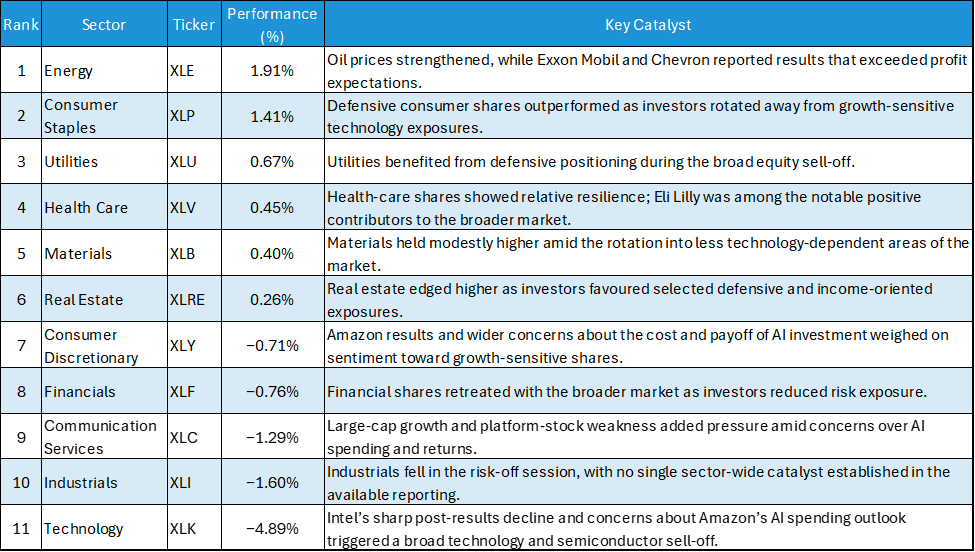
- Energy Leads: Energy (XLE) gained 1.91%, the strongest performance among the 11 sectors, supported by higher oil prices and upbeat results from major oil producers.
- Defensive Rotation: Consumer Staples (XLP) rose 1.41%, while Utilities (XLU) gained 0.67%, reflecting relative resilience as investors reduced exposure to growth-sensitive shares.
- Health Care and Materials Advance: Health Care (XLV) added 0.45% and Materials (XLB) rose 0.40%; Real Estate (XLRE) edged up 0.26%.
- Technology Suffers a Sharp Decline: Technology (XLK) fell 4.89%, the weakest sector, as disappointing results and concerns about the scale and returns of AI Investment hit chip and technology shares.
- Industrials and Communication Services Weaken: Industrials (XLI) lost 1.60% and Communication Services (XLC) fell 1.29%, while Financials (XLF) and Consumer Discretionary (XLY) also declined.
- Broad Market Risk-Off Session: Six sectors advanced and five declined, but the S&P 500 fell about 1.8% and the Nasdaq dropped around 2.9%.
US sector performance on 30 October 2026 showed a pronounced rotation away from Technology and toward Energy and selected defensive sectors. Energy advanced 1.91%, while Consumer Staples rose 1.41% and Utilities gained 0.67%. By contrast, Technology slumped 4.89% after disappointing results from Intel and Amazon intensified investor concerns about the cost of artificial-intelligence investment and the time required for those investments to generate returns. The S&P 500 fell approximately 1.8%, with the Nasdaq down about 2.9%, indicating that strength in defensive areas was not enough to offset the technology-led sell-off.
Performance Breakdown by Sector
Energy and Defensive Sectors Provide a Haven
Energy (XLE) led the market with a 1.91% gain. News that Exxon Mobil and Chevron had exceeded profit expectations supported the sector, while oil prices also rose. The advance stood out against a session in which the major US indexes fell sharply. Stronger results from large producers can help reassure investors about cash generation and operating resilience, although the sector remains sensitive to crude prices, Supply developments and global demand. Energy’s Leadership therefore reflected both company-specific support and its relative strength during a broad retreat from growth shares.
Consumer Staples (XLP) advanced 1.41%, the second-best result, while Utilities (XLU) rose 0.67%. Health Care (XLV), Materials (XLB) and Real Estate (XLRE) also recorded small gains. The pattern suggests investors favoured areas perceived as more defensive as concerns about expensive technology valuations and AI-related Capital Expenditure intensified. However, positive sector returns should not be interpreted as proof of broad market strength: the overall index decline shows that these gains were not large enough to counterbalance weakness in major growth stocks.
Technology Sell-Off Dominates the Session
Technology (XLK) dropped 4.89%, by far the weakest sector. Disappointing quarterly results from Intel and Amazon sharpened questions about the enormous spending required to build AI infrastructure and whether the eventual returns will justify that outlay. Intel plunged after reporting results that raised concerns about cash burn, while semiconductor shares broadly weakened. The sell-off also affected other large technology names, showing that the pressure extended beyond one company.
Communication Services (XLC) declined 1.29%, while Consumer Discretionary (XLY) lost 0.71%. These sectors include companies whose valuations and growth expectations can be sensitive to changes in sentiment around digital platforms, advertising, consumer Demand and technology investment. Financials (XLF) fell 0.76%, and Industrials (XLI) lost 1.60%, indicating that selling pressure extended beyond the most directly affected technology names. The session’s sector dispersion was substantial: the gap between Energy’s gain and Technology’s loss was 6.80 percentage points.
Market Outlook and Risks
The immediate focus is likely to remain on Earnings guidance, AI-related capital expenditure and evidence that technology investment can produce sustainable Revenue and cash flow. A stabilisation in semiconductor and mega-cap technology shares would help determine whether Friday’s decline was a sharp repricing or the beginning of a more persistent de-rating. Energy will remain sensitive to crude prices and geopolitical supply risks, while defensive sectors may continue to attract interest if Volatility remains elevated. Nevertheless, defensive outperformance can fade if risk appetite recovers, and the modest gains in several sectors do not by themselves establish a durable rotation.
Bottom Line
The 30 October session was defined by a sharp technology-led sell-off and relative strength in Energy and defensive sectors. XLE gained 1.91%, followed by XLP at 1.41%, while XLK plunged 4.89% amid renewed concerns about AI spending and its returns. Six sectors rose and five declined, but the falls in Technology, Industrials and Communication Services helped pull the major indexes lower. Investors are likely to watch upcoming company guidance, semiconductor performance, oil-market developments and broader risk appetite to judge whether the rotation persists.

 Nov 02, 2026



 Please wait processing your request...