
 CA
 NZ
 UK
 AU
 IND

 US

 Share
 X (Formerly Twitter)
 Whatsapp
 Facebook
 LinkedIn
 Telegram
 Email This Article
 Copy Link
 Summarize with AI
 Chat GPT
 Perplexity

Key Highlights
- Energy Leads: XLE gained 0.96%, making Energy the only sector to advance.
- Utilities Underperform: XLU declined 1.92%, recording the largest sector loss.
- Real Estate Weakens: XLRE fell 1.55% as rising Treasury yields pressured rate-sensitive assets.
- Consumer Discretionary Falls: XLY declined 1.50% amid a broader risk-off session.
- Communication Services Slips: XLC dropped 0.85% following the recent technology-led rally.
- Health Care Under Pressure: XLV declined 0.64% as higher yields and rate concerns weighed on the sector.
- Broad Sector Weakness: Ten of the 11 major sectors declined.
- Narrow Leadership: Energy's 0.96% gain contrasted with Utilities' 1.92% decline, creating a 2.88-percentage-point performance gap.
The US sector performance data for 23 September 2026 showed a significant Reversal from the strong growth-oriented Leadership seen earlier in the week. Energy was the only sector to finish higher, gaining 0.96%, while all other 10 major sectors declined. The session therefore reflected a sharply defensive and risk-sensitive market environment, with rising oil prices supporting Energy while higher Treasury yields pressured rate-sensitive and growth-oriented sectors.
Performance Breakdown by Sector
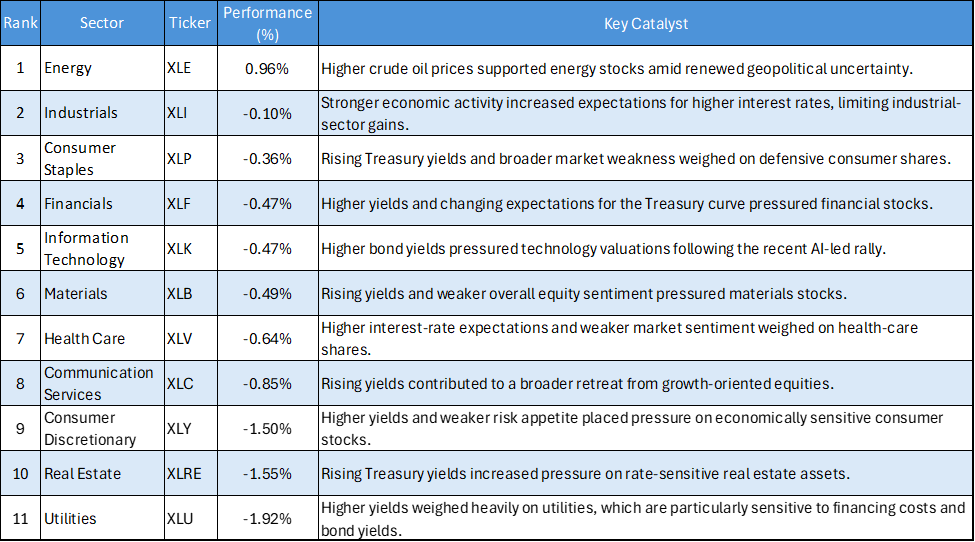
Energy Leads While Defensive and Rate-Sensitive Sectors Decline
Energy (XLE) was the strongest-performing sector on 23 September, gaining 0.96% and standing alone above the flat line. The advance followed a rebound in Crude Oil prices, with renewed geopolitical uncertainty providing support for energy markets. The move represented a notable reversal from the previous session, when Energy had been under pressure.
The Energy leadership provided an important sector-specific catalyst while the broader Equity market remained weak. The sector's performance also highlighted the importance of Commodity prices in determining relative sector strength, particularly when broader market sentiment is under pressure.
Industrials (XLI) were comparatively resilient, declining only 0.10%. However, the sector remained exposed to the broader increase in borrowing costs and changing expectations for monetary policy. Stronger economic activity can support industrial companies, but it can also increase expectations for higher interest rates, creating a mixed environment for the sector.
Utilities, Real Estate and Consumer Discretionary Under Pressure
Utilities (XLU) recorded the largest decline, falling 1.92%, followed by Real Estate (XLRE) at 1.55% and Consumer Discretionary (XLY) at 1.50%. The performance of Utilities and Real Estate was particularly sensitive to the increase in Treasury yields. Higher bond yields can reduce the relative attractiveness of dividend-oriented sectors while increasing financing costs for property-related businesses.
Consumer Discretionary also weakened substantially as the broader market moved into a risk-off phase. Earlier in the week, growth-sensitive sectors had benefited from stronger risk appetite, but that environment reversed as yields and commodity prices moved higher.
Communication Services (XLC) declined 0.85%, while Technology (XLK) fell 0.47%. The weakness in these sectors came despite strong recent momentum in AI-related equities. Rising Treasury yields reduced support for higher-growth companies, with technology stocks particularly sensitive to changes in discount rates.
Broad Sector Weakness Signals a Sharp Rotation
The breadth of the session was notably weak, with 10 of the 11 sectors declining. Even sectors that had recently demonstrated relative strength, including Technology and Communication Services, moved lower. Health Care fell 0.64%, while Materials and Financials declined 0.49% and 0.47%, respectively.
Consumer Staples (XLP) also declined 0.36%, despite traditionally defensive characteristics. This indicated that the weakness was not limited to economically sensitive sectors. Instead, the broad decline suggested that changing interest-rate expectations and overall market sentiment were important drivers across the sector spectrum.
The contrast between Energy's 0.96% gain and Utilities' 1.92% decline produced a 2.88-percentage-point gap between the strongest and weakest sectors. Although narrower than the previous session's sector spread, the differential highlighted a clear divergence between commodity-linked Energy and interest-rate-sensitive sectors.
Strategic Summary
The US sector performance picture on 23 September 2026 was characterised by Energy leadership and broad weakness across the remaining sectors. Energy gained 0.96% as crude oil prices rebounded, while Utilities, Real Estate and Consumer Discretionary recorded the largest declines.
The session also demonstrated how quickly sector leadership can change when macroeconomic conditions shift. Rising Treasury yields and stronger economic activity increased expectations for further monetary tightening, creating pressure across growth, defensive and rate-sensitive sectors.
The key issue for subsequent sessions is whether Energy can maintain its relative strength if oil prices remain elevated, and whether higher Treasury yields continue to weigh on Utilities, Real Estate, Technology and other rate-sensitive sectors.


 Oct 30, 2026




 Please wait processing your request...