
 CA
 NZ
 UK
 AU
 IND

 US

 Share
 X (Formerly Twitter)
 Whatsapp
 Facebook
 LinkedIn
 Telegram
 Email This Article
 Copy Link
 Summarize with AI
 Chat GPT
 Perplexity

Key Highlights
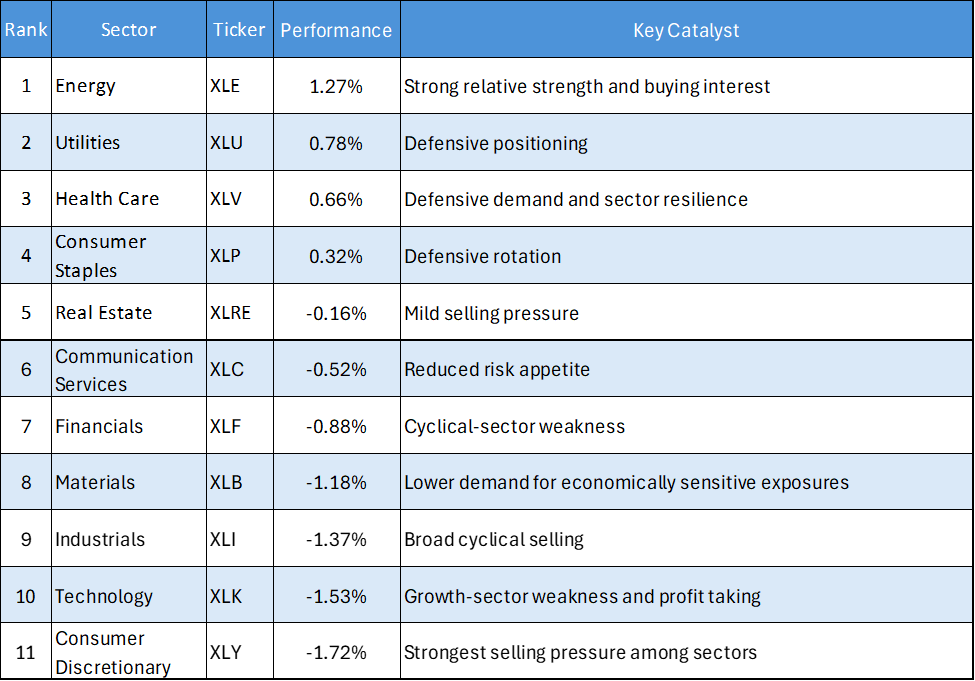
- Energy Leads: Energy (XLE) gained 1.27%, ranking first among all eleven sectors.
- Utilities and Health Care Advance: Utilities (XLU) rose 0.78%, while Health Care (XLV) gained 0.66%.
- Consumer Staples Moves Higher: Consumer Staples (XLP) increased 0.32%, adding to the defensive-sector strength.
- Real Estate Edges Lower: Real Estate (XLRE) declined 0.16%, recording the smallest loss among the declining sectors.
- Communication Services Weakens: Communication Services (XLC) fell 0.52%, moving into negative territory.
- Financials and Materials Retreat: Financials (XLF) declined 0.88%, while Materials (XLB) dropped 1.18%.
- Industrials and Technology Fall: Industrials (XLI) declined 1.37%, while Technology (XLK) fell 1.53%.
- Consumer Discretionary Lags: Consumer Discretionary (XLY) recorded the largest decline at 1.72%.
- Mixed but Defensive Breadth: Four of the eleven sectors advanced, while seven declined, with Energy and defensive sectors showing relative strength.
The latest US sector performance data for 1 September 2026 shows a mixed but predominantly weak market environment, with Energy (XLE) standing out after gaining 1.27%. Utilities (XLU), Health Care (XLV) and Consumer Staples (XLP) also advanced, while seven sectors declined.
Market breadth remained negative, with four sectors advancing compared with seven declining. The strong performance of Energy and defensive sectors contrasted with pronounced weakness across Technology, Consumer Discretionary, Industrials and Materials.
Performance Breakdown by Sector
Energy Leads the Market
Energy (XLE) was the strongest-performing sector, gaining 1.27% during the latest session. The advance placed Energy at the top of the eleven-sector performance ranking and represented the clearest area of buying interest across the US Equity market.
The strength of XLE was particularly notable because the next-best-performing sector, Utilities, gained only 0.78%. This created a 0.49-percentage-point gap between Energy and Utilities, highlighting Energy's relative strength.
Defensive Sectors Provide Support
Utilities (XLU) ranked second after gaining 0.78%, while Health Care (XLV) advanced 0.66%. Consumer Staples (XLP) also moved higher, rising 0.32%.
The gains across Utilities, Health Care and Consumer Staples indicate that defensive areas of the market attracted buying interest during the session. Combined with Energy's leadership, the sector performance suggests investors favoured relatively defensive and resilient areas while several growth-oriented sectors came under pressure.
Real Estate and Communication Services Weaken
Real Estate (XLRE) declined 0.16%, making it the strongest-performing sector among those that fell. The relatively small decline indicates greater resilience compared with the other sectors in negative territory.
Communication Services (XLC) fell 0.52%, moving lower despite the strength recorded in Energy and defensive sectors. The decline placed XLC below Real Estate but above the more heavily sold sectors further down the ranking.
Financials and Materials Retreat
Financials (XLF) declined 0.88%, adding to the weakness across cyclical areas of the market. Materials (XLB) performed even worse, falling 1.18%.
The weakness across Financials and Materials suggests reduced buying interest in economically sensitive sectors. Their declines also contributed to the broader negative Market Breadth during the session.
Industrials, Technology and Consumer Discretionary Lag
Industrials (XLI) declined 1.37%, while Technology (XLK) fell 1.53%. The weakness in Technology was particularly notable because XLK had been one of the strongest-performing sectors in the previous session.
Consumer Discretionary (XLY) recorded the largest decline, falling 1.72%. This placed Consumer Discretionary at the bottom of the eleven-sector performance ranking.
The contrast between Energy's 1.27% gain and Consumer Discretionary's 1.72% decline represents a 2.99-percentage-point performance gap, highlighting the significant rotation away from weaker cyclical and growth-oriented areas toward Energy and defensive sectors.
Strategic Summary
The latest session points to a predominantly weak US sector environment, with four of eleven sectors advancing and seven declining. Energy led decisively with a 1.27% gain, followed by Utilities at 0.78% and Health Care at 0.66%.
While Energy and defensive sectors showed relative strength, Technology, Consumer Discretionary, Industrials and Materials experienced notable selling pressure. The weakness across these sectors suggests that market participation remained selective rather than broadly supportive.
Overall, the session highlights a rotation toward Energy and defensive sectors amid weakness in several growth-oriented and economically sensitive areas. Sustained strength across a broader range of sectors would be needed to signal an improvement in overall market breadth.


 Nov 04, 2026




 Please wait processing your request...