
 CA
 NZ
 UK
 AU
 IND

 US

 Share
 X (Formerly Twitter)
 Whatsapp
 Facebook
 LinkedIn
 Telegram
 Email This Article
 Copy Link
 Summarize with AI
 Chat GPT
 Perplexity

Key Highlights
- Energy Dominates the Market: Energy (XLE) surged 3.01%, making it the strongest-performing sector as investors aggressively rotated into oil and energy-related stocks.
- Defensive Sectors Provide Stability: Utilities (XLU), Consumer Staples (XLP), Real Estate (XLRE), and Health Care (XLV) all finished higher, reflecting continued demand for defensive assets.
- Financials Extend Their Advance: Financials (XLF) gained 0.65%, supported by strength across banking and financial institutions.
- Technology Leads the Decline: Information Technology (XLK) fell 2.42%, making it the weakest-performing sector as investors took profits following recent outperformance.
- Consumer-Oriented Sectors Weaken: Consumer Discretionary (XLY) and Communication Services (XLC) underperformed as investors reduced exposure to growth-oriented sectors.
- Market Rotation Becomes Evident: The session highlighted a clear rotation away from technology and consumer growth sectors toward energy, defensive, and value-oriented areas.
The US equity market displayed a mixed performance on July 13, 2026, as investors rotated capital away from growth-oriented sectors and into energy and defensive industries. Energy stocks delivered a standout performance, while Utilities, Consumer Staples, Financials, Real Estate, and Health Care also advanced. In contrast, Information Technology experienced significant selling pressure, making it the weakest-performing sector of the session. The divergence between defensive and growth sectors suggests investors may be adopting a more cautious approach following the strong technology-led rally seen in recent months.
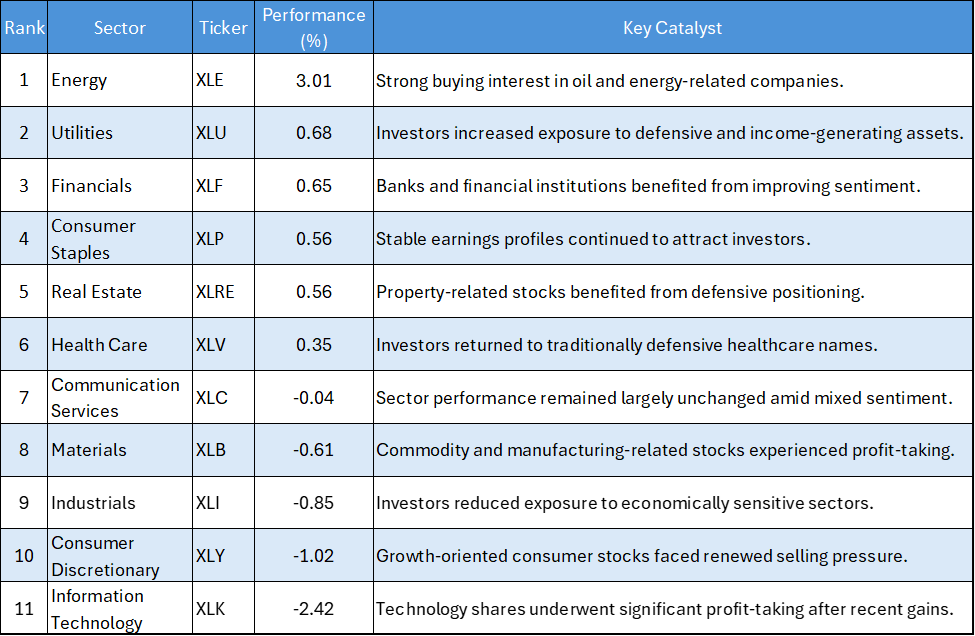
Daily US Sector Performance Summary
Key Market Themes
Energy Leads a Powerful Rotation
- Energy (XLE) delivered the strongest performance of the session, surging 3.01%. The sharp advance suggests investors are becoming increasingly optimistic about energy-sector earnings prospects and commodity-related opportunities. The strength of the move significantly outpaced all other sectors, highlighting a notable shift in capital flows toward energy-related assets.
Defensive Sectors Return to Favour
- Utilities (XLU) gained 0.68%, while Consumer Staples (XLP), Real Estate (XLRE), and Health Care (XLV) also recorded positive performances. The broad participation among defensive sectors suggests investors are seeking stability amid growing uncertainty surrounding growth-oriented sectors. Stable earnings profiles, reliable cash flows, and dividend income remain attractive characteristics during periods of market rotation.
Financials Continue to Attract Buyers
- Financials (XLF) advanced 0.65%, extending their recent strength. Continued participation from banks and financial institutions suggests investors remain confident in the sector's earnings outlook. The strong performance also indicates that investors are maintaining exposure to value-oriented sectors despite weakness elsewhere in the market.
Growth Sectors Come Under Pressure
- Information Technology (XLK) fell 2.42%, making it the weakest-performing sector by a wide margin. The decline likely reflects profit-taking following a prolonged period of outperformance. Consumer Discretionary (XLY) also struggled, falling 1.02%, while Communication Services (XLC) finished marginally lower. The weakness across these sectors highlights a temporary shift away from growth-oriented investments.
Cyclical Sectors Deliver Mixed Results
- Materials (XLB) and Industrials (XLI) declined 0.61% and 0.85%, respectively. The underperformance suggests investors became more selective toward economically sensitive sectors during the session. While Energy benefited from strong buying interest, other cyclical industries failed to attract similar levels of demand, resulting in a more uneven market performance.
Bottom Line
The July 13 session highlighted a significant rotation within the US equity market. Energy emerged as the clear leader, while Financials and several defensive sectors also attracted strong investor interest. At the same time, Technology, Consumer Discretionary, and Industrials faced notable selling pressure as investors reduced exposure to some of the market's recent leaders.
Unlike previous sessions where growth sectors dominated performance, the latest trading activity suggests investors are adopting a more defensive and value-oriented positioning. If this rotation continues, Energy and Financials could become increasingly important drivers of near-term market performance, while Technology may require a period of consolidation following its recent weakness.

 Nov 04, 2026



 Please wait processing your request...