
 CA
 NZ
 UK
 AU
 IND

 US

 Share
 X (Formerly Twitter)
 Whatsapp
 Facebook
 LinkedIn
 Telegram
 Email This Article
 Copy Link
 Summarize with AI
 Chat GPT
 Perplexity

Key Momentum Shifts
- Energy (XLE) remains the dominant leadership sector, although its south-easterly trajectory indicates that relative momentum continues to moderate despite maintaining the strongest relative strength in the market.
- Financials (XLF), Real Estate (XLRE), Consumer Staples (XLP), Communication Services (XLC), and Utilities (XLU) continue to reside in the Leading quadrant, reinforcing broad market leadership across both defensive and cyclical sectors.
- Materials (XLB) remain the only sector in the Improving quadrant, with its north-easterly trajectory signalling strengthening relative momentum and increasing potential to rotate into Leadership.
- Health Care (XLV) remains the sole sector in the Weakening quadrant, indicating that although relative strength remains above average, momentum continues to deteriorate.
- Technology (XLK), Consumer Discretionary (XLY), and Industrials (XLI) continue to occupy the Lagging quadrant, highlighting persistent relative underperformance versus the broader market.
- Leadership remains broadly diversified, although Energy continues to outperform all other sectors while Materials emerge as the strongest candidate to become the next leadership sector.
- The Improving quadrant has narrowed to a single sector, suggesting investors are becoming increasingly selective in allocating capital towards sectors exhibiting strengthening relative momentum.
The latest Relative Rotation Graph (RRG) for 28 July 2026 suggests that US market leadership remains broad despite continued moderation in Energy's momentum. Financials, Real Estate, Consumer Staples, Communication Services and Utilities continue to demonstrate above-average relative strength within the Leading quadrant, while Materials remain the only sector exhibiting improving momentum capable of transitioning into Leadership. Meanwhile, Health Care continues to weaken despite maintaining positive relative strength, and Technology, Consumer Discretionary and Industrials remain the market's weakest-performing sectors on a relative basis. Overall, sector rotation continues to favour defensive and value-oriented sectors while growth-related industries remain under pressure.
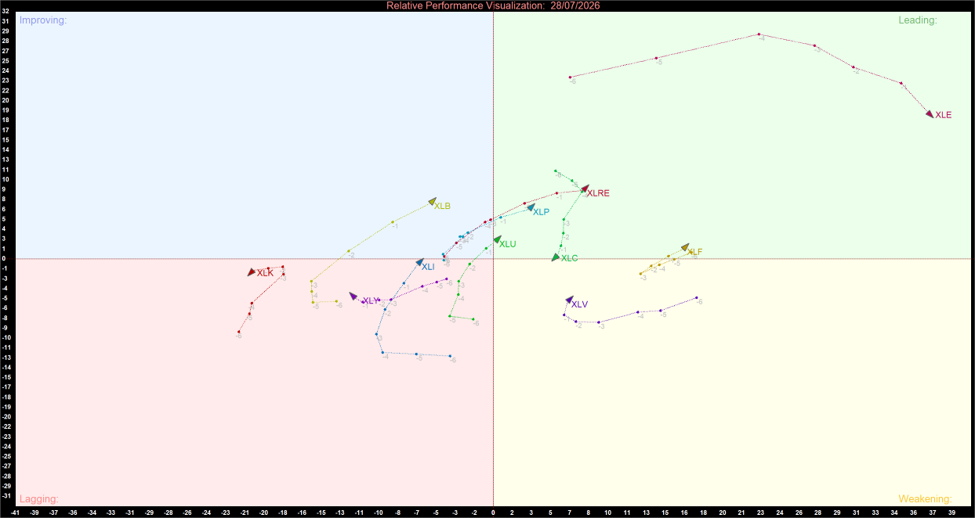
US Sector Relative Momentum Chart (at the closing price of 28/07/2026). Powered by: amibroker.com.
Momentum Breakdown by Quadrant
Leading Quadrant
- Energy (XLE) remains the market's strongest leadership sector. Although its south-easterly trajectory indicates that relative momentum continues to moderate following an extended period of outperformance, the sector still exhibits the highest level of relative strength versus the broader market.
- Financials (XLF) continue to strengthen within the Leading quadrant. The sector's north-easterly trajectory indicates improving relative momentum, reinforcing investor confidence in banking and financial stocks.
- Real Estate (XLRE) remains firmly positioned in the Leading quadrant, continuing to demonstrate above-average relative strength despite some moderation in momentum.
- Consumer Staples (XLP) continue to occupy the Leading quadrant, highlighting sustained institutional demand for defensive companies with resilient earnings and stable cash flows.
- Communication Services (XLC) remain in the Leading quadrant and continue to display constructive relative strength. Their position suggests investors maintain favourable exposure to media, internet and telecommunications companies.
- Utilities (XLU) have strengthened into the Leading quadrant, reflecting improving relative strength after previously residing in the Improving quadrant. The move reinforces the sector's increasingly constructive medium-term outlook.
Improving Quadrant
- Materials (XLB) remain the sole sector in the Improving quadrant. Its strong north-easterly trajectory reflects accelerating relative momentum and positions the sector as the most likely candidate to rotate into the Leading quadrant should current momentum persist.
Weakening Quadrant
- Health Care (XLV) remains the only sector in the Weakening quadrant. While the sector continues to exhibit above-average relative strength, its westerly trajectory indicates momentum continues to soften, suggesting leadership characteristics are gradually fading.
Lagging Quadrant
- Technology (XLK) continues to reside within the Lagging quadrant despite showing signs of stabilisation. Sustained improvement in both relative strength and momentum will be required before the sector can rotate into Improving.
- Consumer Discretionary (XLY) remains in the Lagging quadrant, indicating continued relative underperformance despite a gradual improvement in momentum.
- Industrials (XLI) also remain within Lagging, suggesting institutional investors continue to underweight economically sensitive industrial companies relative to the broader market.
Strategic Summary
The latest Relative Rotation Graph indicates that Energy (XLE) remains the US market's dominant leadership sector, although its moderating trajectory suggests its exceptional momentum is gradually easing. Importantly, Financials (XLF), Real Estate (XLRE), Consumer Staples (XLP), Communication Services (XLC), and Utilities (XLU) continue reinforcing broad market leadership, while Materials (XLB) remain the strongest candidate to rotate into the Leading quadrant if current momentum persists.
Conversely, Health Care (XLV) continues to lose momentum within the Weakening quadrant, while Technology (XLK), Consumer Discretionary (XLY), and Industrials (XLI) remain the weakest relative performers. Overall, the latest sector rotation suggests investors continue favouring sectors with strong relative strength while selectively accumulating industries demonstrating improving momentum characteristics.


 Nov 13, 2026





 Please wait processing your request...