
 CA
 NZ
 UK
 AU
 IND

 US

 Share
 X (Formerly Twitter)
 Whatsapp
 Facebook
 LinkedIn
 Telegram
 Email This Article
 Copy Link
 Summarize with AI
 Chat GPT
 Perplexity
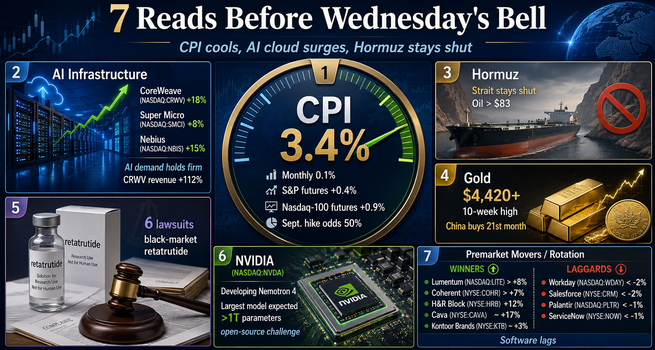
July CPI matched forecasts at 3.4% annual and 0.1% monthly, pulling September rate-hike odds down to 50% from 60% before last week's jobs report. S&P 500 futures rose 0.4% and Nasdaq 100 futures gained 0.9% on the tame print, AI infrastructure Earnings from CoreWeave, Super Micro, and Nebius all beat and surged premarket, and Iran said the Strait of Hormuz stays shut until Washington changes its position.
1. INFLATION: July CPI Matches Forecast at 3.4% Annual, 0.1% Monthly; Equities Advance on the Soft Print, Yet Crude's Climb Keeps the Fed's Inflation Worry Alive
The Consumer Price Index rose 0.1% in July after falling 0.4% in June, with the annual rate cooling to 3.4% from 3.5%; core CPI rose 0.2% on the month and 2.5% year over year, both matching consensus. Shelter accounted for roughly two-thirds of the monthly increase, while energy fell 1.5%. S&P 500 futures climbed 0.4% and Nasdaq 100 futures rose 0.9% on the in-line print, while Dow futures gained 144 points, or 0.3%. Treasury yields eased modestly: the 10-year fell to 4.658% and the 2-year dropped 3 basis points to 4.191%. Traders now price a 50% chance of a September rate hike, down from 60% before last week's weaker-than-expected jobs report, according to the CME FedWatch Tool. Three officials dissented at the Fed's last meeting in favor of a hike, and the underlying inflation worry driving that dissent remains unresolved: crude climbed past $83 a barrel Wednesday as prospects for a near-term Strait of Hormuz reopening faded, leaving September as the next live decision point.
- Core CPI holding at 2.5% for a second straight in-line month gives the Fed room to treat July's weak payrolls as the more urgent signal heading into September rather than wait for confirmation from inflation data.
- Risk note: Thursday's PPI print, following a softer-than-expected reading last month, is the next test of whether wholesale price pressure is building beneath the CPI numbers; a hot print, paired with oil back above $83, would complicate today's disinflation narrative.
2. AI INFRASTRUCTURE: CoreWeave Surges 18% on 112% Revenue Growth, Super Micro Jumps 8% on Beat-and-Raise, Nebius Adds 15% as AI Cloud Demand Holds Firm
CoreWeave (NASDAQ:CRWV) shares jumped as much as 21% premarket after second-quarter revenue reached $2.6 billion, up 112% year over year, with a revenue Backlog that swelled to $104 billion including more than $25 billion in new commitments added early in the third quarter; the company raised full-year 2026 guidance to $12.4-13.2 billion. Super Micro Computer (NASDAQ:SMCI) rose as much as 9.9% after issuing first-quarter guidance of $1.01-1.10 adjusted Earnings Per Share against a 76-cent consensus, with revenue guidance of $14.5-15.5 billion far above the $11.68 billion expected; fiscal 2026 revenue nearly doubled to a record $39.1 billion. Nebius Group (NASDAQ:NBIS) climbed as much as 17% after second-quarter revenue of $582.3 million beat estimates, up 454% year over year, and closed four landmark AI cloud deals during the quarter each worth more than $1 billion. Other AI-linked names advanced in sympathy, with Dell Technologies (NYSE:DELL) and Micron Technology (NASDAQ:MU) each up more than 2%.
- All three companies beat on revenue growth well above 100% year over year while raising forward guidance, directly countering recent concern that AI infrastructure spending has outrun customer demand.
- Risk note: Nebius and CoreWeave's customer concentration among a handful of hyperscale and AI lab counterparties means a single customer pulling back committed capacity, rather than a broad demand slowdown, is now the more realistic risk to the sector.
3. IRAN/HORMUZ: New Security Council Chief Says Strait Stays Closed Until US "Changes Its Behaviour"; Vessels Struck in Gulf of Oman and Bab al-Mandab
Iran's newly installed head of the Supreme National Security Council said the Strait of Hormuz will not reopen until the United States changes its behaviour and accepts Iran's conditions for ending the war, according to Iranian state media. The statement came as attacks on shipping escalated: US forces said they struck a cargo ship attempting to enter the Gulf of Oman in violation of Washington's blockade of Iranian ports, while Iran-backed Houthi forces separately attacked a vessel in the Bab al-Mandab strait. An Interactive Brokers senior economist said investors have awaited a Hormuz deal for weeks and that tangible progress, not just diplomatic optimism from intermediaries like Pakistan, is now required for yields to fall meaningfully and for stocks to extend their rally.
- Attacks now spanning both Hormuz-adjacent waters and Bab al-Mandab show the conflict's shipping disruption risk has broadened geographically, complicating any resolution that addresses Hormuz alone.
- Risk note: if strikes on commercial vessels continue at the current pace, insurers are likely to widen war-risk premiums across both chokepoints simultaneously, a cost that would show up in freight and energy prices well before any diplomatic breakthrough is confirmed.
4. GOLD: Extends Gains Above $4,420, Approaching a 10-Week High as Fed Hike Odds Fall and China Buys for a 21st Straight Month
Gold extended gains above $4,420 an ounce Wednesday, approaching a 10-week high as investors weighed the in-line CPI print, Fed policy expectations, and developments around the Strait of Hormuz. The softer inflation picture following last week's weak jobs report encouraged traders to trim September rate-hike expectations, supporting demand for the metal. Geopolitical uncertainty remained a parallel driver: Pakistan's defense minister said the US and Iran were close to some sort of arrangement to reopen Hormuz, even as Trump claimed the US had total control of the waterway and Iran's security council chief said the strait stays shut. Central Bank buying continued to underpin demand independent of the day's rate and geopolitical signals: China's central bank added roughly 20 tonnes to its reserves in July, its 21st consecutive month of purchases, while global central banks bought an estimated 289 tonnes in the second quarter. Chicago Fed President Austan Goolsbee separately said he remains more concerned about elevated inflation than about labor market weakness, a hawkish counterpoint to the rate-cut pricing driving gold's move.
- China's 21-month buying streak and the second quarter's 289-tonne global central bank total show a structural bid beneath gold that is independent of today's Fed-odds repricing, a distinction that matters for how durable the current rally proves to be.
- Risk note: Pakistan's "close to some sort of arrangement" framing and Trump's "total control" claim sit awkwardly against Iran's own statement that Hormuz stays shut; if that gap resolves toward genuine de-escalation rather than renewed conflict, gold's geopolitical support could fade faster than its rate-driven support.
5. ELI LILLY: Files Six Lawsuits Against Black-Market Sellers of Unapproved Obesity Drug Retatrutide; CBP Seizures More Than Doubled in July
Eli Lilly (NYSE:LLY) filed six lawsuits against US companies it accuses of illegally selling black-market versions of retatrutide, its experimental obesity and type 2 diabetes drug that remains in Phase 3 trials and has not been approved by regulators. The lawsuits target compounding pharmacies, medical spas, and online sellers, including Aesthetic Envy Cosmetic Centers, Astra, and Texas Peptides. The company said it has referred more than 200 individuals and entities to the FDA, the Justice Department, and law enforcement. US Customs and Border Protection intercepted more than 690 shipments totaling over 31,000 units of illicit GLP-1 drugs in fiscal 2025; in July alone, seizures more than doubled to over 1,400 shipments and nearly 90,000 vials.
- Lilly pursuing litigation before its own product is approved is an unusual sequencing that reflects how far ahead consumer demand for GLP-1 drugs has run relative to the regulatory pipeline.
- Risk note: continued unauthorized retatrutide sales ahead of an approval decision raise the prospect of adverse-event reports tied to unregulated formulations being attributed to the Lilly-branded drug once it does launch.
6. NVIDIA: Developing Trillion-Parameter Nemotron 4 Model Family to Compete With Cheap Chinese Open-Source Systems
Nvidia (NASDAQ:NVDA) is developing a new open-source AI model family called Nemotron 4, aimed at competing with leading global open-source systems, with the largest model expected to exceed 1 trillion parameters. The company has not set a release date, though the model could be ready as early as late fall. A vice president of generative AI said Nvidia is investing in Nemotron because every company and country needs accessible frontier open models to strengthen safety and provide a reliable foundation. The push comes as cheap Chinese open-source models increasingly near the capability of leading systems from Anthropic and OpenAI, and follows a wave of disclosed security incidents involving autonomous AI agents. Nvidia separately unveiled Nemotron 3.5 Lightning for code review and security monitoring, and formed an industry coalition on AI safety and Cybersecurity last month.
- Nvidia building a trillion-parameter open model despite recent security incidents tied to autonomous agents signals the company is betting that open-weight competitiveness against Chinese labs outweighs the near-term cybersecurity risk.
- Risk note: if Nemotron 4 launches without demonstrable safeguards against the kind of autonomous misuse already seen in other open models this year, it would hand critics a direct example to cite in pushing federal legislation like the AI Kill Switch Act through Congress.
7. PRE-MARKET MOVERS: Lumentum and Coherent Jump on AI Optics Strength; H&R Block and Cava Surge on Guidance Beats; Software Names Lag
Lumentum Holdings (NASDAQ:LITE) rose more than 8% after fourth-quarter adjusted earnings and revenue beat expectations, extending a rally that has the AI-linked optics maker up more than 120% year to date; Coherent (NYSE:COHR) gained more than 7% in sympathy ahead of its own results due after Wednesday's close. H&R Block (NYSE:HRB) surged 12% after guiding fiscal 2027 adjusted earnings to $6.04-6.24 per share, above consensus of $5.86. Cava Group (NYSE:CAVA) jumped almost 17% after second-quarter earnings of 19 cents per share topped an 18-cent estimate. Kontoor Brands (NYSE:KTB) rise nearly 3% after second-quarter revenue missed narrowly, as the company raised full-year guidance above consensus. Software stocks broadly lagged even as AI infrastructure names rallied: Workday (NASDAQ:WDAY) and Salesforce (NYSE:CRM) each fell more than 2%, while Palantir Technologies (NASDAQ:PLTR) and ServiceNow (NYSE:NOW) were down more than 1%.
- Software stocks falling on a day when AI infrastructure and cloud names surged is a rotation pattern worth tracking, suggesting investors are currently distinguishing between AI infrastructure providers and software companies still working out how AI affects their own margins.
- Risk note: if the software underperformance extends into Cisco Systems' (NASDAQ:CSCO) earnings later this week, it would suggest the market is drawing a harder line between AI capex beneficiaries and software incumbents than the broader AI trade has priced in so far.

 Nov 20, 2026


 Please wait processing your request...