
 CA
 NZ
 UK
 AU
 IND

 US

 Share
 X (Formerly Twitter)
 Whatsapp
 Facebook
 LinkedIn
 Telegram
 Email This Article
 Copy Link
 Summarize with AI
 Chat GPT
 Perplexity
Key Highlights
- The US and China extend the Busan truce to January 10, 2027.
- Trump and Xi meet at the White House on Thursday.
- The truce paused Tariff escalation, rare-earth curbs and port fees.
- Agriculture and non-tariff barriers lead the near-term agenda.
- Near-term Supply chain risk eases, but structural disputes remain.
A Deadline Deferred, Not Removed
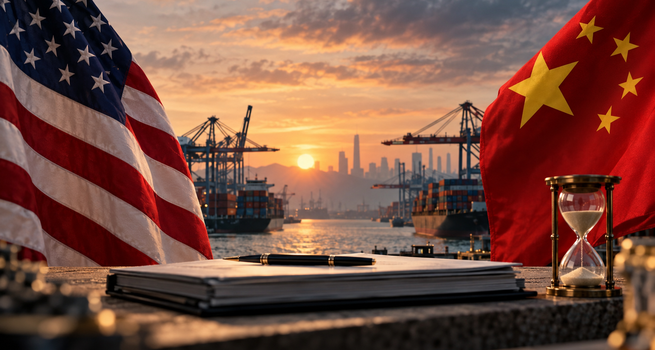
The world's two largest economies have chosen to keep talking rather than start counting down. On Wednesday, US Treasury Secretary Scott Bessent said on Fox News that Washington and Beijing had agreed to extend what he called the Busan Agreement, the economic detente between the two countries, until January 10, 2027. The arrangement had been due to expire on November 10.
The announcement followed talks between Mr Bessent and Chinese Vice Premier He Lifeng, held ahead of President Xi Jinping's state visit to Washington, which began on Wednesday. Mr Bessent framed the purpose of the meeting plainly. The two sides had gathered, he said, to see whether they could reach a bigger deal as opposed to a series of smaller things.
That framing matters for institutional investors. A rolling extension is a holding pattern. A broader understanding would be a change of regime. The market question is which of the two the extra weeks will produce.
The timing is notable. Presidents Trump and Xi are due to meet at the White House on Thursday, a day after the extension was announced and on the same day as the main summit events. The announcement therefore sets the backdrop for the talks rather than following them. Mr Bessent has suggested the extra time could allow further discussion at meetings planned in China in November and in Florida in December.
What Is the Busan Agreement?
The Busan Agreement is the name given to the trade truce reached by President Donald Trump and President Xi in Busan, South Korea, in October 2025. It was not a comprehensive trade treaty. It was a structured set of pauses and reciprocal commitments designed to halt a spiral that had begun to reach well beyond tariffs.
Under the arrangement, the United States agreed to reduce some tariffs on Chinese goods, including the levy linked to fentanyl-related concerns. China agreed to resume purchases of American soybeans, pause new rare-earth export restrictions and take steps against the trade in fentanyl precursor chemicals.
Both sides also suspended or delayed other measures that had threatened to deepen the disruption. Washington set aside certain technology-related restrictions and measures aimed at China's maritime, logistics and shipbuilding sectors. The two governments agreed to pause the retaliatory port fees each had imposed on shipping tied to the other's maritime industry.
The deal broadly rolled back some of the escalation seen during the year. It did not, however, settle the deeper disagreements over China's industrial policy, its Manufacturing capacity, or American restrictions on technology exports. Busan was a truce, not a settlement.
How the Two Sides Reached Busan
The truce was the product of a dispute that widened step by step. Mr Trump's return to the White House in 2025 brought a fresh round of tariffs on Chinese goods. Beijing answered with duties of its own and with restrictions on critical minerals.
The confrontation sharpened after the "Liberation Day" tariff announcements, when Washington unveiled sweeping new levies. China retaliated, and both governments threatened further measures. At one stage, the tariff rates being threatened on each side exceeded 100 percent, raising concerns about a far broader disruption to global trade.
The stakes were unusually high because the contest had moved into areas where each side held leverage. China is a dominant supplier of rare earths and magnets used in vehicles, electronics, aerospace and defence. For manufacturers worldwide, the question was no longer only what an imported Chinese product would cost in the American market. It was whether critical inputs would arrive at all.
Busan offered a way to step back from that edge.
Why the Extension Matters for Markets
The value of the truce lies partly in the tariffs it reduced and partly in the uncertainty it avoided. A manufacturer that can assume tariffs, export controls and shipping charges will not change abruptly has more room to plan production, source materials and set prices. Extending the arrangement preserves that planning horizon through the end of the year and into early 2027.
The transmission channels are broad. The United States and China sit at the centre of global manufacturing and supply chains. A renewed confrontation would tend to appear quickly in shipping costs, factory input prices, technology supply and the cost of goods far from either capital. Firms with exposure to rare-earth inputs, agricultural exports, container shipping or cross-border electronics assembly are among those most sensitive to the trajectory of these talks.
For Capital allocation decisions, the extension reduces one category of near-term risk without eliminating the longer-term one. Companies and investors can reasonably treat the next several months as a period of lower headline Volatility on trade policy, while recognising that the underlying framework remains temporary.
The Near-Term Agenda: Agriculture and Non-Tariff Barriers
US Trade Representative Jamieson Greer has said the two countries are expected to make announcements on agriculture and non-tariff barriers. Traders are watching for progress on a mutual tariff reduction covering about $30 billion in goods, with China potentially able to move first by cutting duties on American agricultural imports.
Agriculture is a logical starting point. Soybean purchases were one of the clearest commitments in the original Busan package, and farm trade produces visible, measurable results for both governments. Non-tariff barriers are harder. Licensing rules, inspection regimes, standards and administrative practices can restrict market access as effectively as duties, and they are more difficult to verify and negotiate.
Mr Bessent has also indicated that some Chinese commitments still need to be implemented more fully. That suggests the extension is being used both to extend the runway and to test compliance on existing pledges.
The Unresolved Structural Questions
The extension does not answer the disagreements that produced the trade war. Washington continues to raise concerns about China's industrial policy, manufacturing capacity, technology access and trade practices. Beijing continues to oppose American tariffs and restrictions on its access to advanced technologies.
These are structural questions, not negotiating tactics. They touch on how each economy organises production, subsidises strategic sectors and defines national security. They are unlikely to be resolved by a single round of concessions, which is one reason the Busan arrangement has been described as fragile.
The risks are therefore two-sided. On the upside, a successful move from truce to a broader economic understanding could reduce policy uncertainty and support supply chain stability. On the downside, failure to make progress by January 10, 2027 could leave both governments facing another deadline, with the possibility of renewed tariffs or retaliatory measures returning to the agenda. Any outcome depends on political decisions in both capitals and cannot be assumed.
What to Watch Before January 10
Several indicators will help show whether the truce is consolidating or merely being prolonged:
- Agricultural purchases: Follow-through on soybeans and any Chinese tariff cuts on American farm goods, as a measure of good faith.
- The $30 billion tariff reduction: Whether a mutual cut covering about $30 billion in goods is formalised, and in what sequence.
- Rare-earth policy: Whether the pause on new export restrictions holds and whether licensing practices ease.
- Technology controls: Any signal that Washington or Beijing is tightening or loosening restrictions on advanced technology.
- Shipping measures: The status of the paused port fees and other maritime-sector measures.
- Summit outcomes: Statements from Thursday's White House talks, and whether the November meeting in China and the December meeting in Florida are confirmed as venues for a broader deal.
A Truce That Buys Time, Not Certainty
The extension of the Busan Agreement to January 10, 2027 buys time, and time has economic value. It keeps a fragile detente intact between the two economies most central to global trade, and it gives negotiators room to pursue what Mr Bessent described as a bigger deal.
It does not, however, resolve the contest over industrial policy, technology and market access that lies beneath the tariff headlines. The coming months will show whether the truce becomes the foundation for a more durable relationship or simply another pause before tensions rise again. For businesses and institutional investors, the sensible posture is to treat the extension as a reduction in near-term risk while continuing to weigh a range of outcomes.


 Nov 02, 2026


 Please wait processing your request...