
 CA
 NZ
 UK
 AU
 IND

 US

 Share
 X (Formerly Twitter)
 Whatsapp
 Facebook
 LinkedIn
 Telegram
 Email This Article
 Copy Link
 Summarize with AI
 Chat GPT
 Perplexity
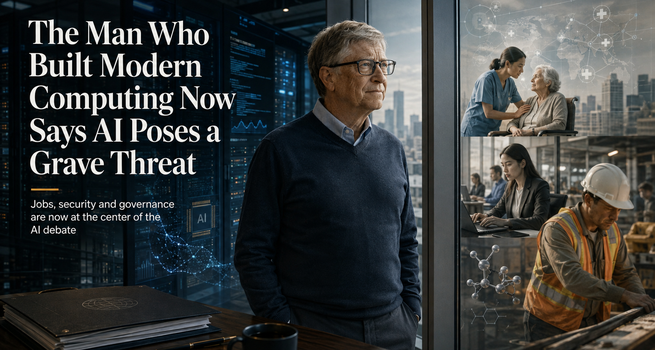
Key Highlights
- Bill Gates says the AI transition will be structurally different from past technology shifts, warning of Job losses across sectors simultaneously rather than over generations.
- He accuses parts of the technology industry of privately acknowledging AI's risks while publicly downplaying them to protect fundraising momentum.
- Gates proposes a tax on AI computing usage and a "Human Reserved" category shielding certain jobs, such as caregiving, from automation.
- He is calling for new domestic and international institutions built specifically to govern AI's economic and security effects.
- His warnings arrive as he re-enters public life following a period of personal scandal, adding scrutiny to his credibility as a messenger.
An Unusual Voice of Caution
Bill Gates has spent five decades as one of the technology industry's most visible champions of innovation. That is what makes his recent turn notable. In both a lengthy personal essay and a separate sit-down interview, Gates has argued that the artificial intelligence transition already underway could be one of the most disruptive economic events in modern history, and that neither governments nor the industry itself are treating it with the urgency it demands.
Gates's core claim is a break from what much of Silicon Valley says publicly. In an interview, he suggested that many executives privately understand how disruptive advanced AI could become but are reluctant to say so, wary of unsettling the fundraising narratives underpinning trillion-dollar valuations. In his essay, he was more measured but reached a similar conclusion in his own voice, writing that resolving AI's risks and rewards should be "the world's top priority."
Whether one hears this as an insider's overdue honesty or a wealthy industry veteran second-guessing the Business he helped build likely depends on priors. Gates himself raised the question of his own credibility unprompted, acknowledging his continued financial exposure to the technology sector and noting that any related proceeds go to the Gates Foundation rather than personal use. He also arrives at this moment carrying reputational baggage: renewed scrutiny this year over his past ties to Jeffrey Epstein, and a six-hour congressional appearance in June, have left him more publicly exposed than at any point since his Microsoft antitrust years. He has called those episodes mistakes of his own making and said he believes people understand the difference between what he did and did not do.
Why Gates Thinks This Time Is Structurally Different
The substance of his argument rests on a comparison to history. Past technological shifts, Gates notes, such as the move from agricultural to office-based work over the twentieth century, unfolded across multiple generations and tended to create new categories of skilled work as old ones faded. He argues AI breaks that pattern because it can substitute directly for cognitive labor across many industries at once, including law, customer service, medicine, and software development, compressing a multi-generational adjustment into roughly a decade.
He points to early data suggesting employment has already softened among younger workers in roles most exposed to generative AI tools, while older colleagues in similar jobs have been comparatively insulated. He expects that pattern to widen well beyond the white-collar roles currently affected, extending into physical work as robotics, still behind software-based AI but advancing quickly, becomes cost-competitive in sectors like construction and hospitality before the end of the decade.
This is very much a minority position within the industry, where the dominant view remains that AI will generate as much new work as it displaces, much as previous technologies did. Gates has acknowledged as much, describing his own view as one he is prepared to defend against that consensus. Labor economists, for their part, remain genuinely split on how quickly displacement might outpace new job creation, and the honest answer at this stage is that nobody has strong data covering a technology this new.
Two Policy Ideas, Neither Yet Adopted Anywhere
Gates has floated two specific mechanisms to manage the transition, and it is worth being clear that neither has been adopted by any government to date.
The first is a tax on AI computing usage, sometimes called a token tax. His reasoning is that the current tax code already tilts toward automation, since employers pay Payroll Tax on human wages but can typically write off automation-related Capital spending immediately. A usage-based levy, he argues, would narrow that gap and fund retraining and safety-net programs for displaced workers. He has conceded this is not the most economically efficient policy in a narrow sense, but argues the social value of preserved employment justifies the tradeoff.
The second is a category he calls "Human Reserved" employment, in which certain jobs, caregiving roles in particular, would be formally shielded from automation regardless of whether the technology could technically perform them. He has compared the idea to a nature reserve: land that could be developed but is deliberately left alone because the loss would be too great. He has also acknowledged the idea raises unresolved questions about who decides which jobs qualify, how enforcement would work, and what happens to International Trade if one country adopts the standard and a competitor does not.
Beyond Jobs: Security and Institutional Gaps
Gates's essay also addresses risks beyond employment, including AI-assisted cyberattacks on infrastructure such as hospitals and financial systems, and the harder-to-discuss possibility that AI could lower the technical barrier to designing biological weapons. In an interview, he went further, dismissing the voluntary safety commitments favored by much of the industry and government in blunt terms: "Self-regulation on the most dangerous tool ever invented? No, thanks!" That rejection has previously put Anthropic's Leadership at odds with parts of the policy establishment as well, on similar grounds.
His proposed remedy is institutional rather than technical: new domestic bodies capable of coordinating AI risk across departments that currently operate in silos, paired with an international framework modeled loosely on nuclear inspection regimes or aviation safety standards. He was candid that building either would take years, which he offers as the reason to start now rather than a reason to wait.
The Harder Question Gates Doesn't Fully Answer
For all the detail in Gates's proposals, the essay is more persuasive on diagnosis than on cure. A usage tax and a protected-jobs category are the kind of ideas that sound coherent in a single country with a single tax authority and grow considerably harder once you ask how they would work across borders, among competitors who would simply decline to adopt them, or inside a Congress that has struggled to pass far simpler technology legislation. Gates does not pretend otherwise. He has described the institutional buildout he wants as comparable in scale to the U.S. government's post-9/11 reorganization, and that comparison cuts both ways: it signals how seriously he takes the problem, but it also signals how far current politics sits from the kind of coordinated action he is calling for.
The more interesting tension may be reputational rather than technical. Gates is asking to be heard as a sober industry insider at the exact moment his public standing has taken the biggest hit of his post-Microsoft career. Readers do not have to resolve that tension to take his substantive argument seriously, but it is fair to hold both facts at once: a warning can be worth engaging with on its merits even from an imperfect messenger, and a messenger's credibility problems do not disappear just because the argument is well constructed.
What is clear is that Gates has moved the debate in one useful direction, forcing a concrete conversation about mechanisms, a tax structure, a protected-jobs category, an institutional framework, rather than leaving AI risk as an abstract concern. Whether any of it survives contact with legislatures, competing national interests, and an industry with strong incentives to keep moving fast is now the open question, and one that will likely take years rather than months to answer.

 Nov 06, 2026




 Please wait processing your request...