
 CA
 NZ
 UK
 AU
 IND

 US

 Share
 X (Formerly Twitter)
 Whatsapp
 Facebook
 LinkedIn
 Telegram
 Email This Article
 Copy Link
 Summarize with AI
 Chat GPT
 Perplexity
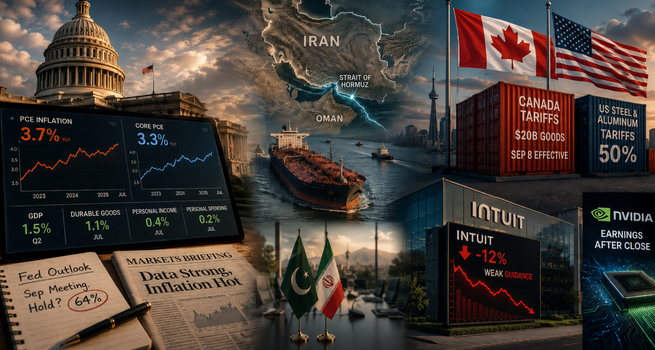
July's PCE price index came in hotter than expected at 3.7% annually, though Core Inflation matched forecasts, as GDP, durable goods, and Personal Income all beat estimates. Oil extended its slide for a third session on Iran-Oman talks over a temporary Hormuz shipping corridor, Canada's retaliatory tariffs took formal shape ahead of a September 8 effective date, Intuit crashed on weak guidance, and markets brace for Nvidia's Earnings after today's close.
1. INFLATION: July PCE Runs Hot at 3.7% Annually as Core Matches Forecasts; GDP, Durable Goods, and Personal Income All Beat Estimates
The personal consumption expenditures price index rose 0.2% in July and 3.7% annually, both above the 3.6% economists expected, while core PCE, which excludes food and energy, matched forecasts at 0.2% monthly and 3.3% annually; services inflation accelerated to 0.3% from 0.1% in June, while goods prices fell 0.1%. Separate data showed second-quarter GDP confirmed at 1.5% growth, durable goods orders rose 1.1% against a 0.5% forecast, and personal income climbed 0.4%, its ninth consecutive monthly increase, while personal spending rose 0.2%, both above expectations.
The mild upside inflation surprise wasn't what investors or the Fed wanted to see, though it likely won't shift the balance for September's meeting on its own. Treasury yields were little changed following the report, with the 10-year holding near 4.65-4.666%, after falling broadly Tuesday when the 10-year lost nearly 8 basis points. A prominent hedge fund investor argued the Treasury's expanded buyback plan undermines the Treasury market's credibility. Traders are pricing roughly a 64% chance the Fed holds rates in September, according to the CME FedWatch Tool.
- Headline inflation running hot while core matches expectations and growth data broadly beats suggests the economy remains resilient enough that the Fed retains room to hold rates, even as the upside surprise adds a note of caution heading into September.
- Risk note: with durable goods, personal income, and GDP all confirming underlying economic strength alongside a hotter headline inflation print, if subsequent data continues pointing the same direction, the Fed may face growing pressure to reconsider its current holding pattern.
2. OIL: Crude Falls to $80.74 as Iran and Oman Discuss a Temporary Hormuz Shipping Corridor; Trump's Mine-Clearing Claim Contradicted
WTI crude fell to $80.74, down 1.96%, and Brent dropped to $86.76, down 2.05%, extending losses into a third consecutive session after Iran and Oman discussed establishing a temporary joint maritime corridor through the Strait of Hormuz, with technical talks continuing toward a permanent arrangement covering traffic management and security services. Oman's foreign minister said he was hopeful a route and practical arrangements to restore safe navigation could be announced soon; the two countries also discussed a mission to clear mines from the strait, directly contradicting Trump's Truth Social claim earlier this week that all mines had already been removed or detonated. Pakistan's army chief traveled to Tehran to support the diplomatic effort. China's foreign ministry called the US sanctions illegal and said its trade with Iran should not be interfered with, signaling Iran's trading partners remain unmoved by Washington's pressure campaign. Oil has come under pressure this week after the sanctions announced Monday proved less aggressive than markets expected, with the US stopping short of secondary sanctions on Iran's trading partners.
- Iran and Oman actively discussing mine clearance, in direct contradiction to Trump's public claim the strait is already clear, suggests the administration's public messaging is running ahead of the actual operational status of the waterway.
- Risk note: if the temporary corridor talks produce a concrete agreement, oil could extend its decline further; but the same de-escalation pressuring prices now would need to hold through the technical talks on a permanent arrangement, leaving room for prices to reverse if negotiations stall.
3. US-CANADA TRADE WAR: Canada Formalizes Retaliatory Tariffs Covering 700 Goods Worth $20 Billion, Effective September 8; Steel and Aluminum Duties Double to 50%
Canada officially announced its retaliatory tariffs on the US, matching the Trump administration's 50% duties dollar for dollar; the new tariffs, covering more than 700 US goods and totaling roughly $20 billion, take effect September 8. Canada doubled its existing tariffs on steel and aluminum to 50% and will impose levies of 15-50% on goods including furniture, clothing, dairy, and machinery. Canadian Finance Minister Francois-Philippe Champagne said the US had asked too much and offered too little after trade talks collapsed last week. The US economy remains roughly 13 times larger than Canada's, leaving Ottawa with a clear incentive to avoid a full-scale Trade War despite its retaliatory stance.
- Canada's decision to double steel and aluminum tariffs specifically, rather than spreading retaliation evenly, targets an industry where the US has historically shown particular sensitivity to Import competition, maximizing political pressure per dollar of trade affected.
- Risk note: with the size disparity between the two economies limiting Canada's Leverage in an extended standoff, Ottawa's willingness to formalize rather than delay its retaliation suggests domestic political pressure to appear firm may be outweighing purely economic calculations.
4. NVIDIA: All Eyes on Earnings After the Bell as Investors Watch for Signs of Hyperscaler Dependence; Consensus Calls for $2.09 EPS on $92.28 Billion Revenue
Nvidia (NASDAQ:NVDA) reports second-quarter earnings after the close Wednesday, with Wall Street projecting adjusted EPS of $2.09 on Revenue of $92.28 billion. Investors are watching closely for signs of whether the company is growing more or less dependent on hyperscaler customers Amazon, Google, and Microsoft amid ongoing concerns about customer concentration. Despite repeatedly beating analyst expectations over the past year, Nvidia's stock has often been penalized following its earnings reports, a pattern some attribute to an expectations premium already priced into shares; the stock rose about 2% Tuesday, snapping its longest losing streak in four years. Given Nvidia's market Capitalization exceeding $5 trillion as the largest S&P 500 constituent, the report carries broader implications for the index and for stocks that tend to move in sympathy with its results.
- A stock with Nvidia's scale moving sharply on earnings, in either direction, creates mechanical index-level effects independent of the fundamental news itself, meaning tonight's reaction could shape broader market sentiment heading into Friday's Jackson Hole speech.
- Risk note: with the market already conditioned to punish Nvidia even after beats due to an elevated expectations bar, a merely in-line quarter could trigger a larger negative reaction than the underlying numbers alone would justify, particularly if hyperscaler concentration concerns are not directly addressed.
5. INTUIT: Shares Crater 12% as Fiscal 2027 Revenue Guidance Falls Well Short of Expectations Despite a Fiscal Fourth-Quarter Beat
Intuit (NASDAQ:INTU) shares fell as much as 12.27% premarket after the company guided fiscal 2027 revenue to $23.28-23.51 billion, below a roughly $23.7 billion consensus and implying growth of just 9-10% against 14% growth in fiscal 2026, even though fiscal fourth-quarter revenue of $4.4 billion and adjusted EPS of $4.03 both beat estimates. Management cited a deliberate pivot toward customer acquisition, slowing TurboTax unit growth, and rising competitive pressure from generative AI tools and lower-cost providers; total online paying customers grew just 3% in fiscal 2026, down roughly 2 percentage points from the prior year.
Chief Executive Sasan Goodarzi said the company could face pricing pressure to defend market share. The disappointing outlook triggered a wave of price target cuts and downgrades from JPMorgan, Bank of America, Morgan Stanley, Goldman Sachs, Wells Fargo, Stifel, Barclays, and Deutsche Bank. The selloff dragged the broader software sector lower, with the iShares Expanded Tech-Software ETF down more than 1%, ServiceNow off more than 2.5%, and Workday and Salesforce each down 2%.
- A beat-and-raise-adjacent quarter turning into a 12% selloff shows the market weighting forward guidance far more heavily than trailing results, particularly when the guidance implies a meaningful deceleration from the prior year's growth rate.
- Risk note: with TurboTax facing simultaneous pressure from generative AI tools and lower-cost competitors, Intuit's stated strategy of prioritizing customer Acquisition over near-term pricing could compress margins further before any market-share gains materialize.
6. RETAIL EARNINGS SPLIT: Kohl's Raises Guidance on Tariff Refunds Despite a Comp Sales Miss While J.M. Smucker Beats Cleanly
Kohl's (NYSE:KSS) shares fell as much as 6.62% premarket even after the company posted adjusted EPS of $1.28 against a $0.55 consensus and sharply raised full-year adjusted EPS guidance to $1.80-2.40 from $1.00-1.60, aided by roughly $150 million in tariff refunds; investors focused instead on comparable sales falling 0.9%, worse than a 0.6% decline expected, despite the company resuming share Buybacks of up to $100 million and naming a new chief customer officer. J.M. Smucker (NYSE:SJM) shares rose 5.6% after fiscal first-quarter revenue of $2.22 billion topped a $2.13 billion consensus, with adjusted EPS of $3.24.
- Kohl's stock falling despite a guidance raise more than double its prior range shows investors treating tariff-refund-driven earnings strength as lower quality than genuine sales momentum, echoing skepticism seen elsewhere this earnings season toward one-time benefit-driven beats.
- Risk note: with Kohl's continued sales softness persisting even as margins improve on tariff refunds and cost discipline, the underlying question of whether traffic and Demand are genuinely stabilizing remains unresolved heading into the holiday season.
7. MARKET SETUP: Gold Pulls Back From a Three-Month High Ahead of Jackson Hole; Zoom, SolarEdge, and Other Movers React to Earnings and Analyst Calls
Gold fell almost 1% to $4,613.10 an ounce, on track to snap a three-session winning streak after reaching its highest level since May 14 on Tuesday, with analyst saying the rally looks technically stretched ahead of Fed Chair Kevin Warsh's Friday Jackson Hole speech. China's net gold imports via Hong Kong rose about 11% in July. Zoom Communications (NASDAQ:ZM) shares fell 7% after third-quarter guidance of $1.46-1.48 adjusted EPS missed a $1.50 estimate.
SolarEdge Technologies (NASDAQ:SEDG) jumped nearly 7% after UBS upgraded the stock to buy with a $42 target, citing a new FCC policy expected to support share gains and pricing power. Semtech (NASDAQ:SMTC) rose more than 5% on a second-quarter beat, while Box (NYSE:BOX) gained more than 2% despite trimming its full-year earnings forecast slightly. Boston Scientific (NYSE:BSX) fell more than 3% after disclosing a Cybersecurity incident expected to disrupt product access, and SAP (NYSE:SAP) dropped almost 4% after UBS downgraded the stock to neutral, citing slow delivery of agentic AI. Mortgage rates rose to a three-week high of 6.78% on the 30-year fixed, with application Volume falling 1% for the week.
- Gold's pullback arriving alongside hot inflation data and ahead of Warsh's speech suggests the market is positioning cautiously in both directions, unwilling to extend the rally further until the Fed's next signal is clearer.
- Risk note: the cluster of company-specific selloffs tied to forward guidance rather than trailing results, spanning Intuit, Zoom, and Kohl's alike, points to a market applying unusually strict scrutiny to management's own outlook statements, a pattern that could extend to Nvidia's own guidance tonight.


 Nov 04, 2026



 Please wait processing your request...