
 AU
AU
 UK
UK
 CA
CA
 NZ
NZ
 IND
IND

 US
US

 Share
Share
 X (Formerly Twitter)
 Whatsapp
 Facebook
 LinkedIn
 Telegram
 Email This Article
 Copy Link
 Summarize with AI
 Chat GPT
 Perplexity
Netflix shares declined 2.18% to $82.52 on January 20, 2026, extending a brutal six-month selloff that has now erased over 40% of shareholder value since the July peak near $140. The decline came despite the streaming giant reporting impressive 2025 financial results, including $45.2 billion in revenue (up 16% year-over-year), a 29.5% operating margin, and surpassing the critical 325 million paid subscriber milestone in Q4.
The market's negative reaction to otherwise stellar fundamentals underscores a stark disconnect between operational performance and investor sentiment. While Netflix exceeded all financial objectives and delivered 18% revenue growth in Q4 with operating income surging 30% year-over-year, the stock's technical deterioration suggests deeper structural concerns are overriding positive earnings momentum.
Why the Selloff Persists
Several factors explain the continued pressure despite strong results. First, Netflix's ambitious 2026 revenue guidance of $50.7-$51.7 billion (12-14% growth) represents a deceleration from 2025's 16% expansion, raising questions about growth sustainability. While management emphasized ad revenue doubling and highlighted initiatives like the World Baseball Classic, video podcasts, and cloud gaming, investors appear skeptical about these newer revenue streams offsetting core business maturation.
Second, the pending Warner Bros. acquisition introduces significant execution risk and integration uncertainty. Large M&A transactions typically face regulatory scrutiny and can distract management focus, creating a fundamental overhang that technical sellers are exploiting.
Third, the streaming wars remain intensely competitive with formidable rivals like Disney+, Amazon Prime Video, and emerging competitors fragmenting market share. Despite Netflix's content leadership and healthy engagement metrics—including 2% viewing hour growth driven by a 9% surge in branded original consumption—investors question whether premium valuation multiples are justified in an increasingly crowded marketplace.
What the Charts Are Saying
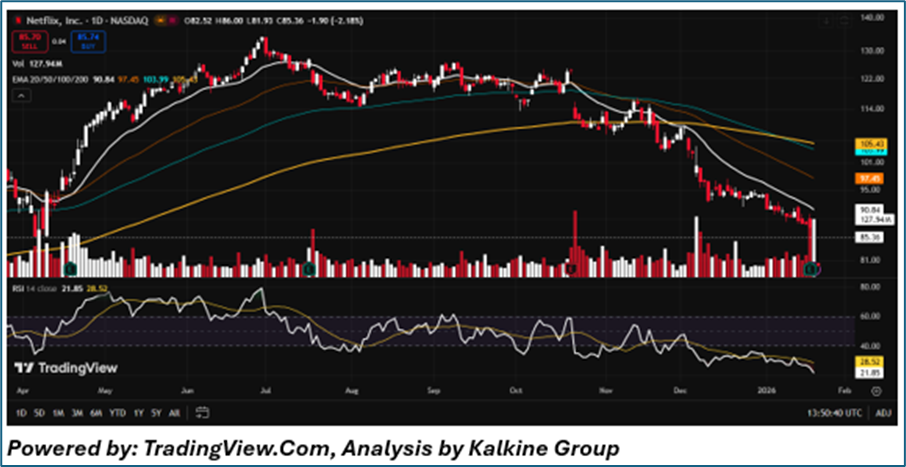
The technical picture paints an unambiguously bearish outlook. Netflix exhibits a pronounced downtrend across all timeframes, with price action trapped decisively below the 200-day exponential moving average at $105—a level that now represents formidable overhead resistance. The complete bearish alignment of the 20/50/100/200 EMA complex, with accelerating negative slope, confirms structural weakness rather than temporary consolidation.
Most concerning is the 14-period Relative Strength Index plunging to 21.85, approaching capitulation territory. While extreme oversold conditions typically precede tactical bounces, the persistent downward momentum without bullish divergence signals continued institutional distribution rather than accumulation. The RSI's failure to reclaim the 40 level—a classic bear market characteristic—indicates sellers maintain firm control.
Volume analysis reinforces the negative narrative. Recent sessions show elevated selling volume, particularly during sharp selloffs in early January, confirming aggressive institutional liquidation rather than retail panic. Conversely, rally attempts have occurred on diminishing volume, demonstrating lack of buyer conviction and suggesting counter-trend bounces represent distribution opportunities.
The chart displays a textbook descending channel with lower highs and lower lows since July. Recent price action suggests potential head-and-shoulders distribution pattern formation, projecting measured downside targets toward the $70-$75 zone if current support fails.
Critical Levels and Outlook
Immediate support sits at the psychological $81 level, with critical support in the $75-$77 zone representing April 2024 lows. A breakdown below $75 could trigger accelerated selling toward $65-$70, representing key Fibonacci retracement levels. Resistance layers stack formidably at $90.84, $97.45, and $105.43, making sustainable recovery unlikely without fundamental catalysts.
The outlook remains decidedly bearish. Continued downside pressure toward the $75-$77 support cluster appears probable as all technical indicators remain negatively configured with no reversal signals. A meaningful trend change would require reclaiming the 50 EMA (~$97) on sustained volume, followed by consolidation above $105—a tall order given current momentum.
While extreme oversold conditions may produce short-term tactical bounces, the structural bias remains bearish for intermediate-term holders. Until technical damage is repaired and fundamentals demonstrate sustainable acceleration, Netflix faces continued headwinds despite operational excellence.


 Jun 09, 2026




 Please wait processing your request...