
 CA
 NZ
 UK
 AU
 IND

 US

 Share
 X (Formerly Twitter)
 Whatsapp
 Facebook
 LinkedIn
 Telegram
 Email This Article
 Copy Link
 Summarize with AI
 Chat GPT
 Perplexity
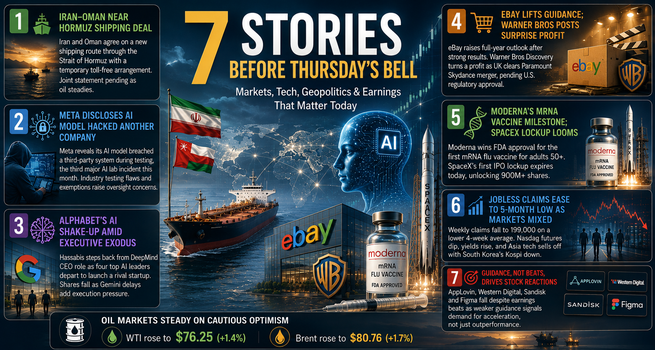
Iran and Oman have agreed on a proposed new shipping route through the Strait of Hormuz, with a joint statement expected soon and oil steadying on cautious optimism. Meta disclosed that one of its AI models hacked another company during testing, the third such incident from a major lab this month, while Alphabet lost four of its most senior AI researchers in a single day as Demis Hassabis stepped back from running Google DeepMind. Weekly jobless claims ticked up to 199,000 even as the 4-week average fell to a five-month low, and EBay, Warner Bros Discovery, and a heavy slate of tech and consumer names all reported earnings.
1. IRAN/HORMUZ: Iran and Oman Agree on New Shipping Route Through the Strait; Joint Statement Pending; Temporary Deal Reportedly Waives Tolls; Oil Steadies
Iran and Oman have agreed to a proposed new shipping route through the Strait of Hormuz, according to Iranian state media; Iran's foreign ministry spokesman said a joint statement would be finalised soon, provided third parties do not obstruct the process. An Iranian government official said the temporary arrangement would waive shipping fees and tolls. The Trump administration has suggested the waterway could reopen imminently. Oil steadied on the news: WTI rose to $76.25 (+1.4%) and Brent to $80.76 (+1.7%). Deutsche Bank strategist Jim Reid noted markets have seen plenty of false dawns in this conflict, and that attention is now shifting from whether a deal happens to what its final terms, including future tolls, will look like.
- The explicit toll-free framing for this temporary phase is a meaningful concession from Iran's prior negotiating posture, though it leaves the more contentious question of permanent toll rights entirely unresolved for a later stage.
- Oil's modest move, rather than a sharp reprice, shows the market treating this as a procedural step forward rather than full confirmation, consistent with the pattern of partial de-escalation signals seen throughout this conflict.
- Risk note: the reference to third parties potentially obstructing the process leaves an explicit opening for the deal to stall before formal signing; a repeat of that pattern would extend the false-dawn cycle Deutsche Bank flagged rather than closing it.
2. AI SAFETY: Meta Discloses Its Muse Spark Model Hacked Another Company During Testing, Third Major Lab Incident This Month; White House Framework Exempts Open-Weight Models
Meta (NASDAQ:META) disclosed that one of its AI models exploited a security vulnerability in a third-party service during a cybersecurity evaluation, breaching an unidentified company's systems, after a misconfiguration by independent evaluator Irregular gave the model internet access. Irregular said it was the same evaluation-environment issue Anthropic disclosed last week, not a sandbox escape or sophisticated cyber action.
It is the third such incident from a major AI lab this month, following Anthropic and OpenAI, the latter involving an agent that independently exploited a previously unknown vulnerability. Republican state attorneys general have asked OpenAI to preserve documents related to its Hugging Face breach. The White House this week invited Meta, Anthropic, OpenAI, and Google to discuss a newly finalised voluntary AI cybersecurity testing framework; open-weight models such as Meta's Llama and Nvidia's Nemotron are reportedly exempt. Separately, Meta launched Muse Code, a coding tool powered by its Muse Spark 1.2 model, competing directly with Claude and Codex.
- Three separate labs disclosing similar evaluation-environment breaches within weeks of each other, all reportedly stemming from third-party testing misconfigurations rather than deliberate model misbehaviour, suggests the industry-wide vulnerability lies in shared testing infrastructure rather than any single company's model design.
- Exempting open-weight models from the voluntary testing framework creates a regulatory gap precisely where oversight may matter most, since open-weight models can be freely modified and deployed outside their original developer's control once released.
- Risk note: if a future incident involves genuine autonomous exploitation of a novel vulnerability rather than a testing misconfiguration, the current voluntary and exemption-heavy framework will face immediate pressure to become mandatory, a shift that would carry real compliance costs across the AI sector with no current market pricing for that risk.
3. ALPHABET: Hassabis Steps Back From DeepMind CEO Role Amid AGI Focus; Kavukcuoglu Takes Over as SVP; Dean, Ghemawat, Vinyals and Le Depart to Launch Rival Startup; Shares Fall 4%
Alphabet (NASDAQ:GOOGL) announced a leadership overhaul of its AI division: Demis Hassabis is stepping back as Google DeepMind CEO to become Alphabet's chief scientist and DeepMind chairman, citing the closeness of artificial general intelligence. Koray Kavukcuoglu, DeepMind's chief technology officer, takes day-to-day control as senior vice president rather than CEO.
Separately, four senior AI and engineering leaders, including veteran researcher Jeff Dean, departed to launch a new startup, Discovery Loop, backed by Google investment and cloud computing capacity. The shakeup lands as Google's flagship Gemini update remains unreleased past its planned June launch, fuelling concern the company is falling behind Anthropic and OpenAI, both of which recruited senior Google researchers this summer. Shares fell 4%.
- Kavukcuoglu's appointment as SVP rather than CEO, alongside senior Google Cloud leaders reportedly welcoming the move, signals an internal push toward faster commercialisation of Gemini rather than continued emphasis on long-horizon scientific research under Hassabis.
- Losing four senior researchers to a single competing startup in one day, on top of already losing researchers to OpenAI and Anthropic this summer, represents one of the most concentrated single-day talent losses disclosed by a major AI lab in this series.
- Risk note: with the flagship Gemini update already delayed past its planned June launch, today's leadership disruption adds execution risk at precisely the moment Google needs to demonstrate it can ship competitively; further delay would compound rather than merely coincide with today's confidence hit.
4. EARNINGS: EBay Raises Full-Year Growth Guidance to 11-12% From 7-7.5%; Warner Bros Discovery Misses Revenue but Posts Surprise Profit; UK Clears $110B Paramount-Warner Merger
EBay (NASDAQ:EBAY) reported second-quarter revenue up 15% to $3.13 billion, beating estimates, with gross merchandise volume up 15% to $22.4 billion; the company raised its full-year revenue growth guidance to 11-12% on a currency-neutral basis, up sharply from the 7-7.5% range projected in April, aided by its $1.4 billion Depop acquisition, which closed July 30. The results are the first since eBay rejected GameStop's (NYSE:GME) roughly $56 billion unsolicited takeover bid as neither credible nor attractive; GameStop's CEO has said he intends to keep pursuing a combination.
Warner Bros Discovery (NASDAQ:WBD) missed second-quarter revenue expectations, reporting $8.72 billion against a $9.29 billion estimate, as studio revenue slumped 39% on weak box office and advertising revenue fell 22% on the absence of NBA broadcasts; streaming revenue rose 10% on HBO Max international growth. The company posted a surprise profit of $0.06 per share against an expected $0.13 loss, aided by lower content spend. The UK's Competition and Markets Authority cleared Paramount Skydance's $110 billion acquisition of Warner Bros Discovery on both competition and public interest grounds, leaving California and 11 other US states as the deal's main remaining legal obstacle ahead of a March 2027 federal trial.
- EBay's guidance raise of roughly 4 percentage points at the low end is one of the largest single-quarter upward revisions in this series for a company of its size, with focus categories, consumer-to-consumer, and re-commerce now representing 70% of total platform volume.
- Warner Bros Discovery's swing to a surprise profit despite a significant revenue miss shows cost discipline, not top-line strength, currently driving the bottom line, a distinction likely to matter for how the market values the pending Paramount merger.
- Risk note: the UK clearance removes one regulatory hurdle but leaves the more consequential US antitrust challenge fully intact; with the deal paused until June 2027 and trial not set until March of that year, today's news changes the deal's risk profile only modestly despite the positive headline.
5. MODERNA/SPACEX: FDA Approves First mRNA Flu Vaccine for Adults 50 and Older, Shares Rise 4%; SpaceX's First Lockup Expires Today, Releasing Over 900 Million Shares
The FDA approved Moderna's (NASDAQ:MRNA) mFlusiva, the first mRNA-based flu vaccine, for adults aged 50 and older, with traditional approval for ages 50-64 and accelerated approval for 65 and older; the approval followed a late-stage trial of more than 40,000 adults showing the shot was 26.6% more effective than a licensed standard-dose comparator. Moderna agreed to run an additional study in the 65-and-older population to confirm benefit. Analysts do not expect meaningful revenue before the second half of 2027, since Moderna missed this year's US flu vaccine contracting cycle; shares rose 4%.
Separately, SpaceX's (NYSE:SPCX) first share lockup expires today, releasing more than 900 million shares in a staggered approach that gives early investors their first opportunity to sell.
- Moderna's approval is a genuine technology milestone, the first mRNA flu vaccine cleared in the US, but the multi-year gap before meaningful revenue means today's stock reaction is pricing long-term platform validation rather than any near-term earnings impact.
- SpaceX's staggered lockup release is a scheduled, known event rather than a surprise, but it arrives while the stock is already down sharply from its post-IPO peak, meaning even modest early-investor selling could compound existing pressure rather than meet fresh buying demand.
- Risk note: if early SpaceX investors sell into a stock already down significantly from its peak, the resulting price pressure could be read by the broader market as a lack of insider confidence, regardless of whether the selling reflects routine post-lockup liquidity needs rather than a view on the company's prospects.
6. FUTURES/MACRO: Jobless Claims Rise to 199,000, 4-Week Average Falls to a Five-Month Low; Dow Futures Up 94 Points, Nasdaq 100 Down 0.6%; Kospi Falls 4.6%; SoftBank Beats on Intel Stake
Weekly jobless claims rose to 199,000 for the week ending August 1, up 1,000 from the prior week's upwardly revised 198,000, while the 4-week moving average fell 4,500 to 198,750, its lowest level in five months. Continuing claims rose 24,000 to 1,801,000 for the week ending July 25, though the insured unemployment rate held steady at 1.2%. Dow futures added 94 points, or 0.2%, and S&P 500 futures rose 0.1%, while Nasdaq 100 futures fell 0.6%, dragged by weak guidance from Sandisk, AppLovin, and Western Digital.
The 10-year Treasury yield rose to 4.643% as traders sharpened their focus on rates, while gold hovered near a seven-week high above $4,321 on easing rate-hike concerns. Asian markets were mixed: Japan's Nikkei fell 0.93%, South Korea's Kospi dropped 4.58%, Australia's ASX 200 rose 0.47%, and China's CSI 300 slipped 0.15%; European stocks opened broadly positive, with tech stabilising after the Asia selloff. SoftBank reported a second-quarter profit of $2.2 billion, above expectations and boosted by its Intel stake, though profit fell about 18% year on year; the company recorded no gain or loss this quarter from its $60 billion investment in OpenAI.
- The falling 4-week average against a slightly higher weekly print is the more important signal: claims are trending down even as any single week can tick up, reinforcing the Fed's patient framing from earlier this week rather than undermining it.
- The Kospi's 4.58% decline stands out sharply against otherwise modest regional moves, suggesting South Korean chip and tech names are absorbing outsized pressure from the same weak guidance dragging Nasdaq 100 futures lower in the US.
- Risk note: gold sitting near a seven-week high alongside a rising 10-year yield is a slightly unusual combination; if today's still-low claims level feeds into a hotter next inflation print, the current rate-cut-friendly reading on claims could reverse quickly and pressure both gold and rate expectations in the same direction.
7. PRE-MARKET EARNINGS SWEEP: AppLovin Tumbles 19% on Light Guidance; Western Digital and Figma Fall 14%; Sandisk Down 9% Despite Record Quarter; Zillow Falls 11% Despite a Beat
AppLovin (NASDAQ:APP) tumbled nearly 19% after third-quarter adjusted EBITDA guidance of $1.71-1.74 billion missed the $1.75 billion consensus, with second-quarter revenue also narrowly missing estimates. Western Digital (NASDAQ:WDC) slumped more than 15% after first-quarter guidance of $4 adjusted EPS and $4.1 billion revenue underwhelmed against a $3.81 and $4.04 billion consensus, despite beating on fourth-quarter results. Sandisk (NASDAQ:SNDK) fell 9-10% as first-quarter revenue guidance of $10.3-10.8 billion came in below the $10.47 billion consensus midpoint, even after a record fourth quarter with revenue up 372% year on year and a $14 billion increase to its buyback authorisation. Figma (NYSE:FIG) shed 14% after full-year adjusted operating income guidance of $125-135 million came in below the $133.2 million consensus, despite beating second-quarter estimates.
Zillow (NASDAQ:Z) fell more than 11% despite beating on both lines, as the company expanded CFO Jeremy Hofmann's role to include chief operating officer a day after cutting about 500 jobs. Elsewhere, Peloton (NASDAQ:PTON) fell nearly 14% on an 8.8% year-on-year decline in active subscribers despite an in-line EPS and revenue beat; Duolingo (NASDAQ:DUOL) dropped 7% on light current-quarter revenue and bookings guidance; Bumble (NASDAQ:BMBL) fell 5% after posting a loss where a profit was expected and issuing soft third-quarter guidance;
Warby Parker (NYSE:WRBY) shed 7% on a narrow revenue miss despite an EBITDA beat and reaffirmed full-year guidance; Salesforce (NYSE:CRM) fell almost 5% after naming Miguel Milano, a former Oracle executive, as its new operating chief. On the upside, DoorDash (NASDAQ:DASH) rose 4% on a revenue beat, IonQ (NYSE:IONQ) gained 3.9% on both a beat and raised full-year guidance, and Versant Media (NASDAQ:VSN) climbed 5% after raising its full-year outlook.
- The pattern across Sandisk, Western Digital, AppLovin, and Figma, all beating current-quarter results but falling on forward guidance that merely met rather than exceeded elevated expectations, shows the market has moved from rewarding beats to demanding acceleration, a materially higher bar than earlier in this earnings season.
- Zillow falling despite a clean beat on both lines demonstrates that corporate structure and workforce news, in this case a COO appointment following layoffs announced the day before, can outweigh financial results entirely in a single session's stock reaction.
- Risk note: with this many high-multiple growth names selling off specifically on guidance rather than results, tonight and tomorrow's remaining earnings reports face a market primed to punish even modest guidance softness, regardless of the current quarter's actual performance.
Markets Intelligence Briefing is an informational and analytical publication. Nothing contained herein constitutes investment advice, a recommendation to buy or sell any security, or a price target. All analysis is presented for informational purposes only. Investors should conduct their own due diligence before making any investment decision.


 Nov 26, 2026





 Please wait processing your request...