
 CA
 NZ
 UK
 AU
 IND

 US

 Share
 X (Formerly Twitter)
 Whatsapp
 Facebook
 LinkedIn
 Telegram
 Email This Article
 Copy Link
 Summarize with AI
 Chat GPT
 Perplexity
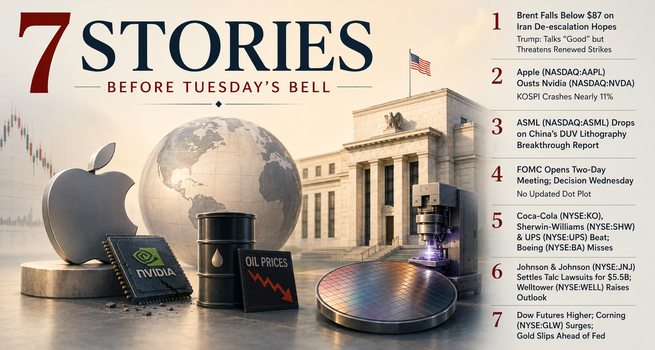
Apple overtook Nvidia on Monday to reclaim the title of world's most valuable company as chip stocks sold off across three continents, with South Korea's KOSPI falling nearly 11%. Oil dropped more than 2% on hopes U.S.-Iran hostilities are pausing, even as Trump warned he would resume strikes if talks fail. The Fed opens a two-day rate meeting today, with Wednesday's decision arriving without a dot plot.
- IRAN/OIL: WTI Falls to $81.47, Brent to $86.99 on De-escalation Hopes; Trump Says Talks "Good" But Threatens Renewed Strikes; Gulf Allies Attacked
WTI crude trades at $81.47 (-1.38%) and Brent at $86.99 (-1.55%) pre-market, both down more than 2% as investors price a pause in U.S.-Iran hostilities. Trump said America was "having good talks" with Iran but warned he would resume strikes if negotiations collapse. Iran-backed militias in Iraq and Yemen attacked American Gulf allies on Monday, a reminder the pause has not stopped proxy activity. Separately, Trump said Israel "wouldn't survive" without America, ahead of his Tuesday meeting with Israeli leader Binyamin Netanyahu.
- Natural gas fell in tandem, confirming a broad de-escalation repricing rather than an oil-specific supply signal.
- The Iraq and Yemen attacks show the conflict has not fully paused at the proxy level even as headline diplomacy softens.
- Risk note: a public rift at the Netanyahu meeting could reverse the de-escalation premium supporting the 2% oil drop before Wednesday's Fed decision.
- MARKET STRUCTURE: Apple Overtakes Nvidia as World's Most Valuable Company; Nvidia -5%; KOSPI -10.8% as Samsung and SK Hynix Both Fall Around 15%
Apple (NASDAQ:AAPL)'s market capitalization closed Monday at approximately $4.95 trillion, pulling ahead of Nvidia (NASDAQ:NVDA)'s $4.77 trillion, after Apple shares rose more than 1% and Nvidia fell nearly 5%. It is the first time Apple has held the title since April 2025. Investors are rewarding Apple's restrained AI capital spending, which has declined over three quarters, while capital rotates away from AI infrastructure names. The rotation hit hardest in Asia: South Korea's KOSPI fell nearly 11%, with Samsung Electronics and SK Hynix (NASDAQ:SKHY) each down around 15% on AI spending durability and Chinese competition concerns. Apple reports fiscal third-quarter earnings Thursday, its first chance to disclose the memory chip shortage impact that forced it to raise Mac and iPad prices in June.
- Apple's year-to-date gain of more than 22% makes it the top performer among the largest technology companies, a reversal from the AI-capex-driven leadership pattern that dominated 2026.
- The KOSPI's near-11% decline alongside Samsung and SK Hynix both falling around 15% signals the memory selloff is now a cross-continental event, not a single-market correction.
- Risk note: a larger-than-expected memory cost hit in Thursday's Apple earnings would undercut the market-cap flip, since Apple's own supply chain faces the same shortage pressuring its rivals.
- SEMICONDUCTORS: ASML Falls More Than 8% on Report China Is Developing Its Own Deep Ultraviolet Lithography Tools
ASML (NASDAQ:ASML) shares dropped over 8% after a report that China has begun producing its own deep ultraviolet lithography machines, the equipment used to manufacture advanced semiconductors. Deep ultraviolet, or DUV, tools are not at the cutting edge of chipmaking technology, but domestic Chinese production would mark a manufacturing breakthrough and reduce reliance on Dutch and other foreign suppliers. The report lands the same day chip stocks are already pressured by the Samsung and SK Hynix selloff, compounding sector-wide sentiment.
- ASML's decline is a supply-chain story distinct from the demand-side memory selloff; it concerns whether China can manufacture its own lithography equipment, not whether AI infrastructure spending continues.
- A confirmed domestic DUV capability would not immediately threaten ASML's extreme ultraviolet, or EUV, monopoly on the most advanced chips, but it narrows the gap Beijing has raced to close for years.
- Risk note: if confirmed rather than walked back, expect further de-rating across semiconductor equipment names as investors price a longer-term erosion of Western export-control leverage.
- FED: FOMC Opens Two-Day Meeting Today; Rate Decision Wednesday at 2 PM Eastern With No Dot Plot; Treasury Yields Ease Ahead of Verdict
The Federal Reserve's rate-setting committee opens its two-day meeting today, with the policy statement and rate decision due Wednesday at 2 PM Eastern, followed by a press conference. This is one of four annual meetings without a Summary of Economic Projections, meaning no updated dot plot will accompany the decision. The federal funds rate has held at 3.50%-3.75% since June. The 10-year Treasury yield eased to 4.63% pre-market, and the 2-year similarly edged lower, as investors positioned ahead of the announcement.
- The absence of a dot plot removes the clearest forward-guidance tool from Wednesday's release, leaving the statement's language and press conference as the only signals on the rate path.
- Yields easing alongside falling oil prices suggests the market leans toward a hold rather than pricing fresh hawkish risk, though the setup remains genuinely contested.
- Risk note: if Wednesday's statement drops any reference to prior easing bias or shortens materially versus June, markets will read it as hawkish regardless of the headline decision.
- EARNINGS: Coca-Cola +2% and Sherwin-Williams +6% Beat and Raise; UPS Beats and Lifts Outlook; Boeing Posts Wider Loss Despite Air Force One Cost Overruns
Coca-Cola (NYSE:KO) rose 2% after posting adjusted earnings per share of 97 cents against a 93-cent estimate, with revenue of $13.38 billion beating the $13.16 billion expected; the company raised its full-year outlook, citing trademark Coca-Cola's strongest quarterly volume growth in 17 years outside pandemic recovery. Sherwin-Williams (NYSE:SHW) climbed nearly 6% on adjusted earnings of $3.70 per share on $6.79 billion in revenue, both ahead of estimates, and raised full-year guidance. UPS (NYSE:UPS) beat top and bottom line estimates and raised its outlook to approximately $91.2 billion in revenue and $7.22 in diluted earnings per share, aided by completion of its Amazon volume-reduction plan. Boeing (NYSE:BA) posted a wider-than-expected loss as Air Force One program costs offset higher revenue and deliveries, though the stock still rose more than 1%.
- Coca-Cola's North America volume growth benefited from World Cup and America 250 activations, while Latin America and EMEA showed uneven performance, a reminder the beat was not uniform across geographies.
- UPS completing its planned reduction of lower-margin Amazon volume while raising guidance signals the turnaround is now translating into margin improvement rather than just cost-cutting.
- Risk note: Boeing's stock rising despite a wider loss suggests the market is pricing the Air Force One overrun as contained; a further delivery slip next quarter would test that tolerance.
- HEALTHCARE: Johnson & Johnson +2% on $5.5 Billion Talc Settlement; Universal Health Services -3% on Guidance Cut; Welltower +4.5% on Raised Outlook
Johnson & Johnson (NYSE:JNJ) rose more than 2% after agreeing to pay $5.5 billion to resolve roughly 76,000 lawsuits alleging its talc-based products caused ovarian cancer. The company maintains the claims are meritless but wants to end the decade-long dispute; the settlement requires acceptance from 95% of claimants before finalization. Universal Health Services (NYSE:UHS) fell 3% after lowering full-year adjusted earnings guidance to $22.28-$23.65 per share, down from $22.64-$24.52 prior. Welltower (NYSE:WELL) climbed 4.5% after raising its full-year outlook for normalized funds from operations to $6.36-$6.44 per share, above the $6.30 consensus estimate.
- The 95% claimant acceptance threshold is the key execution risk in the J&J settlement; a lower rate would leave the company exposed to continued litigation despite the deal.
- Welltower's guidance raise in senior housing contrasts with Universal Health Services' cut in hospital operations, suggesting healthcare strength is concentrated in specific sub-sectors.
- Risk note: if claimant acceptance stalls below 95% in coming weeks, J&J's 2% gain on settlement news would need reassessing against reopened litigation risk.
- PRE-MARKET SETUP: Monday Closed Mixed as DJIA Rose 0.51% but Nasdaq Fell 0.18%; Corning +17% on Beat and Raised Long-Term Targets; Gold and Silver Fall Ahead of Fed
Monday closed mixed: DJIA at 52,210.08 (+262.83, +0.51%), S&P 500 at 7,413.18 (+1.20, +0.02%), NASDAQ at 24,932.081 (-43.743, -0.18%), as chip weakness offset broader strength. Corning (NYSE:GLW) rose after posting second-quarter sales up 17% year over year to $4.74 billion and adjusted earnings per share of 78 cents, both ahead of estimates; the company raised its long-term "Springboard" targets to a $20 billion annualized sales run rate by 2026, rising to $40 billion by 2030, and disclosed new multi-year partnerships with Apple, Meta, Nvidia, and Amazon. Gold fell 1.20% to $4,028.00 and silver dropped 2.05% to $57.51 as the dollar firmed ahead of Wednesday's decision.
- Corning's Optical Communications segment led growth, up 32% year over year, with the four megacap partnerships confirming the AI buildout is broadening into the physical connectivity layer.
- Gold and silver falling together into the Fed decision reflects dollar strength rather than a risk-on rotation, the same dynamic seen during the Iran de-escalation earlier this year, now in reverse.
- Risk note: if Wednesday's statement reads dovish despite no rate change, the dollar-driven pressure on gold and silver could reverse sharply heading into Thursday's Apple earnings.
Markets Intelligence Briefing is an informational and analytical publication. Nothing contained herein constitutes investment advice, a recommendation to buy or sell any security, or a price target. All analysis is presented for informational purposes only. Investors should conduct their own due diligence before making any investment decision.

 Nov 20, 2026


 Please wait processing your request...