
 CA
 NZ
 UK
 AU
 IND

 US

 Share
 X (Formerly Twitter)
 Whatsapp
 Facebook
 LinkedIn
 Telegram
 Email This Article
 Copy Link
 Summarize with AI
 Chat GPT
 Perplexity
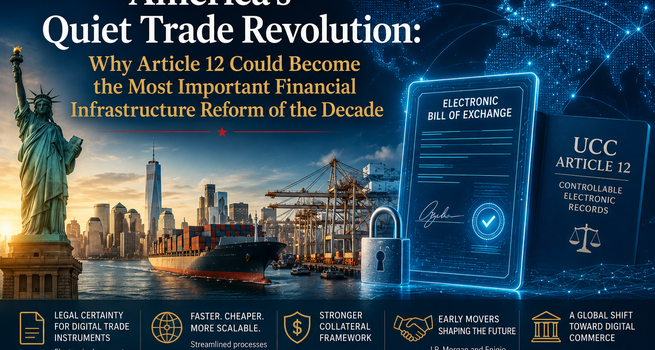
Key Highlights
- New York's Article 12 Brings Legal Recognition to Digital Trade Documents
The legislation introduces Controllable Electronic Records (CERs), allowing electronic trade instruments to be owned, transferred, and enforced with legal certainty similar to paper documents. - J.P. Morgan and Enigio Are Emerging as Early Infrastructure Winners
J.P. Morgan's expansion of electronic bills of exchange (eBoEs) in the U.S., powered by Enigio's trace:original platform, positions both firms at the forefront of digital trade finance adoption. - Trade Finance Could Become Faster, Cheaper, and More Scalable
By eliminating paper-based processes, Article 12 has the potential to reduce operational risk, shorten transaction times, and improve efficiency across global supply chains. - Digital Assets Gain Stronger Standing in Secured Lending Markets
Qualifying electronic records can now be used as collateral under UCC Article 9, creating new opportunities for banks, lenders, and corporate treasury departments. - The U.S. Joins a Global Movement Toward Fully Digital Trade
New York's adoption aligns with similar reforms in the UK, Singapore, Bahrain, Abu Dhabi, and other major financial centres, accelerating the global transition toward paperless international commerce.
The Digitisation of Trade Has Finally Reached Its Legal Moment
For decades, investors have been mesmerized by technological revolutions. Artificial intelligence dominates headlines, quantum computing attracts speculative capital, and space exploration captures public imagination. Yet some of the most consequential economic transformations occur far from public view. They emerge quietly through legal reforms, infrastructure upgrades, and institutional changes that gradually alter the way commerce functions.
The introduction of Article 12 to New York's Uniform Commercial Code belongs firmly in this category.
At first glance, the legislation appears technical. It concerns something called Controllable Electronic Records (CERs), a legal framework designed to allow digital negotiable instruments to be owned, transferred, pledged, and enforced in much the same manner as paper documents. For lawyers and trade finance specialists, the significance is immediately obvious. For investors, however, the implications may be even larger.
What New York has effectively done is remove one of the last major obstacles preventing the digitisation of global trade finance.
The world has digitised communication, payments, entertainment, banking, and increasingly manufacturing. Yet international trade continues to depend heavily on physical documentation, signatures, courier services, and manual verification processes that would look familiar to merchants from decades ago. Article 12 represents a decisive attempt to bring this system into the digital era.
Why Paper Has Survived Longer Than Anyone Expected
One of the paradoxes of modern finance is that some of the world's most sophisticated transactions continue to rely on paper.
A semiconductor manufacturer in Taiwan may use artificial intelligence to optimise production. A logistics company may track shipments in real time using satellites. Banks may settle billions of dollars across global networks within seconds. Yet the documentation supporting the transaction often still exists in physical form.
The reason is not technological. It is legal.
Trade finance depends upon ownership rights. Ownership rights depend upon possession. Possession has historically been easiest to establish through physical documents.
A bill of exchange, promissory note, or bill of lading is more than paperwork. It represents enforceable legal rights. Simply converting such documents into PDFs does not solve the problem because digital files can be copied infinitely.
What Article 12 introduces is a legally recognised concept of control. Instead of proving possession through physical custody, parties can prove ownership through exclusive digital control.
This seemingly modest legal change could have consequences that extend across trillions of dollars of annual global trade.
Why New York's Decision Matters More Than Most Jurisdictions
Not all legislation is created equal.
When a smaller jurisdiction updates its commercial laws, the impact is often local. New York occupies a different position. It remains one of the most influential financial centres in the world and serves as the governing legal framework for a vast volume of international commercial contracts.
Many multinational corporations choose New York law precisely because of its predictability and legal credibility.
This means Article 12 is not merely a state-level reform. It is a signal to global markets.
The importance of legal certainty cannot be overstated. Throughout financial history, capital has consistently gravitated toward jurisdictions that provide clear and enforceable rules. The emergence of London as a financial centre, the rise of Delaware in corporate law, and the dominance of New York in global finance all reflect this principle.
By providing a framework for digital negotiable instruments, New York has effectively endorsed the next phase of trade-finance modernisation.
Why J.P. Morgan and Enigio Are Positioned at the Centre of the Shift
Investors often focus on the users of new technologies. The bigger opportunities frequently lie with the infrastructure providers.
This is one of the recurring lessons of capitalism.
Railroads generated enormous economic value, but suppliers to the rail ecosystem often became highly profitable businesses. The internet created consumer platforms, but semiconductor manufacturers, networking providers, and cloud infrastructure companies ultimately captured significant portions of the economic surplus.
The same pattern may emerge in digital trade finance.
J.P. Morgan's decision to expand its electronic bill of exchange solution into the United States represents an important institutional endorsement of the trend.
Meanwhile, Enigio's trace:original platform occupies an intriguing position. The company is not simply offering software. It is helping establish the infrastructure layer required for digital ownership, transferability, and enforceability.
Such businesses often benefit from powerful network effects.
As more banks adopt the platform, its utility increases. As more corporates participate, adoption becomes easier for others. Over time, network effects can evolve into economic moats that are difficult for competitors to replicate.
The Hidden Link Between AI, Energy Security and Digital Trade Finance
One of the most interesting observations in J.P. Morgan's announcement was the reference to America's capital expenditure boom.
Artificial intelligence, energy security, and defence spending are driving one of the largest investment cycles in decades.
These industries require enormous amounts of working capital. Equipment must be financed. Components must be sourced. Supply chains must be coordinated. International contracts must be executed efficiently.
As investment volumes increase, the inefficiencies associated with paper documentation become more costly.
This is why Article 12 matters.
The reform arrives at a moment when capital-intensive industries are expanding rapidly. The more investment activity grows, the more valuable digital trade infrastructure becomes.
In that sense, digital trade finance is not a separate trend from AI or energy security. It is an enabling layer supporting both.
The Future of Global Trade Is Being Built Quietly
The most successful investors often recognise major structural changes before they become obvious.
Today, most market participants focus on artificial intelligence models, semiconductor demand, and technological innovation. Yet beneath those themes, another transformation is underway.
Global trade is gradually becoming digital.
The legal frameworks are emerging.
The technological infrastructure already exists.
Institutional adoption is accelerating.
And the economic incentives are overwhelmingly aligned toward greater efficiency.
History suggests that such transitions rarely happen overnight. They unfold over years, sometimes decades. But once the direction becomes clear, reversals become unlikely.
Article 12 may ultimately be remembered not as a legal amendment but as one of the foundational building blocks of a fully digital global trading system.
For investors searching for long-duration compounding opportunities, the lesson is familiar: look beyond the headlines. The most valuable businesses are often those building the invisible infrastructure that allows the global economy to function more efficiently.
That is where the next generation of durable wealth creation frequently begins.
Yes. For a Saurabh Mukherjea-style premium long-form article, it is much better to use visual breaks with thematic images and longer analytical paragraphs, rather than relying heavily on bullet points.
A structure like this works well:
America's Quiet Trade Revolution: Why Article 12 Could Become the Most Important Financial Infrastructure Reform of the Decade
The Digitisation of Trade Has Finally Reached Its Legal Moment
For decades, investors have been mesmerized by technological revolutions. Artificial intelligence dominates headlines, quantum computing attracts speculative capital, and space exploration captures public imagination. Yet some of the most consequential economic transformations occur far from public view. They emerge quietly through legal reforms, infrastructure upgrades, and institutional changes that gradually alter the way commerce functions.
The introduction of Article 12 to New York's Uniform Commercial Code belongs firmly in this category.
At first glance, the legislation appears technical. It concerns something called Controllable Electronic Records (CERs), a legal framework designed to allow digital negotiable instruments to be owned, transferred, pledged, and enforced in much the same manner as paper documents. For lawyers and trade finance specialists, the significance is immediately obvious. For investors, however, the implications may be even larger.
What New York has effectively done is remove one of the last major obstacles preventing the digitisation of global trade finance.
The world has digitised communication, payments, entertainment, banking, and increasingly manufacturing. Yet international trade continues to depend heavily on physical documentation, signatures, courier services, and manual verification processes that would look familiar to merchants from decades ago. Article 12 represents a decisive attempt to bring this system into the digital era.
Why Paper Has Survived Longer Than Anyone Expected
One of the paradoxes of modern finance is that some of the world's most sophisticated transactions continue to rely on paper.
A semiconductor manufacturer in Taiwan may use artificial intelligence to optimise production. A logistics company may track shipments in real time using satellites. Banks may settle billions of dollars across global networks within seconds. Yet the documentation supporting the transaction often still exists in physical form.
The reason is not technological. It is legal.
Trade finance depends upon ownership rights. Ownership rights depend upon possession. Possession has historically been easiest to establish through physical documents.
A bill of exchange, promissory note, or bill of lading is more than paperwork. It represents enforceable legal rights. Simply converting such documents into PDFs does not solve the problem because digital files can be copied infinitely.
What Article 12 introduces is a legally recognised concept of control. Instead of proving possession through physical custody, parties can prove ownership through exclusive digital control.
This seemingly modest legal change could have consequences that extend across trillions of dollars of annual global trade.
Why New York's Decision Matters More Than Most Jurisdictions
Not all legislation is created equal.
When a smaller jurisdiction updates its commercial laws, the impact is often local. New York occupies a different position. It remains one of the most influential financial centres in the world and serves as the governing legal framework for a vast volume of international commercial contracts.
Many multinational corporations choose New York law precisely because of its predictability and legal credibility.
This means Article 12 is not merely a state-level reform. It is a signal to global markets.
The importance of legal certainty cannot be overstated. Throughout financial history, capital has consistently gravitated toward jurisdictions that provide clear and enforceable rules. The emergence of London as a financial centre, the rise of Delaware in corporate law, and the dominance of New York in global finance all reflect this principle.
By providing a framework for digital negotiable instruments, New York has effectively endorsed the next phase of trade-finance modernisation.
Why J.P. Morgan and Enigio Are Positioned at the Centre of the Shift
Investors often focus on the users of new technologies. The bigger opportunities frequently lie with the infrastructure providers.
This is one of the recurring lessons of capitalism.
Railroads generated enormous economic value, but suppliers to the rail ecosystem often became highly profitable businesses. The internet created consumer platforms, but semiconductor manufacturers, networking providers, and cloud infrastructure companies ultimately captured significant portions of the economic surplus.
The same pattern may emerge in digital trade finance.
J.P. Morgan's decision to expand its electronic bill of exchange solution into the United States represents an important institutional endorsement of the trend.
Meanwhile, Enigio's trace:original platform occupies an intriguing position. The company is not simply offering software. It is helping establish the infrastructure layer required for digital ownership, transferability, and enforceability.
Such businesses often benefit from powerful network effects.
As more banks adopt the platform, its utility increases. As more corporates participate, adoption becomes easier for others. Over time, network effects can evolve into economic moats that are difficult for competitors to replicate.
The Hidden Link Between AI, Energy Security and Digital Trade Finance
One of the most interesting observations in J.P. Morgan's announcement was the reference to America's capital expenditure boom.
Artificial intelligence, energy security, and defence spending are driving one of the largest investment cycles in decades.
These industries require enormous amounts of working capital. Equipment must be financed. Components must be sourced. Supply chains must be coordinated. International contracts must be executed efficiently.
As investment volumes increase, the inefficiencies associated with paper documentation become more costly.
This is why Article 12 matters.
The reform arrives at a moment when capital-intensive industries are expanding rapidly. The more investment activity grows, the more valuable digital trade infrastructure becomes.
In that sense, digital trade finance is not a separate trend from AI or energy security. It is an enabling layer supporting both.
The Future of Global Trade Is Being Built Quietly
The most successful investors often recognise major structural changes before they become obvious.
Today, most market participants focus on artificial intelligence models, semiconductor demand, and technological innovation. Yet beneath those themes, another transformation is underway.
Global trade is gradually becoming digital.
The legal frameworks are emerging.
The technological infrastructure already exists.
Institutional adoption is accelerating.
And the economic incentives are overwhelmingly aligned toward greater efficiency.
History suggests that such transitions rarely happen overnight. They unfold over years, sometimes decades. But once the direction becomes clear, reversals become unlikely.
Article 12 may ultimately be remembered not as a legal amendment but as one of the foundational building blocks of a fully digital global trading system.
For investors searching for long-duration compounding opportunities, the lesson is familiar: look beyond the headlines. The most valuable businesses are often those building the invisible infrastructure that allows the global economy to function more efficiently.
That is where the next generation of durable wealth creation frequently begins.

 Nov 03, 2026




 Please wait processing your request...