
 AU
AU
 UK
UK
 CA
CA
 NZ
NZ
 IND
IND

 US
US

 Share
Share
 X (Formerly Twitter)
 Whatsapp
 Facebook
 LinkedIn
 Telegram
 Email This Article
 Copy Link
 Summarize with AI
 Chat GPT
 Perplexity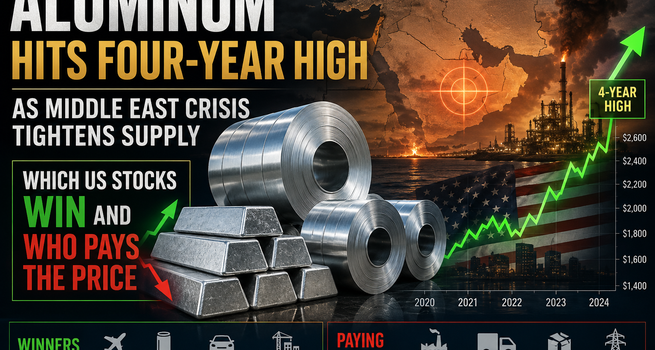
Key Highlights
- Benchmark aluminum on the London Metal Exchange touched $3,707.50 per metric ton, its highest level since March 2022, driven by escalating US-Iran military conflict disrupting Middle East Supply routes.
- The Strait of Hormuz closure has restricted aluminum exports from a region that accounts for 9% of global smelting capacity, with analysts forecasting a market Deficit exceeding 2 million tons this year.
- Copper climbed 1.5% to $13,840 per ton as tight supply outside the US combines with Tariff uncertainty ahead of a late June decision on US copper Import duties.
- US aluminum producers and recyclers stand to benefit directly from elevated prices, while manufacturers dependent on the metal as a raw material face meaningful cost pressure.
- China's Manufacturing activity expanded for a sixth consecutive month, providing additional Demand support across industrial metals including zinc, tin, and nickel.
The metals market has a habit of reflecting geopolitical reality before the rest of the financial system catches up. On Monday, it did so again. Aluminum prices surged to their highest point in more than four years as the consequences of US-Iran military exchanges rippled through Commodity markets with speed and clarity. The Strait of Hormuz, one of the world's most strategically critical waterways, is now effectively closed to normal commercial traffic. For a metal whose Middle East production base accounts for nearly one in ten tons smelted globally, that is not a distant geopolitical risk. It is an immediate supply shock.
The Aluminum Supply Shock Explained
The Middle East is home to some of the world's most cost-competitive aluminum smelters, located primarily in the Gulf states. These facilities benefit from cheap and abundant Natural Gas, which powers the highly energy-intensive smelting process. Countries including the UAE, Bahrain, and Saudi Arabia have built significant aluminum export capacity over the past two decades, supplying markets across Asia, Europe, and beyond.
The Strait of Hormuz is the single chokepoint through which virtually all of this production must travel to reach global markets. With the strait now restricted following US-Iran military strikes, two problems are occurring simultaneously. Finished aluminum exports from Gulf smelters cannot move freely, and the raw materials those same smelters depend on, primarily alumina refined from bauxite, are being blocked from coming in.
The result is exactly the kind of supply squeeze that commodity markets price aggressively. The extreme backwardation currently visible on the LME, where cash contracts trade at a premium of more than $100 per ton over three-month forwards, is a textbook signal of physical tightness. Buyers who need aluminum now are paying a significant premium over those willing to wait. That dynamic does not resolve quickly, and with analysts forecasting a market deficit above 2 million tons for the year, the price pressure has structural, not merely speculative, support behind it.
US Companies That Stand to Benefit
For American aluminum producers, the current environment is as favourable as it has been in years. Higher LME prices directly improve the Revenue and Margin profile of domestic smelters and recyclers, and the supply disruption from the Middle East reduces competition in export markets.
Century Aluminum Company (Nasdaq: CENX) is the most direct beneficiary among US-listed names. As one of the largest domestic primary aluminum producers, Century operates smelters that sell into a market now facing genuine physical tightness. Every dollar increase in the LME aluminum price flows through to its realised selling prices. The company has historically been highly leveraged to aluminum price movements, meaning the current rally has an outsized positive effect on its Earnings profile.
Arconic Corporation (NYSE: ARNC), which produces rolled aluminum products for aerospace, automotive, and industrial applications, benefits from the higher value environment while sourcing a portion of its input requirements domestically. Its position in the value chain, closer to finished products than raw smelting, provides some insulation while still capturing the upside of elevated metal prices in its own product pricing.
Kaiser Aluminum Corporation (NASDAQ: KALU) similarly stands to gain. The company focuses on fabricated aluminum products for aerospace and industrial end markets, sectors where supply security commands a premium. In a tight market, fabricators with reliable domestic supply chains and existing customer relationships gain pricing power.
On the broader industrial metals side, Freeport-McMoRan (NYSE: FCX) is the most prominent US-listed copper producer and stands to benefit materially from copper's continued strength at $13,840 per ton. With operations across North and South America, Freeport generates substantial free Cash Flow at current copper price levels, and any further tariff-driven price support in the US market would reinforce that position.
Companies Facing Cost Pressure
The same price surge that rewards producers creates a meaningful headwind for any manufacturer that uses aluminum as a primary input. In the United States, several large industrial and consumer companies are now looking at materially higher raw material costs.
Boeing (NYSE: BA) is among the most exposed. Commercial aircraft are roughly 80% aluminum by weight, and Boeing's production ramp across its narrowbody and widebody programmes requires consistent and affordable aluminum supply. A sustained rally in aluminum prices adds directly to the cost of building each aircraft at a time when the company is already navigating production challenges and supply chain complexity.
Ford Motor Company (NYSE: F) and General Motors (NYSE: GM) both face significant aluminum cost exposure. Modern vehicles use aluminum extensively in body panels, engine components, and structural parts, a trend that has accelerated as automakers chase weight reduction targets to meet fuel economy and electric vehicle range requirements. Higher aluminum prices compress margins on vehicles already under pricing pressure from a competitive market and ongoing tariff uncertainty.
Ball Corporation (NYSE: BALL), the world's largest aluminum beverage can manufacturer, operates in a Business where input costs are central to profitability. Ball produces billions of cans annually, and aluminum is by far its largest cost item. While the company uses hedging programmes to manage short-term price exposure, a sustained multi-month rally at current levels will eventually flow through to its cost structure.
Constellation Brands (NYSE: STZ) and other large beverage companies that rely on aluminum packaging face secondary exposure through their can supply chains, though their insulation is greater given the intermediary role of can manufacturers.
Copper Prices: What Credible Sources Are Projecting
Copper's 1.5% gain to $13,840 per ton on Monday reflects a distinct but related set of dynamics. Goldman Sachs, in its most recent commodities outlook, projected copper prices averaging between $10,000 and $11,000 per metric ton through 2025 and into 2026 under base case assumptions, with upside scenarios pushing toward $12,000 if supply deficits materialise faster than expected. Current prices have significantly exceeded even those upside projections, driven by the combination of tariff-related stockpiling in the US, mine supply disappointments in Chile and Peru, and robust Chinese demand.
The Bank of America commodities team has noted that Comex copper inventories, up more than 550% since February 2025 when the Trump administration initiated its tariff investigation, represent a market that has been thoroughly front-run on the US side. The consequence is that copper markets outside the United States are running tight, which is now pushing LME prices higher as non-US buyers compete for available supply.
The International Copper Study Group, the most authoritative independent body tracking copper supply and demand, projected a global refined copper deficit of approximately 150,000 to 200,000 metric tons for 2025, a figure that current mine supply trends suggest may prove conservative. Wood Mackenzie, the respected commodities research firm, has maintained a constructive medium-term copper price view, citing a structural deficit driven by the energy transition's demand for copper in electric vehicles, grid infrastructure, and renewable energy installations.
The late June US tariff decision on copper imports represents the next major catalyst for price direction. If tariffs are imposed at a significant rate, the arbitrage between Comex and LME prices could widen further, pulling even more copper into US warehouses and tightening conditions for the rest of the world.
The Bigger Picture
What Monday's metals market moves illustrate is the degree to which geopolitical risk has become inseparable from commodity price formation. The Middle East has always mattered to energy markets. It now matters equally to metals markets, and the Strait of Hormuz has joined the Suez Canal and the Panama Canal as infrastructure whose disruption sends immediate shockwaves through global industrial supply chains.
For investors, the current environment rewards clarity about which side of the commodity price move a given company sits on. Producers and recyclers are in a strong position. Manufacturers with heavy raw material exposure face a more difficult few quarters ahead. The speed with which these dynamics resolve depends entirely on how quickly, or slowly, the geopolitical situation in the Middle East stabilises.


 Jun 03, 2026
_06_03_2026_20_43_37_229696.jpg)
 Please wait processing your request...